Showing posts with label Commentary. Show all posts

Wednesday, 10 November 2021

Acknowledgments

This blog has traced the performances at the Rose playhouse from 1592 to 1597. Until recently, it would have been almost impossible to write, because most of the plays recorded in the Diary are lost and information about them is often scarce and uncertain. It was made possible by the work of some amazing scholars, to whom I would like to say thank you. 

One of the most important aids was Martin Wiggins' magisterial catalogue British Drama, 1533-1642, the relevant volume of which was published in 2013. It includes a detailed entry on every play of the period, including the lost ones. The 'Wiggilogue' is an extraordinary achievement, and my copy of volume 3 is now thoroughly battered and coffee-stained. 


Another amazing resource is the Lost Plays Database, an online resource created by Roslyn L. Knutson, David McInnis and Matthew Steggle; this ongoing project is attempting to create a detailed encyclopedic entry on every lost play of the period. It's not yet complete - but be the change you want to see

Also invaluable has been the burgeoning field of 'repertory study', which investigates the careers of individual playing companies and treats their plays as a body of work, much as a more traditional study might group plays according to their author. In the early days of the blog, I was using Lawrence Manley's and Sally-Beth Maclean's Lord Strange's Men and their Plays (2014), and in the latter stages two books about the Admiral's Men: Andrew Gurr's Shakespeare's Opposites (2009) and Tom Rutter's Shakespeare and the Admiral's Men (2017). Laurie Johnson's Shakespeare's Lost Playhouse (2018) wasn't published at a time when I could use it, but it's a brilliant study of the period in which Henslowe's Diary records performances at the Newington Butts playhouse.

And of course, there are the scholars who have worked to understand and explicate the huge and baffling document that is Henslowe's Diary. The standard editions are R.A. Foakes's (2002) and the online facsimile at the Henslowe-Alleyn Digitization Project. But they were built on the foundations of work by Edmund Malone in the 18th century, the complicated John Payne Collier in the 19th, and W.W. Greg in the early 20th. I also found extremely useful Carol Rutter's Documents of the Rose Playhouse (1984) and Neil Carson's Companion to Henslowe's Diary (1988). 

There is much more to learn about this fascinating document, as you can see, and we owe a great debt to the work of these heroes of scholarship.


Monday, 8 November 2021

What won the Diary?

We have completed our journey through Philip Henslowe's diary of performances at the Rose playhouse! On the way, we have seen a great many plays rise and fall in popularity. So, which were the greatest triumphs?

Well, it depends on how you define success. But we can identify a number of winners. I'll begin by considering the entire sweep of the Diary, which began back in 1592 when Lord Strange's Men were the residents at the Rose, and ended in 1597 with the Admiral's Men. Looking at the big picture, we can see that the most-performed plays were as follows:
  • The Jew of Malta (36 performances between 1592 and 1596). This satirical tragedy by Christopher Marlowe has survived and is still performed today.
  • The Wise Man of West Chester (31 performances between 1594 and 1597). This anonymous play is probably lost, although it might be an alternative title for John a Kent and John a Cumber.
  • Hieronimo (29 performances between 1592 and 1597). This is probably an alternative title for Thomas Kyd's The Spanish Tragedy, which is still performed today.
  • Belin Dun (25 performances between 1594 and 1597). This lost play was about a villainous highwayman in medieval England.
  • The Seven Days of the Week (24 performances between 1595 and 1596), although this may include some performances of its sequel. The subject of this lost play is unknown.
  • The Blind Beggar of Alexandria (22 performances between 1596 and 1597). This comedy of disguise by George Chapman still survives in print. 
  • A Knack to Know an Honest Man (21 performances between 1594 and 1596). This anonymous comic morality play still survives in print.
A Grand Master of the Knights of
Malta, by Caravaggio (1607-8)
To judge from this list, the most impressive play is The Jew of Malta, not only for the sheer number of performances but also for its staying power. And during its time, its popularity did not dwindle as much as others; while other plays by Marlowe, such as Doctor Faustus and Tamburlaine, often received box offices that indicate tiny audiences, The Jew of Malta rarely did. It was a play that the company could usually count on in tough times. 

However, studying the entire run of the Diary can be unfair to some of the plays introduced later into the Rose repertory. For example, the 22 performances of The Blind Beggar of Alexandria are more impressive when one notices that they all took place in less than a year.

For this reason, it may be fairer to study the performances by just one company, the Admiral's Men, who began working at the Rose in 1594 and were still there when the Diary ended three years later. Luckily for me, Holger Syme has already crunched the numbers in his article "The Meaning of Success". And in Syme's list of the most popular Admiral's Men plays, The Jew of Malta does not even appear, because the number of performances dwindled in the last few years of the Diary.

A man, who might possibly be
wise, carved on the choir
stalls of Chester Cathedral
Instead, Syme identifies The Wise Man of West Chester as the top play of the Admiral's Men, with its 29 performances. But he also looks at other data, including the average box office per performance; measured that way, the winner is The Comedy of Humours (almost certainly another name for George Chapman's A Humorous Day's Mirth), which had only 13 performances over a single year but scored a remarkable 49 shilling average; as Syme says, "this may have been the most successful play the company ever staged, but since Henslowe's daily receipts break off in early November, 1597 ... we will never know" (510). 

However one looks at it, the most remarkable conclusion is that so many of these immensely popular plays are now either lost or forgotten. While there are some famous plays in there, it is startling to see the success of complete enigmas like The Seven Days of the Week and of hard-to-find and rarely staged plays like The Blind Beggar of Alexandria. Despite its vivid evocation of the workings of an Elizabethan playhouse, Henslowe's Diary reminds us of how little we really know about what people loved to see on the stage. 

Watch this space for some final thoughts!


FURTHER READING


  • Holger Schott Syme, "The Meaning of Success: Stories of 1594 and its Aftermath", Shakespeare Quarterly 61.4 (2010), 506-10.


Comments?


Did I make a mistake? Do you have a question? Have you anything to add? Please post a comment below!

Saturday, 6 November 2021

Where are they now?

Edward Alleyn (portrait
of unknown date)
Henslowe's list of performances at the Rose may be over, but that does not mean that his story is done. He will continue to make Diary entries of different kinds, and he will support theatre for many more years.

So too will his son-in-law, the actor Edward Alleyn, who had played the lead roles in many performances recorded in the Diary. Alleyn seems to have retired from acting at around the same time Henslowe ceased to record the names of the plays performed at the Rose; it is almost as if Henslowe no longer cared once his son-in-law was no longer in them. The two men will continue their business partnership for the rest of their lives.

In 1599, a new rival will appear close to the Rose in their Bankside vicinity: the Globe theatre, built by the Chamberlain's Men, Shakespeare's company. But by that time, Henslowe and Alleyn will already have decided to move to a new theatre north of the river: the Fortune playhouse in the suburb of Clerkenwell, completed in 1600. The Admiral's Men will perform there, albeit under different names, until 1631; they will sometimes revive old plays that we have seen in the Diary, such as Doctor Faustus

As for the Rose, it will cease to be used in the early 1600s and will ultimately be torn down. Its foundations, however, will survive to be rediscovered in the 1980s, and can now be visited thanks to the Rose Theatre Trust

Christ's Chapel of God's Gift, one of the original
buildings of Dulwich College
Henslowe will die in 1616 at the age of about 60, having apparently suffered from a stroke. Alleyn will live longer. Immensely rich, he will become concerned about his legacy. Having bought a manorial estate in the village of Dulwich, he will use his wealth to endow a charitable establishment there for 'poor scholars'; he will name it the College of God's Gift, but it will ultimately become known as Dulwich College, and will survive to the present day as a school, an almshouse, a chapel and a picture gallery.

Alleyn will bequeath many things to the College, including a chest containing old documents. Among those documents will be Henslowe's Diary, which will sit there quietly until scholars begin to investigate it in the late 18th century, and will remain there to this day. You can now study this amazing document from the comfort of your own home, thanks to the Henslowe-Alleyn Digitization Project

Stay tuned for some further reflections on the end of the Diary!


FURTHER READING


  • R.A. Foakes (ed.), Henslowe's Diary, 2nd ed. (Cambridge University Press,. 2002), xv-xvi.
  • S.P. Cerasano, "Henslowe, Philip (c. 1555–1616), theatre financier." Oxford Dictionary of National Biography (2004), accessed November 2021.
  • Cerasano, S. P. "Alleyn, Edward (1566–1626), actor, theatre entrepreneur, and founder of Dulwich College." Oxford Dictionary of National Biography (2004), accessed November 2021.
  • "The Henslowe-Alleyn Papers, Past, Present and Future", The Henslowe-Alleyn Digitization Project (2021), accessed November 2021. 


Comments?


Did I make a mistake? Do you have a question? Have you anything to add? Please post a comment below!

Monday, 4 June 2018

4 June, 1594 - Henslowe is back - but it's all different

Welcome back, Henslowe fans! This blog is returning to life in a serious way tomorrow, after a number of fits and starts over the past few months. Pretty soon, we'll settle into a lengthy stretch of unbroken records of performances by the Admiral's Men at the Rose playhouse. But before then, we have a rather puzzling section to get through.

Richard Burbage, leading actor of
the Chamberlain's Men
From now until 13th June, Henslowe's records refer not to performances not at the Rose, but to those at a playhouse far to the south, known as Newington Butts. And the performances are not by the Admiral's Men alone - instead, they are sharing the playhouse with the Chamberlain's Men. You can read more about these companies and their shared playhouse by clicking the links above, but, suffice to say, the Admiral's and Chamberlain's Men had recently become the only two companies allowed to perform in London. They will soon part their ways to settle permanently at the Rose and at the Theatre, respectively. Exactly why they will spend next week working together at an obscure playhouse is a mystery.

It's also not clear exactly what it means to be sharing a theatre. Henslowe records a series of performances that seem to alternate between plays associated with the Admiral's Men and plays associated with the Chamberlain's. Does this mean their leading actors were performing together in each other's plays? Or does it simply mean the companies were taking turns to perform? The latter makes more sense, in my opinion.

London and the village of
Newington (bottom left), in
Symonson's map of Kent (1596)
However it worked, and whatever the reasons, this must have been an exciting week in the village of Newington. The greatest artists of the age - including Edward Alleyn, Richard Burbage, William Shakespeare and Will Kemp - were all performing at its local theatre!

Henslowe records extremely low takings for these performances, though. This might simply be because he was renting the playhouse from somebody else, and so his personal rewards were much lower than for the Rose, which he owned. But it's also likely that the audiences were smaller: Newington Butts was half a mile outside London, so only the most dedicated theatregoers of the city would travel there. We may, therefore, need to imagine the great theatre stars of the age performing to tiny audiences in the middle of nowhere; if so, they were probably be glad to get away by the end of the week.

See you tomorrow at Newington Butts, for a week that will include some very famous plays!

FURTHER READING


Information about this week at Newington


  • Roslyn Lander Knutson, Playing Companies and Commerce in Shakespeare's Time (Cambridge University Press, 2001), 39-40
  • Laurie Johnson, Shakespeare's Lost Playhouse: Eleven Days at Newington Butts (Routledge, 2018)


Henslowe links


Comments?


Did I make a mistake? Do you have a question? Have you anything to add? Please post a comment below!

Saturday, 25 June 2016

Looking back: war and nation in the Rose plays

Having reached the end of this stage of Henslowe's Diary, I had been planning to conclude with some reflections on the plays - both lost and extant - that we've been looking at over the last few months, I wanted to think about the variety of stories that Lord Strange's Men told, but also about the recurring themes and ideas that made their plays distinctive to them.

Unfortunately, I found this entry rather hard to write. That's because I was trying to compose my thoughts on the very day that the UK voted to exit the European Union. I don't mean that I was distracted by the need to stare in horror at the TV (although I was). Rather, it was the unfortunate parallels between what I wanted to write about and what was in the news. In case you are reading this in the distant future, I should explain that the 'Brexit' vote took place following months of public debate that had rapidly veered away from the complex issues of EU policy and had instead degenerated into clumsy arguments about immigration, British/English identity, tradition, and terrorism, all of which had unleashed a cesspool of nastiness and hatred within our sceptred isle.
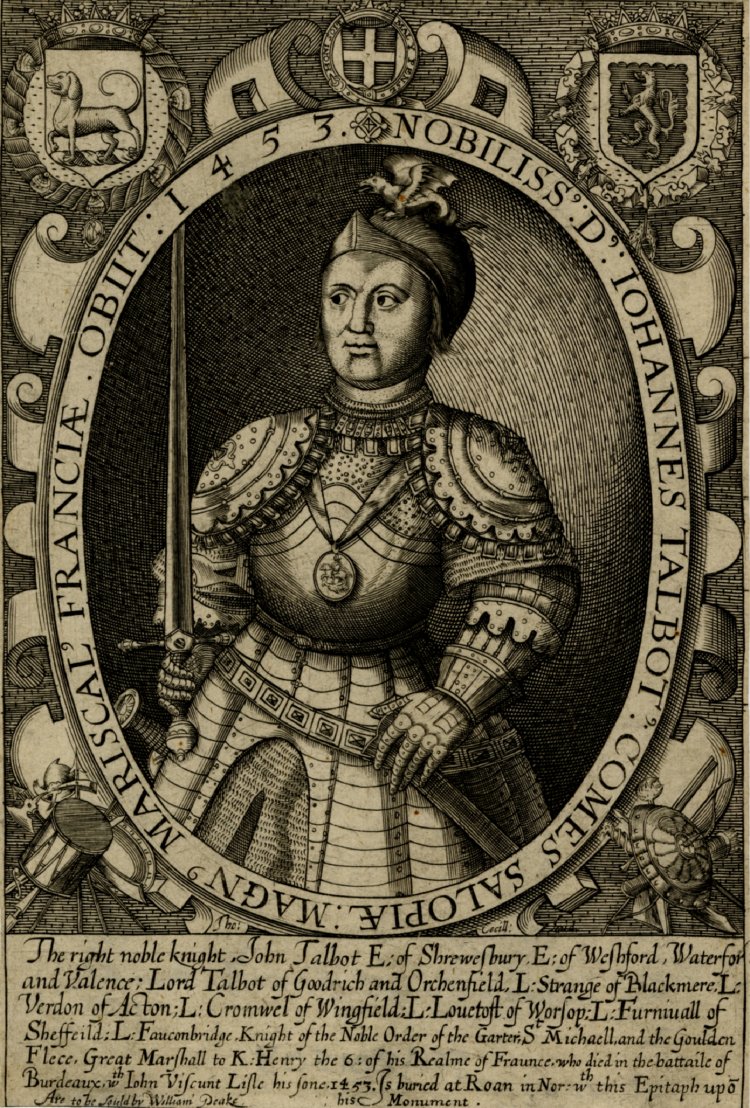
Imaginary portrait of Talbot,
"the terror of the French", by
Thomas Cecil, c.1626-32
This background made it rather depressing for me to write that the most-performed play at the Rose was a work of English triumphalism about bashing the French (Harry VI), and that a remarkable number of the other plays drew on the imagery of the Crusades against Islam in the Middle East. I'm generally reluctant to draw specious connections between Renaissance plays and the modern world, but I couldn't help feeling that I was seeing in the popular culture of 400 years ago the same kind of simplistic nationalism that was unfolding in the vacuous discussions on TV.

However, having thought about it a bit more, I've decided that the popular culture on display in the Rose playhouse was in no way as crass and stupid as the Brexit debates. The plays were certainly violent, and they were definitely written during an era of patriotic triumphalism, but it's surprising how little they invoke mindless flag-waving and encourage more complex responses.


Theatre of violence


The plays of Lord Strange's Men were varied: the company performed histories, tragedies, comedies, and even a pastoral. Despite this, it's very clear that one of their specialities was stage violence: in particular, the audience of Lord Strange's Men enjoyed watching fight scenes.

From Joachim Meyer's swordfighting manual (1570)
Most of the plays are about wars - Harry of Cornwall (English civil wars), Harry VI (England vs. France), Jerusalem (the Crusades), Muly Molocco (Moroccan civil wars), The Spanish Comedy (Spain vs. Portugal), Tamar Cam (Mongols vs. the Middle East), Titus and Vespasian (Romans vs. Jews), and Zenobia (Roman civil wars). War may also have been present in Constantine, Brandimer, Friar Bacon and The Tanner of Denmark.

Other plays are not literally about war, but still contain violent scenes, whether they're revenge tragedies such as The Jew of Malta, The Spanish Tragedy and, probably, Machiavel, or whether they're romances like Sir John Mandeville and Orlando Furioso, or Biblical moralities like A Looking-Glass for London.

Indeed, it's hard to find anything sweet and fluffy in the repertory. Even the Italianate comedy Bindo and Ricciardo probably included a horrid death and the moralistic Knack to Know a Knave describes hideous punishments for the bad guys. The only innocuous-seeming play is the lost pastoral Cloris and Ergasto, but for all we know it may have been about shepherds hitting each other with sticks.

This suggests that onstage fighting was one of the specialities of Lord Strange's Men, and that would have fitted with their star Edward Alleyn's reputation for playing larger-than-life warriors. This emphasis on fighting may have been a characteristic of this particular company rather than of early 1590s theatre as a whole. If you look at what Shakespeare was doing around 1592, you find him writing romantic comedies such as The Comedy of Errors and The Two Gentlemen of Verona alongside the gore and war of Titus Andronicus or the Henry VI plays. But there's almost nothing like those at Henslowe's Rose. The Rose was a theatre of violence.


Theatre of triumph


Queen Elizabeth poses with her hand on the globe in the
aftermath of the defeat of the Spanish Armada (1588)
And what better way to make onstage fighting more thrilling than to mix it with triumphalist patriotism? Such a theme would certainly have been very much in tune with the public mood, as England was still buoyant after its defeat of the invading Spanish Armada in 1588. By 1592, England was engaged in a war in France to support French Protestants,

It's no surprise, then, that the Rose's most frequently-performed play was Harry VI, which packed the theatre with spectators who reportedly wept to see the English hero Lord Talbot fight bravely against the French army, and presumably cheered as the English defeated Joan of Arc (who is portrayed as a devil-summoning witch). Another play in the same mode may have been the popular but mysteriously one-off Tanner of Denmark; if it was indeed the play we know as Edmund Ironside, it has an English hero who defeats the brash Danish invaders.

But this kind of straightforward nationalism is actually surprisingly rare in the Rose repertory. England itself rarely appears in the plays, and when it does it's compromised: A Knack to Know a Knave portrays an England filled with sinners, and Harry of Cornwall is about a civil war, a traitor, and a sacrilegious murder. A Looking-Glass for London lectures the city on its similarity to the sinful Nineveh in the Bible.

Tiepolo, Queen Zenobia Addressing her Troops (c.1725)
Of course, tales set in lands far away could still tap into the national mood. The lost Zenobia may have used its eastern warrior heroine to reenact the victories of Queen Elizabeth. The Spanish Tragedy permits its audience to enjoy seeing vicious Spaniards murder each other. A play like Jerusalem might enable its audience to identify with French warriors as they push the Turks from the Holy City, while Tamar Cam may have done the same as its Christianized Mongol protagonist scourged the Islamic world.

If we read those plays that way, we can also see an 'us vs. them' narrative in the surprising number of plays that use the imagery of the Crusades. One thing I had not expected when beginning this blog is the almost continuous theme of war with Islamic nations. Many of the plays are set in the Middle East, and the Crusades are usually somewhere in the background of others. Wars involving Muslims are very important to The Jew of Malta, Muly Molocco, Tamar Cam, and Jerusalem. The Crusades are in the background, if not enormously significant, of Orlando Furioso. There is a possibility that they were also included in Harry of Cornwall, Brandimer and Sir John Mandeville. And on a vaguer level, the topic of war between east and west is present in Titus and Vespasian and Zenobia. Perhaps, then, the topic of Holy War was another, broader dimension of the belligerent nationalism on display in the Rose plays.

But I actually think not...


Theatre of doubt


Sixteenth century illustration of
the Romans destroying Jerusalem
It's wrong to say that all of the Rose plays tap into a simplistic 'us vs. them' mentality. The Spanish Tragedy, for example, was not simply an excuse to gloat at dying Spaniards; audiences sympathised with the suffering of the grieving father Hieronimo and his desire for revenge. In Muly Molocco, the audience is encouraged to sympathise with the Muslim Abdelmelec against the cruel Muly Mahamet and his European supporters. The play with the most consistently high box office was The Jew of Malta, a satire on hypocrisy in all religions, and on the human ability to use religion to justify crimes - it doesn't single out any one religion for special hatred. Titus and Vespasian may have used the Jewish Wars to satirize religious extremism in England.

And even Harry VI laments the death of English heroes like Talbot and their replacement by squabbling, self-serving politicians, while Edmund Ironside ends with an English machiavel plotting to undermine the hero's triumph. So perhaps we should not automatically assume any of these plays to have produced merely straightforward responses.

The Rose plays are not always well-written and they certainly place great emphasis on spectacle, special effects and, yes, fighting. But if the authors intended their exciting, epic, and exotic tales to indulge in simplistic xenophobia and nationalism, they were doing it all wrong.


Apologia


Well, that's what I think anyway. These are of course vast and complex subjects that have been written about in far more detail elsewhere. Every single sentence that I've written above could be debated, and indeed probably has been, by scholars who know a lot more than I do. All I really wanted to get off my chest is that Elizabethan popular culture, as reflected in the Rose plays, is far more intelligent and sophisticated than a Brexit poster...


Friday, 24 June 2016

Looking back: what was popular?

Since the Rose theatre is now closed until December, let's look back at what we've seen taking place there since 19th February.

I created this blog because I was interested in which plays were popular and which were not, and how their popularity rose and fell over time. Writing it did make me realise, however, that it's hard to define exactly what we mean by 'popular'. And it also made me realise how little we know about why the company staged what they did each day. Allow me to explain...


The most-performed plays


One way of assessing popularity is to look at which plays were performed most frequently. The most-performed play was Harry VI (which is almost certainly the play we now call Shakespeare's First Part of Henry VI). It was staged 15 times in 4 months, being performed on an almost weekly basis.

Here are the figures for the other three 'big hitters', each of which was in the repertory throughout the entire period that we looked at and was normally staged once every 10 days or every fortnight:


These plays were the bastions of Lord Strange's Men, and although they didn't always do that well at the box office - often hovering around the average for the Rose, sometimes lower than average - they could reliably pull in enough of an audience to fill the theatre approximately half-full, or only a bit less.

There are also a bunch of plays that the company revived only once a month or so during this 4 month period. They include:


I find the existence of these monthly performances rather puzzling. The frequent performances of the 'big hitters' must have enabled their lines to stay fresh in the actors' memories. By contrast, it must have been a lot of mental effort for the actors to return to plays that they didn't perform for weeks at a time. And most of these monthly plays didn't receive notably bigger or smaller audiences than the 'big hitters'. I wonder why they were relegated to only occasional performances?

Next, we have some plays that might have had the potential to be stalwarts of the stage, but which were introduced too late for us to know whether they would have done so before the plague rudely interrupted:


Finally, we have the plays that the company apparently gave up on: Brandimer and Jersualem were performed only twice and all the rest just once. A lot of these may have been old plays that the company tried out and decided weren't worth reviving again. But there are also stranger examples, such as the enigmatic Tanner of Denmark, which never returned after its stellar premiere. And even some of these one-offs don't do particularly badly at the box office (such as Four Plays in One), so it's hard to understand why the company abandoned them and continued to perform others.


Box office


Another way to judge popularity is through box office. The highest box office receipt was Harry VI on 3rd March, with 75 shillings. The lowest was A Looking-Glass for London on 8th March with 7 shillings.

But these outlying results aren't very meaningful when considering what we mean by 'popular'. Harry VI achieved amazing box office for a few weeks after its premiere, but then turned into a very average play for the rest of the season. A Looking-Glass for London was catastrophically unpopular one day, but did perfectly well every other time it was revived; perhaps it was simply hit by bad weather. The vast majority of Rose performances hover around the average for box office, which is about 33 shillings, representing a half-full theatre.

Given the above points, the most impressive box office is actually achieved by Marlowe's Jew of Malta. Although not performed as often as some other plays, and never achieving the enormous heights that some occasionally reached, The Jew of Malta almost always achieved box office well above the average and is thus the most consistently popular play. The actors must have looked forward to performing this play, because they could be certain of walking onstage to face a large, happy audience. With almost all the other plays, they never quite knew what they were going to get.

If you're interested, the award for worst play ever thus goes to the lost Constantine: performed once, received a damning 12 shillings, and never looked at again. We do not know what this enigmatically-titled play was about, but clearly London didn't give a damn either way.


The rules


A lot of the time, I found myself scratching my head about the company's choices, and what made the box office go up or down. But I did learn a few 'rules' of Henslowe's Rose.

The most obvious rule is that debut performances of new plays always achieve the highest box office. As I explain in detail here, this is probably because the audiences loved novelty and the chance to see something brand new, although it is also conceivable that the company charged extra for new plays.

Another rule seemed to be that performances of  a play needed to be spaced out to avoid overkill - the company hardly ever performed the same play in one week, and when they did it often drew a smaller audience (see this example). Relatedly, it seemed that with the frequently-performed plays, absence may have made the audience's hearts grow fonder - I found several instances (for example this one) in which the company held off on performing a play for a couple of weeks, and achieved a higher box office when they brought it back, as if this caused the audience to become keener to see it.

The most enjoyable rule I found, however, was that holiday periods could cause Londoners to flock to the theatre. It was nice to imagine the excitement of actors and audiences on May Day and the week of Whitsuntide as people spent their days off at the playhouse. And especially fascinating was the dismal box office during Holy Week (when Londoners perhaps felt guilty about going to see plays), following by a boom during Easter Week (when London was in a more celebratory mood).


Most popular play among readers of this blog


For some reason, this blog gets a huge spike in readership every time The Jew of Malta is mentioned. Conclusion: Marlowe fans are excitable.

Also, the article on Brandimer was inexplicably popular. Conclusion: giants are awesome.


What's next?


It was quite interesting to follow the ebb and flow of box office, but money isn't everything, so in the next post I'll look back at the plays themselves and consider what we've learned about what audiences at the Rose liked to see.