Last season, the company had performed Harry VI almost weekly. This season, they have waited two weeks to revive it. The result has been a theatre only half full, but even this must have been something of a relief for the company after two days of atrocious box office.
Henslowe writes: R at harey the 6 the 16 of Jenewary 1593 ... xxxxvjs
In modern English: Received at HarryVI, 16th January, 1593 ... 46 shillings
1540s portrait of King
Henry VI
Today, for the first time in their new season at the Rose, Lord Strange's Men revived their popular history play Harry VI. This play was almost certainly Shakespeare's First Part of Henry VI; you can read more about it in the blog entry for 3rd March 1592.
It is surprising that the company waited nearly 3 weeks to mount Harry VI at the Rose. After all, it had been the most frequently performed play of their previous season. In their book on Lord Strange's Men, Lawrence Manley and Sally-Beth Maclean suggest a possible reason. They propose that the company had not been performing Harry VI during their long tour of England because it required too many actors and other resources; as a result, they were out of practice at performing it when they returned to London, and needed a few weeks to re-learn their linesand prepare to stage it again.
This theory is interesting because it suggests that the plays we've seen the company perform so far may be the ones they had been performing on tour. It may explain why they have staged the catastrophically unpopular Sir John Mandevillemore than once - perhaps it had been popular in the provinces and the players were now slowly re-aligning themselves back to London's tastes?
Further reading
Lawrence Manley and Sally-Beth Maclean, Lord Strange's Men and their Plays (Yale University Press, 2014), 274-5.
Lord Strange's Men have returned to performing Harry VI weekly, with no notable change in its box office; it continues to be a merely average performer. It's intriguing that the last four performances have been on Mondays, but I have no explanation for why.
Before looking at today's performance at the Rose, it's worth mentioning an event that is not recorded in Henslowe's Diary but which the players must have noticed. Last night, a crowd of apprentice feltmakers swarmed over London Bridge and into Southwark, the suburb that was home to the Rose playhouse. The apprentices claimed they were going to see a play, but instead they caused some kind of public disorder in the streets. William Webbe, Mayor of London, wrote to Lord Burghley that
being informed of a great disorder and tumult like to grow yesternight about 8 of the clock within the borough of Southwark, I went thither with all speed I could, taking with me one of the sherriffs, where I found great multitudes of people assembled together and the principal actors to be certain apprentices of the feltmakers gathered together out of Barmsey Street and the Blackfriars with a great number of loose and masterless men apt for such purposes.
Webbe learned that the apprentices were rioting because a feltmonger's servant had been wrongly imprisoned. He arrested the "doers and authors of the disorder" and asked Burghley if there was anything more that he could do.
You may be wondering what this has to do with the Rose playhouse, but because the apprentices had made "pretense of their meeting at a play" (apparently on a Sunday, although this was against the law), Webbe grumbled in his letter that plays "giveth opportunity of committing these and suchlike disorders". It will take a couple of weeks for the authorities to respond, but when they do it will be with draconian measures that will not only crack down on public disorder but will also be catastrophic for the Rose and the other theatres. More on that later...
Henslowe writes: R at harey the vj the 12 of June 1592 ... xxxijs
In modern English: Received at HarryVI, 12th June, 1592 ... 32 shillings
1540s portrait of King
Henry VI
This play was almost certainly Shakespeare's First Part of Henry VI; you can read more about it in the blog entry for 3rd March. Lord Strange's Men normally perform this play weekly, but this time they have left it alone for two weeks. When they have tried this in the past it has sometimes resulted in a boost to the box office, but that has not happened this time, and the play continues to be a merely average performer.
Friday, 3rd March - 75 shillings (premiere)
Tuesday, 7th March - 60 shillings
Saturday, 11th March - 47 shillings
Thursday, 16th March - 31 shillings
Tuesday, 28th March - 68 shillings (Easter Week)
Wednesday, 5th April - 41 shillings
Thursday, 13th April - 26 shillings
Friday, 21st April - 33 shillings
Thursday, 4th May - 56 shillings
Tuesday, 9th May - 22 shillings
Tuesday, 16th May - 50 shillings (Whitsuntide)
Monday, 22nd May - 30 shillings
Monday, 29th May - 24 shillings
Monday, 12th June - 32 shillings
FURTHER READING
The riot
Carol Chillington Rutter, Documents of the Rose Playhouse (Manchester University Press, 1984), 61-2
Lord Strange's Men continue to stage Harry VI about once a week. By this point, nearly three months after its premiere, the play is normally receiving rather weak box office and is being performed to a theatre that is less than half full. Yet the players still seem to have considered it worth their while to perform Harry VI more often than any other play in their repertory. I wonder why. Was it simply their personal favourite? Did they enjoy performing it more than the others?
Henslowe writes: R at harey the vj the 109 of maye 1592 ... xxxs
In modern English: Received at HarryVI, 22nd May, 1592 ... 30 shillings
Henslowe's Diary becomes very messy this week. He wrote today's date hopelessly wrong, and although he corrected it later, his correction was wrong too, so that his recorded dates become increasingly out of sync with reality. It's further evidence that Henslowe may have been entering the data into his account book some time after the actual performances.
The company have returned to their practice of staging Harry VI once a week. After the boost it received during the Whitsuntide holidays, the play has returned to being merely an average performer at the box office.
The Whitsuntide holidays continued today and have succeeded in reviving the popularity of Harry VI, which had been receiving weak box office of late. Over-familiarity with the play may have been causing its audiences to wane, but at this festive time of year we can guess that the Rose was thronged with people who normally didn't have time to attend the theatre very often.
Henslowe writes: R at harey the vj the 7 of maye 1592 ... xxijs
In modern English: Received at HarryVI, 9th May, 1592 ... 22 shillings
As you may have noticed, Henslowe wrote today's date wrong. This little error will cause some messiness in his accounts, as he will perpetuate the mistake and will be two days out of step for quite a while. It might seem odd that Henslowe would repeatedly not notice that his dates were wrong, but most scholars think he wasn't actually writing these entries one by one on a daily basis; rather, he was adding multiple entries in big blocks, which made it easy for him to get his dates out of sync.
The company had last performed Harry VI only 5 days ago. Previously, they had waited two weeks before reviving it, and had been rewarded with big box office from the Harry-starved crowd. Now, they revived it again in a hurry and received its lowest box office ever. I could have told them that. The clear moral is that you gotta keep the punters hungry.
The company's normal practice has been to perform Harry VI approximately once a week and the play had settled into a routine of producing reliable but unspectacular box office. But this time, the company had waited nearly a fortnight before performing it again. And look what happened: the play's audience nearly doubled! Could this be a case of absence making the heart grow fonder?
Since the premiere of Harry VI in early March, the company has settled into a groove of performing it approximately once a week. But last week's outing was its weakest-ever showing at the box office, and today's was not much better. Harry VI is no longer a blockbuster, and can best be described as reliably solid.
The company last performed Harry VI just over a week ago; since its premiere in early March, it has been their most frequently-performed play. However, today's performance was its weakest so far, faring not much better than that of Bindo and Ricciardo yesterday. Harry VI appears to have officially become just another play.
The company last performed Harry VI just over a week ago; since its premiere in early March, it has been their most frequently-performed play. However, today's production did not repeat its spectacular takings during Easter Week, returning to a merely moderate intake similar to that of The Jew of Malta yesterday. This lower-but-still-not-bad intake is proving to be typical of this week.
After performing this play every few days for a while, the company had left it to rest for nearly two weeks. This seems to have been a good decision, because today's performance produced spectacular box office, almost as high as that of the premiere performance. Another factor may be that England was now in Easter Week, and the festive atmosphere may have encouraged more theatregoing. Either way, Harry VI was clearly still capable of being a blockbuster, despite its slump a fortnight ago.
Henslowe writes: R at harey the 16 of marche 1591 ... xxxjs vjd
In modern English: Received at Harry, 16th March 1592 ... 31 shillings
1540s portrait of King
Henry VI
Today, Lord Strange's Men performed Harry VI again. At least, I assume they did; Henslowe writes merely "Harry"which I suppose could refer to another play, Harry of Cornwall. But I doubt it. For Henslowe right now, there was only one Harry that mattered, and that was the instant blockbuster Harry VI. This play was almost certainly an alternate title for Shakespeare's First Part of Henry VI; you can read more about it in the blog entry for 3rd March.
This was the company's fourth staging of Harry VI within a fortnight, a very unusual frequency of performance. The players clearly wanted to milk this cash cow while it lasted. But its box office returns were now plummeting into mediocrity:
Friday, 3rd March - 75 shillings
Tuesday, 7th March - 60 shillings
Saturday, 11th March - 47 shillings
Thursday, 16th March - 31 shillings
31 shillings was not bad, but far less than the 75 the play had made on its premiere. Perhaps the frequent performances were a bad strategy for sustaining interest among the company's audience?
This is the company's third performance of their popular new play Harry VI in just over a week, a very unusual frequency of performance. Clearly, the players were keen to keep on performing this instant hit. However, the play made considerably less money this time. 47 shillings would be regarded as very good box office for most of their plays, but it is just over half what the company had made with the previous performances of Harry VI.
What's next?
There will be no post tomorrow, because 12th March was a Sunday in 1592 and the players did not perform. Henslowe's Diary ... as a Blog! will thus return on 13th March for a week that will feature a mixture of familiar titles with still more new plays.
Henslowe writes: R at hary vj the 7 of marche 1591 ... iijll
In modern English: Received at Harry VI, 7th March, 1592 ... £3
Today, Lord Strange's Men offered a repeat performance of their play called Harry VI, which was almost certainly Shakespeare's First Part of Henry VI; to learn more, visit the blog entry for 3rd March.
1540s portrait of King
Henry VI
This revival of Harry VI is quite a surprise, as the play's first performance was only three days ago. Clearly, the company saw they had a hit on their hands and wanted to capitalize on it. Presumably they also wanted to get in some practice at performing the play, which was still new to the actors. The tactic seems to have been a successful one, as this performance made almost as much money as its premiere.
That's all I have to say today. Short posts like this one are about to become more frequent, as Lord Strange's Men begin to cycle through the plays in their repertory. But not yet! There are still new plays to learn about this week, so stay tuned!
Henslowe writes: ne ... R at harey the vj the 3 of marche 1591 ... iijll xvjs 8d
In modern English: New. Received at Harry VI, 3rd March 1592 ... £3, 16 shillings and eightpence.
Today, we have the first appearance of William Shakespeare in Henslowe's Diary! Well, sort of. The extent to which Shakespeare was actually involved in Harry VI is unclear, but this entry sheds some interesting light on his early career successes.
There are a couple of things to say about what Henslowe wrote today. First, notice that he writes "ne" next to the entry. Henslowe will add these letters to a few other plays in the future, and scholars have determined that he probably means "new"; in other words, he's noting the first performance of a new play. Secondly, you can see that London's theatregoers were very excited about this new play called Harry VI, because Henslowe achieved his best box office so far. There are twenty shillings in a pound, so he made 75 shillings today, far more than the 50 he made with The Jew of Malta a few days ago).
So, what was this instant blockbuster called Harry VI? It was almost certainly the play we know today as Shakespeare's The First Part of Henry VI (most likely written in collaboration with others). To understand how we know this, it's easiest to begin by looking at the story of Shakespeare's play and then at the evidence connecting it with Harry VI.
What happens in The First Part of Henry VI...
1540s portrait of King Henry VI
The First Part of Henry VI is set in the 15th century, in the aftermath of the early death of the heroic King Henry V, and the coronation of his son, a mere child, as Henry VI.
England is losing its lands in France to a rebellion. The French army is aided by Joan of Arc (called Joan la Pucelle in the play), who is presented as a sinister, witch-like figure who can conjure devils. But the English have their own weapon of mass destruction: the great warrior Lord Talbot, who triumphs at Orléans and Rouen.
Meanwhile, civil war is brewing in England, emerging out of a quarrel between Richard, Duke of York, and the Duke of Somerset. The two factions show their allegiance by choosing red or white roses from a bush. The tensions undermine Talbot's successes in France when rivalry between York and Somerset causes reinforcements to be delayed and Talbot to be killed in battle at Bordeaux.
Joan at the stake; detail from Vigiles du roi Charles VII (1484)
The play ends with uneasy optimism: Joan is captured and Richard has her burned at the stake; and the French and English agree to forge peace by marrying King Henry to a Frenchwoman. The Earl of Suffolk has captured Margaret of Anjou, a French noblewoman, and persuades Henry to marry her.
But Suffolk, who has fallen in love with Margaret, is not trustworthy: in the play's last lines, he tells the audience,
Margaret shall now be queen, and rule the king:
But I will rule both her, the king, and realm.
And on this cliffhanger ending, the play seems designed to make us want to see The Second Part of King Henry VI...
Is Harry VI another name for Shakespeare's The First Part of Henry VI?
The evidence for Harry VI being Shakespeare's play is pretty strong. In his 1592 book Piers Penniless's Supplication to the Devil, Thomas Nashe described the popular success of a patriotic play featuring Lord Talbot:
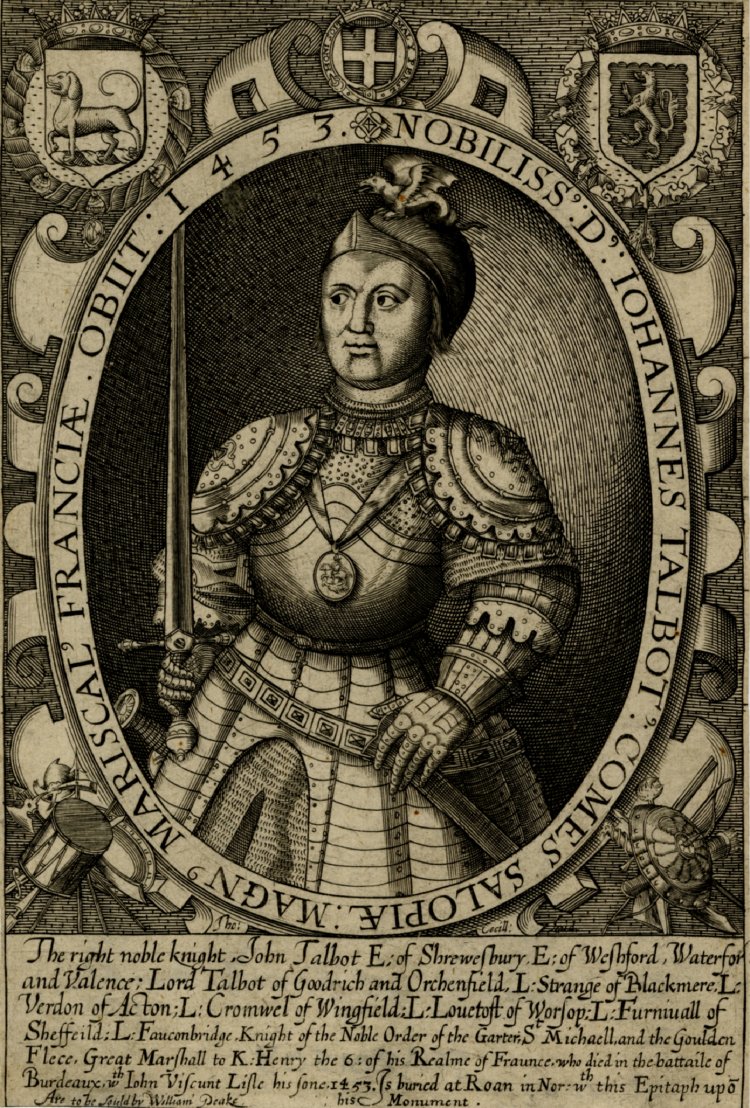
How would it have joyed brave Talbot, the terror of the French, to think that after he had lain two hundred years in his tomb, he should triumph again on the stage and have his bones new-embalmed with the tears of 10,000 spectators at least (at several times), who, in the tragedian that represents his person, imagine they behold him fresh bleeding.
Imaginary portrait of Talbot
by Thomas Cecil, c.1626-32
The play Nashe describes featured the triumphs and death of the famous Lord Talbot, just as Shakespeare's play does. And the apparent popularity of this play (with its "ten thousand spectators") fits with the box office receipts of Harry VI. Furthermore, Nashe's book is dedicated to Lord Strange - the patron of the company that performed Harry VI - and in it he praises the company's leading actor, Edward Alleyn.All of this suggests that Nashe is describing the Harry VI of Lord Strange's Men and that Harry VI has survived under the title The First Part of Henry VI.
That much is clear. More confusing is the play's relationship with the Second and Third parts; here we need to take things more slowly...
What exactly is The First Part of Henry VI?
The Second Part in the 1623 First Folio
1. In 1623, the first ever collected works of Shakespeare (the 'First Folio') was published. In it are three plays about the Wars of the Roses, entitled The First Part of Henry VI, The Second Part of Henry VI, and The Third Part of Henry VI. They are among Shakespeare's earliest plays. Along with his Tragedy of King Richard III they form a 'tetralogy' (a linked series of four plays).
The Second Part, published
in 1594 as The First Part of the Contention
2. But the Henry VI plays didn't always have those titles. In 1594, a version of The Second Part was printed under the title The First Part of the Contention betwixt the Two Famous Houses of York and Lancaster. And in 1595, a version of The Third Part was printed under the title The True Tragedy of Richard, Duke of York, and the Death of Good King Henry VI, with the Whole Contention between the Two Houses, Lancaster and York. These titles imply that in the 1590s, the Second and Third parts were thought of as a two-parter. And those two plays never refer back to the events of The First Part. So why does The First Part (which was never printed before 1623) even exist? 3. Another weird thing is that a 1592 book called Greene's Groatsworth of Wit alludes to The Third Part as if it was so well-known that readers were expected to recognize specific lines from it. If The Third Part was already well-known in 1592, why was TheFirst Part described by Henslowe in that year as "new"?
4. Because of all this, the general consensus among scholars is that Part One was written after the other two; it was a 'prequel' about the backstory of the already popular First Part of the Contention and True Tragedy of Richard Duke of York. The plays were then renamed the First, Second and Third partslater.
Choosing the Red and White Roses
by Henry Payne (1908)
5. That's why The First Part seems so detached from the other two. Indeed, it might not even have been written for the same company, because The First Part of the Contention and True Tragedy of Richard Duke of York never appear in Henslowe's Diary. One theory is that Lord Strange's Men observed the success of a rival company performing Shakespeare's two-parter about Henry VI's reign, and decided to piggyback on its popularity by creating their own prequel; later, Shakespeare's company acquired the play and the three plays were finally performed together. (That's only one of several alternative theories, but it gives you a sense of how complicated the background of this play may have been.)
6. But what of Shakespeare? Many modern scholars think Shakespeare didn't actually write much of TheFirst Part (different styles are detectable within it, and collaborative authorship was very common at the time) and there is a complex debate ongoing about exactly how much Shakespeare wrote and who his co-authors were. Does this mean that Strange's Men hired Shakespeare and others to quickly put together a prequel to his own work? Or perhaps Shakespeare had nothing to do with the original Harry VI and what we read today is a version that he reworked once his own company had got hold of it? Again, there are many theories.
If you've read this far and are still interested, I recommend the detailed reassessment of the evidence in Sally-Beth MacLean and Lawrence Manley's book (cited below). However, you may well feel by this point that the play's the thing and you no longer care when it was made and by whom! So, let's look instead at...
The play today
As we have seen, The First Part of Henry VI was extremely popular when it was first performed at the Rose (and would continue to be so for some time); we can speculate that Edward Alleyn was at his barnstorming best as the warrior Talbot, and we could even speculate that the demonic Joan of Arc was an attempt at recycling the fun of the demonic Pope Joan in the play performed two days previously.
For modern audiences and theatre practitioners, however, The First Part is much less appealing, and is rarely staged. It's easy to see why: the plot is episodic, and some of the writing is bland. As a result, The First Part is almost never performed by itself and is seen only on those rare occasions when ambitious theatre companies perform the entire trilogy (or the entire tetralogy including Richard III). If you'd like to look at images from different productions, the Designing Shakespeare website from Royal Holloway University is a great way of doing so. And look out for Kings of War, an upcoming postmodern adaptation by the amazing Toneelgroep Amsterdam.
Brenda Blethyn as Joan of Arc in the BBC Shakespeare film of The First Part of Henry VI (1981)
But even when it's performed within the trilogy, The First Part is often condensed or rearranged. This is evident in the few available film versions, all of which have been made for TV. The 1960 BBC series An Age of Kingscondensed the play into a 1-hour episode. The RSC's Wars of the Roses series, filmed by the BBC in 1965, shrunk it into two 50-minute episodes. [Update 7/5/16: the BBC's 2016 Hollow Crownadaptation is equally truncated.] The only (almost) uncut version is the 1981 TV film for the BBC Shakespeare series, directed by Jane Howell; a low-budget production with a deliberately artificial aesthetic, it offers the only opportunity most people will have to see The First Part of Henry VI in its entirety.
What we learn from this
One thing that the success of Harry VI demonstrates is that Elizabethan audiences liked prequels. We've already seen some possible prequels in Henslowe's Diary: Muly Moloccomay have been a prequel to The Battle of Alcazar, and The Spanish Comedymay have been a prequel to The Spanish Tragedy.
Prequels remain popular today, of course, as we, like the Elizabethans, desire to see what happened to the characters we enjoy before they became the characters we enjoy. It's a shame that the most famous modern examples - George Lucas's godawful prequels to the Star Wars trilogy - are as aesthetically problematic as TheFirst Part of Henry VI. But even those films manage to send occasional shivers down the spines of those who love the original works, as our knowledge of what the characters will become colours our experience of watching their formation...
A great example in The First Part of Henry VI is the penultimate scene, in which the Earl of Suffolk captures Lady Margaret. In Shakespeare's Second and Third parts, and in his Richard III, Margaret is an extraordinary character, the dynamic and powerful "she-wolf of France" who contrasts with the quiescent King Henry, and who ultimately becomes a vengeful widow spitting fury at the usurping Richard. The audience at the Rose would have been very familiar with this character, so when Margaret appears in The First Part as a fairly ordinary young noblewoman who nonetheless shows flashes of wit and strength, the audience might get a vertiginous thrill as they imagine the future that the character is as yet unaware of. And they will know that Suffolk's smug belief in his dominance over Margaret will prove horribly misguided.
FURTHER READING
Information on The First Part of Henry VI
Edward Burns, ed. King Henry VI, Part 1. The Arden Shakespeare (Thomson, 2000), 67-90.
Michael Taylor, ed. Henry VI, Part One. The Oxford Shakespeare (Oxford University, Press, 2005), 1-14.
Carol Chillington Rutter and Stuart Hampton-Reeves, Shakespeare in Production: The Henry VI Plays (Manchester University Press, 2009)
Martin Wiggins, British Drama, 1533-1642: A Catalogue, vol. 3 (Oxford University Press, 2013), entry 919.
Sally-Beth MacLean and Lawrence Manley, Lord Strange's Men and their Plays (Yale University Press, 2014), 96-99 and chapter 9.