In modern English: 22nd [June, 1597] ... total at Hengist ... 6 shillings
Hengist and Horsa arriving in Britain. From Richard Verstegan's A Resitution of Decayed Intelligence (1605)
Today is one of those strange moments in the Diary when an unknown play appears, attracts a tiny audience, and is never seen again. The title is almost certainly a rendering of Hengist, the Saxon warlord who, in legend, began the Anglo-Saxon settlement of England. However, it may in fact be an alternative name for an existing play.
Henslowe does not mark the play as new, and this is its only appearance in the Diary. Perhaps it is an old one from the archives, but if so, its revival is a complete disaster, attracting only a tiny audience. Most scholars thus assume that it is simply another name for Vortigern, the play about the clashes between Hengist and the native Britons that the company has performed several times this year. The company last performed Vortigern back on April 2; perhaps Henslowe has forgotten the title following its break and the character of Hengist was more memorable than that of Vortigern.
Whatever the truth of the matter, neither Vortigern nor Hengist will appear in the Diary again. Ancient Britain seems not to be a draw for London's audience these days.
FURTHER READING
Hengist information
Andrew Gurr, Shakespeare's Opposites: The Admiral's Company, 1594-1625 (Cambridge University Press, 2009), 223.
Henslowe writes: 13 | tt at times triumpe and fortus | 01| 05
In modern English: 13th
[April, 1597] | total at Time's Triumph and Fortune's | £1 and 5 shillings [i.e. 25 shillings]
Today, the Admiral's Men performed a play that we have not seen before at the Rose! Time's Triumph and Fortune's is not marked as a new play, so it must be an old one from the archives. But this is another of those strange days when a play is performed only once and never repeated.
Father Time in a detail from Poussin's A Dance to the Music of Time (1634-6)
The title is strange too; it's not even clear if it is complete. It could mean 'The Triumph of Time and of Fortune'. Or there might be a word missing; in his catalogue of British drama, Martin Wiggins wonders whether it is related to a mysterious lost play called The Second Part of Fortune's Tennis of which no first part is been recorded; Time's Triumph and Fortune's Tennis certainly sounds right. However, Wiggins continues that such a title would be illogical, because if Time triumphs, it must be because its implacable inevitability defeats the temporary reversals of fortune; he thus proposes that Time's Triumph and Fortune's Fall would be more logical as well as alliterative. Logic and Renaissance drama don't always mix, however...
For some reason, the scholarship on this lost play makes no mention of Robert Greene's prose romance Pandosto, or, the Triumph of Time (1588), a tale of two friends torn apart by jealousy and a daughter separated from her father, which Shakespeare transformed into The Winter's Tale around 1610. Could there be a connection?
Whatever its subject matter, Time's Triumph and Fortune's has received an unspectacular audience on this, its one appearance, and will never be seen again.
FURTHER READING
Time's Triumph and Fortune's information
Andrew Gurr, Shakespeare's Opposites: The Admiral's Company, 1594-1625 (Cambridge University Press, 2009), 228.
Henslowe writes: ye 18 of July 1596 ... ne ... R at the tyncker of totnes ... iijll
In modern English: [24th] July, 1596 ... New ... Received at The Tinker of Totnes ... £3.
Today, the Admiral's Men premiered a new play! The Tinker of Totnes received a large audience but, strangely enough, it will never be performed again. The text is lost, and we do not know what the eponymous tinker got up to in the town of Totnes.
The Tinker by Alphonse Legros (1874)
A tinker was an itinerant artisan who specialized in mending objects made from light metals such as tin.
The Lost Plays Database article on this play suggests that tinkers in Elizabethan literature had a reputation for being rascally thieves, although it also quotes a passage from a tale about a virtuous tinker who plays music.
The 'Brutus Stone' in
Totnes marks the spot where
the mythical founder of
Britain landed.
As for Totnes, it is a small town on an estuary in Devon. In Elizabethan times it was known as a place where people might arrive when travelling to England.
In the fanciful history of Britain by Geoffrey of Monmouth, Totnes is the landing place of Brutus, the mythical Trojan who supposedly founded London. In the town today is a stone known as the "Brutus Stone" which purports to be the spot upon which Brutus first stepped.
Geoffrey also reports that Totnes was where Uther Pendragon, the father of King Arthur, landed when preparing to confront Vortiger, who had usurped the British throne.
It's possible, then, to speculate that The Tinker of Totnes was a tale of legendary Britain, perhaps with a comic subplot about a wily tinker. But that's just a guess.
Today's premiere of The Tinker of Totnes was very successful, bringing a huge crowd to the Rose. But it is all for naught. Tomorrow, the Rose will be closed (watch this space) and the company will never revive this play, leaving today's performance as its only known appearance on the stage.
FURTHER READING
Tinker of Totnes information
Geoffrey of Monmouth, History of the Kings of Britain, Books 1 and 8
Martin Wiggins, British Drama, 1533-1642: A Catalogue, vol. 3 (Oxford University Press, 2013), entry 1039.
Henslowe writes: ye 1 of Junley 1596 ... ne ... R at peth paradox ... xxxxvs
In modern English: 1st July, 1596 ... New ... Received at Paradox ... 45 shillings
The Borromean
Rings, a
paradoxical
object
Today, the Admiral's Men premiered a new play! But this is a puzzling moment in the Diary. The play (now lost) carries the peculiar title of Paradox. And it will never be performed again after today's debut.
Paradox is a strange name for a play. Perhaps it refers to an enigma or difficult puzzle, in which case the play might have been of the same kind as another lost play, Crack Me This Nut, whose title means 'solve this problem for me'.
A paradox could also be an absurd statement. In his article on the play for the Lost Plays Database, David McInnis makes an intriguing observation. A 1607 joke-book entitled Jests to Make You Merry, which contains a "jest" by the playwrights Thomas Dekker and George Wilkins entitled "A Paradox in Praise of Sergeants". Like most jests of this period, it is immensely unfunny. It tells of a spendthrift gentleman in prison who befriends the sergeants watching him and rewards them with a 'paradox': a speech in praise of prisons. He describes prisons as being similar to a private home and as teaching wisdom through experience, and he describes sergeants as "cunning pilots that in all storms bring men safely to these havens of peace and contemplation". How amusing.
The book is too late to be a source for the play, but this jest makes reference to drama throughout (the reprobate gentleman is referred to as a "furious Tamburlaine" at one point) and was written by two playwrights, so it may have some distant connection with the theatre.
But whatever was seen on the Rose stage today, its reception may have been disastrous. Although the promise of a new play seems to have drawn a fairly large audience, but the company will never stage Paradox again. Perhaps it was less funny than a jest-book.
Henslowe writes: ye 29 of novmbȝ 1595 ... R at the welche man ... vijs
In modern English: 29th November, 1595 ... Received at The Welshman ... 7 shillings
Sir Richard Clough (1530-70),
a Welsh merchant
Today's entry represents one of those occasional strange moments in Henslowe's Diary when a previously unknown play suddenly appears, draws a tiny audience, and then never reappears. We know nothing of The Welshman beyond its title and its one enigmatic entry.
Is this performance of The Welshman really what it seems to be: a one-off, spectacularly unsuccessful revival of an old play from the archives? Or is Henslowe giving a new name to an existing play in the repertory, such as Longshanks, which features a Welsh villain named Llywelyn? We'll probably never know. And perhaps it doesn't matter, since hardly anyone in London seems to have cared.
What's next?
There will be no blog entry tomorrow because 30 November was a Sunday in 1595 and the players did not perform. Henslowe's Diary ... as a Blog! will thus return on 1 December. See you then!
Henslowe writes: ye 21 of febreary 1594 ... ne ... R at the macke ... iijll
In modern English: 21st February, 1595 ... New ... Received at The Mack ... £3
Today, the Admiral's Men premiered a new play, The Mack! Unfortunately, this lost play is very mysterious. It also probably wasn't very good, since the company will never perform it again.
Detail from The Triumph of Deathby Pieter Bruegel the Elder (1562)
Mack was a card game of the period, and the Oxford English Dictionary notes that it was often linked to the game of Maw; for example, the dictionary quotes George Tuberville's Book of Falconry (1575) which describes some common pastimes: "To check at chess, to heave at Maw, at Mack to pass the time." In his catalogue of British drama, Martin Wiggins proposes that The Mack was thus connected with The Set at Maw, another card-related play in the repertory of the Admiral's Men.
Sadly, the rules of the game of Mack are lost in the mists of time, so we cannot speculate on what the play might have been like. And even more sadly, the players will never again perform The Mack, despite the large crowd that attended its premiere. Something about it must not have worked.
FURTHER READING
The Mack information
Martin Wiggins, British Drama, 1533-1642: A Catalogue, vol. 3 (Oxford University Press, 2013), entry 990.
Henslowe writes: ye 30 of Julye 1594 ... ne ... R at the marchant of eamden ... iijll and viijs
In modern English: 30th July, 1594 ... New ... Received at The Merchant of Emden ... £3 and 8 shillings.
Today, the Admiral's Men performed a new play, The Merchant of Emden. This is yet another lost play, but we know something about its story, thanks to the existence of a ballad entitled "A Most Sweet Song of an English Merchant born at Chichester", which tells the story of an escape from death in Emden town. The ballad is known to have been in existence as early as March, 1594, so the play was most likely an adaptation of it.
Emden; a detail from Georg
Brand's Civitates Orbis Terrarum
Emden is a trading city in northern Germany with a large port, and thus a likely destination for an English merchant. The ballad itself is about 'scaffold marriages' - that is, the custom in some parts of Europe that if a woman offers marriage to a man about to be executed, his life will be spared.
The ballad tells of a Chichester man who kills a German in Emden, "through quarrels that did rise" and is sentenced to beheading. The authorities build a scaffold for his execution in the marketplace, and all the townsfolk come to watch, dressed in black.
But when the merchant is brought onto the scaffold, the women of the town notice that he is very handsome, and think it a pity that he must die; after all,
His stockings were of silk,
As fine as fine might be;
Of person and of countenance
A proper man was he.
The Emden merchants also want him to live, but their offers of compensatory money to the authorities are turned down by the Duke. Meanwhile, the Englishman himself is full of remorse:
With heart I do repent
This most unhappy deed;
And for his wife and children small,
My very soul doth bleed:
He announces that he will bequeath money to the family of the murdered man, on the sole proviso that they promise to speak well of Englishmen.
The onlookers are moved by his penitence, so much so that ten maidens of Emden offer to marry the Englishmen, citing the law that if a woman offers to marry a condemned man his life will be spared. Indeed, they fight over who will marry him:
'Brave Englishman', quoth one,
''Tis I will beg thy life';
'Nay', quoth the second, 'It is I,
If I must be thy wife!'
''Tis I', the third did say;
'Nay', quoth the fourth, ''Tis I!'.
So each one after other said,
Still waiting his reply.
The Englishman nobly turns them down, explaining that he could never marry a woman with whom he was not in love. Instead, he insists, "To Christ my love I give, / My body unto death", and he gives money to each of the young women.
But as the executioner prepares his weapon, another young women professes her love to the merchant: running onto the scaffold to kiss him, she tells him that even if he dies, she wants him to die in her arms. When he asks her how she can possibly love him after only just seeing him, she says, "Tis not by long acquaintance sir, / Whereby true love doth grow."
The maiden of Emden rescues the Englishman with marriage; from a late seventeenth-century text of the ballad in the Pepys Collection
The merchant is apparently convinced by this statement, and accepts the woman's offer of marriage. The crowd cheers as the maiden approaches the Duke and begs him to spare the man's life. The Duke agrees, the man is pardoned, and the couple marry the same day. And so...
To England came he then,
With this his lovely bride,
A fairer woman never lay
By any merchant's side,
Where I must leave them now
In pleasure and delight.
Hooray! Love, death, and gratuitous English patriotism! This is all good dramatic stuff that is easy to imagine onstage. Still, it doesn't quite feel like an entire play; in his catalogue of British Drama, Martin Wiggins points out that the ballad probably inspired only the last scene of the play, not the entire story. Perhaps the merchant in the play had some other adventures before his climactic rescue on the scaffold.
What went wrong?
The Merchant of Emden had a very successful premiere, receiving the usual high box office of a debut performance. But something must have gone wrong, because this play will never be performed again.
Why? Did the crowd hate it? Did it include some kind of political commentary that resulted in censorship? We will probably never know, and the failure of The Merchant of Emden must remain another of the unanswered mysteries of Henslowe's Diary.
Henslowe writes: R at kinge lude the 18 of Jenewarye 1593 ... xxijs
In modern English: Received at King Lud, 18th January, 1594 ... 22 shillings
Today, Sussex's Men introduced yet another play to the Rose audience. King Lud is now lost, but it must have been about the mythical pre-Roman king of the Britons after whom London is named. The audience would therefore have come to the theatre expecting a dramatization of local history. So, what might a play about King Lud have been like?
The legend of King Lud
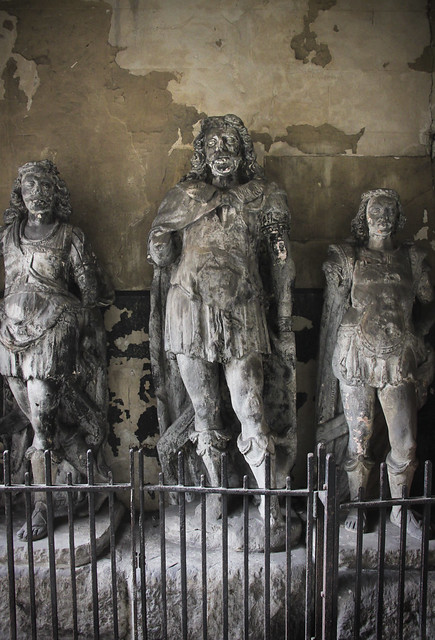
The audience that gathered at the Rose would already have had a strong image of King Lud in their minds. Just a few years ago, in 1586, Ludgate, the great archway next to St Paul's Cathedral, had been enhanced with brand new statues of Lud and his two sons. You can still see these statues today: although Ludgate itself was demolished in the eighteenth century, Lud and his sons can be found standing awkwardly in the porch of the nearby church of St Dunstan in the West.
Ludgate, from Wenceslas Hollar's map of
London (late 17th century)
Why did Lud deserve a statue? According to legend, London was founded by Trojan exiles who named their city Troynovant ('New Troy'); Lud was one of their descendants and made London the great city that it is today. According to the 16th century historian Raphael Holinshed, Lud began his reign in 72 BC. He was a virtuous monarch, whose achievements included "amending the laws of the realm that were defective, abolishing evil customs and manners used amongst his people, and repairing old cities and towns which were decayed".
Lud was most famous for his beautification and enlargment of Troynovant, "which he compassed with a strong wall made of lime and stone in the best manner, fortified with diverse fair towers, and in the west part of the same wall he erected a strong gate, which he commanded to be called after his name, Lud's Gate, and so unto this date it is called Ludgate".
The area of Ludgate and St Paul's, from the 'Agas
Map' (1563)
Holinshed describes how Lud enhanced the surrounding area by causing "buildings to be made betwixt London Stone and Ludgate, and builded for himself not far from the said gate a fair palace ... He also builded a fair temple near to his said palace, which temple (as some take it) was after turned to a church, and at this day called Paul's."
For this reason, it was only natural that the city took his name; as Holinshed explains, "the name was changed so that it was called Caerlud, that is to say, Lud's Town, and after, by corruption of speech. it was named London".
None of this is actually true, but it was a good story, and was deeply embedded in London folklore.
The play
Although Lud was a beloved figure for Londoners, it is hard to imagine the plot of this lost play, because there is no drama or conflict in his legend. For Holinshed, Lud was simply a perfect king: "strong and valiant in arms, in subduing his enemies, bounteous and liberal both in gifts and keeping a plentiful house, so that he was greatly beloved of all the Britons". Perhaps the playwright manufactured an imaginary story about Lud and his subjects and used the building of Ludgate and St Paul's as a spectacular climax.
Whatever its story, King Lud did not draw large crowds to the Rose. The theatre was only half full and the company never performed it there again.
What's next?
There's no record of a performance at the Rose tomorrow, or the day after (which was a Sunday), so Henslowe's Diary ... as a Blog! will return on the 21st, for a week that will include the return of Shakespeare to the Rose. Stay tuned!
Henslowe writes: R at william the conkerer the 4 of Jenewary 1593 ... xxijs
In modern English: Received at William the Conqueror, 4th January, 1594 ... 22 shillings
William the Conqueror,
depicted in the
Bayeux Tapestry
Today, Sussex's Men introduced another of their plays to the Rose audience: William the Conqueror. No play of that title survives today, but some scholars assume Henslowe was referring to an existing play entitled Fair Em, the Miller's Daughter of Manchester, with the Loves of William the Conqueror.
It's not certain William the Conqueror was Fair Em. After all, the two plays were owned by different playing companies: the title page of Fair Em's printed text states that it was performed by Lord Strange's Men, the previous incumbents of the Rose. But since Strange's Men had broken up by this point, and since it's theorized that some of its members became part of Sussex's Men, we can postulate that a play from the former company might have ended up being been performed by the latter.
Here, then, is a description of Fair Em. Even if it wasn't the same play, it may tell us something about what the one performed at the Rose today was like.
If the play was Fair Em
As you can tell from its title, Fair Em, the Miller's Daughter of Manchester; with the Love of William the Conqueror contains two storylines. The title also hints that the focus is on William's romantic escapades rather than the Battle of Hastings.
A man and a woman in the Bayeux Tapestry
In the play, William has already conquered England. He falls in love with a portrait of the Danish princess Blanche and travels in disguise to Denmark to woo her. But he finds the real Blanche disappointing: "Ill head, worse featured, uncomely, nothing courtly," he complains to himself, "I never saw a harder-favoured slut." William is not much of a charmer.
William falls in love instead with Mariana, a Swethian princess held captive by the Danes. Blanche becomes jealous and Mariana is not interested in William at all, so the whole thing is getting quite messy.
Mariana persuades the lovestruck William to help her escape in disguise, but she arranges things so that Blanche (her face hidden by a mask) is the woman who actually accompanies William back to England. William doesn't notice that the women have swapped places until much later when the angry Danes invade England to get Blanche back. The King of Denmark tries to forge peace by offering Blanche to William as a bride, but by this point William has become a confirmed woman-hater: "utterly I do abhor their sex," he announces, "they are all disloyal, unconstant - all unjust!".
Let us leave William stewing in misogynist fury and turn to the subplot. Following the Norman invasion, the old Anglo-Saxon nobility is in hiding. The eponymous Em is the daughter of one such nobleman, Sir Thomas Goddard, who has disguised himself and Em as a Manchester miller and his daughter (it's worth remembering that in Henslowe's day, Manchester was a small rural town rather than the industrial metropolis of today).
Em, as the title indicates, is beautiful, and attracts many suitors despite her humble status, including a local gentleman named Manville, and two Normans, Mountney and Valingford. Manville is Em's preferred choice, so she tries to dissuade the other suitors by faking blindness and deafness. This certainly succeeds in repelling Mountney, but unfortunately for Em it repels Manville too, who decides to chase another woman instead. Only Valingford is revealed to be the only loyal wooer.
In the play's conclusion, Em and her suitors appear before King William the Conqueror for judgement. Em reveals that she's not really blind and deaf. Seeing this, Manville switches his affections back to her, but by this point, Em has decided she no longer wants a fickle suitor and prefers Valingford. Of course, this is tricky, because she's only a miller's daughter, and he's a Norman lord. But when it is revealed that her father is in fact a disguised nobleman, that makes everything all right.
The two plots are finally knitted together when King William is so impressed by Em's virtue that his misogyny crumbles away and he recognizes that he should have loved Blanche all along. A royal wedding is thus in the offing, and in the play's last lines, King William announces,
Then here, Lord Valingford, receive fair Em;
Here, take her, make her thy espousèd wife.
Here go we in, that preparation may be made
To see these nuptials solemnly performed.
If you would like to read Fair Em, take a look at Brett Greatley-Hirsch and Kevin Quarmby's in-progress online edition at Digital Renaissance Editions. If you prefer print, Standish Henning's 1980 edition is the most readable edition, although it's hard to find.
What we learn from this
Fair Em reminds us that it's hard to speculate about a play's nature from its title alone. We might assume that a play called William the Conqueror would have told the story of the Battle of Hastings and the conquest of England. But Fair Em tells us that it could instead have been a wacky romantic comedy, with the Norman conquest used only as an excuse for yet another tale about noblemen disguised as commoners.
Whether or not William the Conqueror was Fair Em, it was performed only once by Sussex's Men at the Rose. If the company was expecting a big audience for this newly-introduced play, they were sorely disappointed with a theatre less than half full, and they never performed it again.
FURTHER READING
Fair Em information
Standish Henning, ed. Fair Em: A Critical Edition (Garland, 1980)
Martin Wiggins, British Drama, 1533-1642: A Catalogue, vol. 3 (Oxford University Press, 2013), entry 852.
Lawrence Manley and Sally-Beth MacLean, Lord Strange's Men and their Plays (Yale University Press, 2014)
William the Conqueror information
Martin Wiggins, British Drama, 1533-1642: A Catalogue, vol. 3 (Oxford University Press, 2013), entry 903.
Henslowe writes: Ne ... R at the taner of denmarke the 14 23 of maye 1592 ... iijllxiijs vjd
In modern English: New. Received at The Tanner of Denmark, 26th May, 1592 ... £3, 13 shillings and sixpence
Today's entry in Henslowe's Diary is very mysterious. It tells us that Lord Strange's Men premiered a new play entitled The Tanner of Denmark, and that it was an enormous success: its box office takings probably represent an almost packed theatre. But the play is now lost, and it is hard to imagine what its subject matter might have been. And stranger still, the company seems never to have staged it again - at least, it never again appears in Henslowe's Diary. Why did they stop performing it if it was so successful?
A solution to the mystery of The Tanner of Denmark has been proposed recently. It rests on slender evidence, but it's better than nothing, so let's walk through the logic, step by step...
A tanner is an artisan who specializes in treating animal hides to turn them into leather. But despite the best efforts of scholarship, no-one can explain why a Danish tanner might have been the subject of a play. There are no such characters in the literature of the time. There is a tanner of Tamworth in Thomas Heywood's history play Edward IV (1599), in which King Edward disguises as a commoner to test the tanner's loyalty. But tanning itself isn't important to this story, so it gives us no clues as to what The Tanner of Denmark might have been about.
But what if it wasn't about a tanner at all? In their book on Lord Strange's Men, Sally-Beth MacLean and Lawrence Manley ask whether Henslowe in fact intended to write The Tamer of Denmark. They admit that the word on the page looks like "taner", but they observe that Henslowe sometimes failed to distinguish 'n' from 'm' clearly.
So, what might a play called The Tamer of Denmark have been about? MacLean and Manley suggest that such a title would apply rather well to a mysterious play called Edmund Ironside, which may be linked to Lord Strange's Men but does not appear in Henslowe's records. This play is about a temperate Anglo-Saxon king who defeats a rash and boastful Danish rival and ultimately forges peace; as such, he could justifiably be called a 'tamer of Denmark'. This is quite a leap of scholarly imagination, but let us, with one eyebrow cautiously raised, look more closely at how this theory works...
Edmund Ironside the English King, or War hath Made All Friends is a play that survives only in a single manuscript now held by the British Library. It tells the story of King Edmund's war with the Danish invader Canute during the eleventh century. No-one knows who wrote this play, or when, or for which playing company. But it has become better-known that it might otherwise have been because a few writers have claimed it to be an early work by Shakespeare. Most notably, in a remarkably acerbic 1985 book, Eric Sams pointed to lines in the play that seem similar to lines in Shakespeare. Most Shakespeare scholars are unconvinced by this claim, seeing these lines as imitations or memories of other plays rather than proof that Shakespeare wrote it.
The plays that Edmund Ironside seems most closely related to include the Henry VI plays, especially the first of them, and Titus Andronicus, but it also seems to have inspired elements of the anonymous A Knack to Know a Knave (which will premiere at the Rose in a couple of weeks). Since The First Part of Henry VIand Knack were performed by Lord Strange's Men, MacLean and Manley see a hint that Ironside might have been too.
In support of this suggestion, they point out an intriguing passage in Thomas Nashe's satirical prose work Piers Penniless's Supplication to the Devil (1592). We've already encountered this book before, because it contains an apparent description of The First Part of Henry VI in performance,and shows some familiarity with the work of Lord Strange's Men. But elsewhere in the book, Nashe includes a satirical description of Danish people, whom he condemns as "gross and senseless proud dolts" who only respect braggart soldiers with giant battleaxes. Some of the language in his description is reminiscent of that used by the swaggering Canute in Edmund Ironside, and this leads MacLean and Manley to propose that Nashe was inspired by a performance of that play. If they're right, then we may get a glimpse of Edward Alleyn in the role of Canute here:
Thus walks he up and down in his majesty, taking a yard of ground at every step, and stamps on the earth so terrible as if he meant to knock up a spirit ... [but] if an Englishman set his little finger to him, he falls like a hog's trough that is set on one end.
This does sounds like the tall Alleyn, who was famed for prowling the stage with his long strides. So, MacLean and Manley knit together all these threads to suggest that maybe Edmund Ironside was performed by Lord Strange's Men under the title The Tamer of Denmark, which ended up in a garbled form in Henslowe's Diary.
MacLean and Manley acknowledge that this is highly speculative, and I must say that I'm not fully convinced, due to the large number of 'ifs'. It might be true if Henslowe meant to write 'tamer' and if the play of Edmund Ironside was known as The Tamer of Denmark, and if it was written for Lord Strange's Men, and if Nashe was remembering it when he satirized Danes. But we can't prove any of those things. And they admit that an apparent borrowing from Shakespeare's poem Venus and Adonis (1593, a year after Henslowe's entry) needs to be shrugged off if their theory is to work.
So, I'm not sure I buy it. And yet...
3. Why was the play performed only once?
Despite being held together with thin strands of evidence, MacLean and Manley's Edmund Ironside theory is still tempting because they propose that it helps solve the other mystery surrounding The Tanner of Denmark: why was it only performed once?
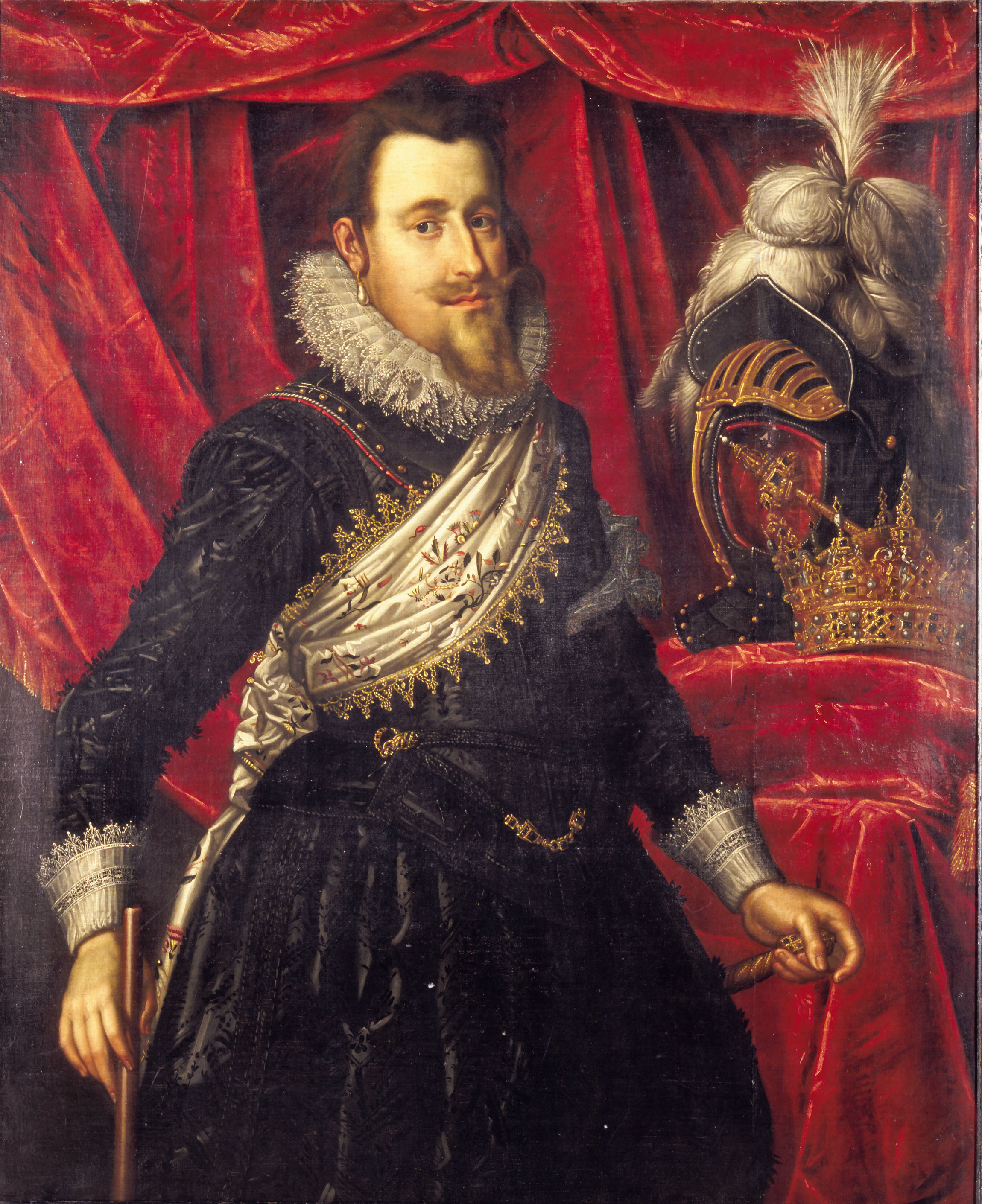
Christian IV, King of Denmark, 1588-1648;
his boozy boorishness fitted the English
stereotype of Danes rather well
They point out that Nashe's satire Piers Penniless was brought to the attention of the Privy Council as a politically dangerous work precisely because it made fun of foreigners such as Danes. What's wrong with laughing at Danes? Well, among other things, King James of Scotland, the likeliest heir to the English throne, had recently married Anne of Denmark, and there was a strain of hostility among the populace about the idea of these foreigners inheriting the English throne. A paranoid politician might have seen Nashe's joking about Danes as contributing to that hostility.
MacLean and Manley thus propose that in this context, a popular play that encouraged its audience to cheer as proud Englishmen beat back a Danish invasion of their nation might have raised alarm bells and could have been suppressed by the authorities. Again, this is all unproven (which MacLean and Manley fully admit), but it does at least make for a tidy solution to the puzzle surrounding Henslowe's entry.
I'm still only half-convinced. But since the alternative is to give up and return to the fruitless subject of tanning in Denmark, let's briefly look at the play of Edmund Ironside itself...
If the play was Edmund Ironside ...
Edmund Ironside the English King, or War hath Made All Friends tells the story of two men who both have claims to the English throne. Edmund Ironside is the son of King Ethelred of England. But the Danes have conquered England and Prince Canute is claiming the crown too. Edmund assumes the role of king and encourages the English people to resist Danish rule.
Battles ensue. In the first, Canute beseiges London, but Edmund's forces rescue the city and push the Danes north. The second battle is inconclusive. In the background of all this lurks a machiavel, the bastard Edricus, who shifts between both sides, and manages to convince both Edmund and Canute that he is spying for them. Edricus plays off the rival kings against one another, while plotting to gain power for himself and gloating to the audience in smug soliloquies.
The battle between Edmund Ironside and Canute, from the Chronica Majora of Matthew Paris (14th century)
In the climax, Edricus persuades Edmund and Canute to end the stalemate with single combat. Edmund wins the fight. But because Canute surrenders honourably, Edmund agrees they will divide England between them. The former enemies leave to celebrate peace. As they go, Edricus expresses pleasure at this amicable ending:
'Tis meet it should be so.
Thus hand in hand and heart in heart we go,
And, till occasion fits them, sleeping wink.
But then he turns aside and says to himself,
But I have sworn and I will keep my vow:
By heaven, I'll be revenged on both of you!
And with this ominous conclusion, the play sets up a sequel, which, so far as we know, never got written...
If you would like to read Edmund Ironside, the most widely available edition is Eric Sams' Shakespeare's Lost Play: Edmund Ironside (1985) but Sams' over-egged claims about Shakespeare's authorship and his pompous dismissal of contrary evidence make for an irritating and misleading read. Harder to find, but a lot more useful, is Randall Martin's edition of Edmund Ironside and Anthony Brewer's The Lovesick King (1991).
But what about tanners?
I've given a lot of space to MacLean and Manley's Edmund Ironside hypothesis, but it's still entirely possible that this play really was about a tanner of Denmark. Let's conclude, therefore, with a celebration of the ancient craft of tanning, and you can decide whether it has any dramatic potential.
FURTHER READING
Tanner of Denmark and Edmund Ironside information
Eric Sams, Shakespeare's Lost Play: Edmund Ironside (Fourth Estate, 1985)
Randall Martin, Edmund Ironside; and Anthony Brewer's The Lovesick King (Garland, 1991)
Will Sharpe, "Authorship and Attribution", William Shakespeare and Others: Collaborative Plays, ed. Jonathan Bate and Eric Rasmussen (Palgrave Macmillan, 2013).
Martin Wiggins, British Drama, 1533-1642: A Catalogue, vol. 3 (Oxford University Press, 2013), entries 929 and 1064.
Sally-Beth MacLean and Lawrence Manley, Lord Strange's Men and their Plays (Yale University Press, 2014), 149-56.
Henslowe writes: R at constantine the 21 marche 1591 ... xijs
In modern English: Received at Constantine, 21st March, 1592 ... 12 shillings
Today, Lord Strange's Men staged a lost play called Constantine. This was the first time they had performed it since Henslowe's records began in mid-February. It did very poorly at the box office and this is the only record of its performance. It was thus probably an old play that was at the end of its stage life.
Unfortunately, the play's title is not very illuminating as to its subject, because there have been numerous Constantines in history and literature. In his catalogue of British drama, Martin Wiggins proposes that in the English Renaissance, the two most famous Constantines would have been the Roman Emperor Constantine the Great and the mythical King Constantine of Britain. Let's briefly and cautiously imagine those possibilities.
Detail from The Baptism of Constantine, workshop of Raphael, c.1520
Constantine the Great was a 4th century Roman Emperor. He is most famous for being the first Christian Emperor of Rome, having converted after experiencing a dream or vision on the eve of a battle. The dramatist might have been able to turn this event into a pious play, and might also have been able to work in some patriotism, given the fact that Constantine visited Britain on more than one occasion.
Stonehenge, from Joan Blaeu's Atlas Maior (1660s)
King Constantine is a figure largely invented by the medieval pseudo-historian Geoffrey of Monmouth. Geoffrey writes that Constantine was the successor to King Arthur but his reign did not match that of his illustrious predecessor. He successfully suppressed a revolt by the two sons of Mordred, but when they both took refuge in different churches, Constantine broke the law of sanctuary and killed them in front of the altars. Four years later, he was "struck down by the vengeance of God" but was still honoured with a burial alongside Uther Pendragon within Stonehenge. This story reminds me of another lost play, Harry of Cornwall, which Strange's Men performed back in February; it too featured an impious murder in a church, against a backdrop of rebellion.
This is all guesswork, and the myriad other Constantines in history mean that it's futile to ponder further. It's a reminder to all playwrights to use specific titles; come on, how hard can it be?
FURTHER READING
Constantine information
Geoffrey of Monmouth, The History of the Kings of Britain, trans. Lewis Thorpe (Penguin, 1966), 262.
P.J. Casey, 'Constantine I', Oxford Dictionary of National Biography, (Oxford University Press, 2004; online edn, Jan 2009).
Martin Wiggins, British Drama, 1533-1642: A Catalogue, vol. 3 (Oxford University Press, 2013), entry 890.
Henslowe writes: R at senobia the 9 of marche 1591 ... xxijs vjd
In modern English: Received at Zenobia, 9th March, 1592 ... 22 shillings and sixpence.
Today, Lord Strange's Men performed Zenobia. This play has not survived, but it is based on a well-known story, so we can guess at its content. It would have been a spectacular tale about the exploits of the warrior queen Zenobia, who became Empress of the Orient and challenged the Roman Empire. This is the play's only appearance in Henslowe's Diary, so it may have been an old play that was being phased out.
Zenobia was a well-known and much-admired figure in the Renaissance; her story can be found, for example, in Chaucer's Canterbury Tales (within the Monk's Tale), and in Boccaccio's On Famous Women. She was praised by writers of the period for her military successes, her chastity, and her wisdom and learning.
I'm going to follow other scholars in assuming that the play of Zenobia was based on William Painter's retelling in his The Palace of Pleasure (1566), an anthology that was frequently used by Renaissance dramatists in search of a good story (it had already supplied the plot of Bindo and Ricciardo, performed last week).
The legend of Zenobia
In Novel 14 of Volume 2 of ThePalace of Pleasure, William Painter describes the Roman forces in the East falling into disarray under the poor leadership of Emperor Galienus. But a brilliant Roman captain-general called Odenatus, King of the Palmerines (from the city of Palmyra in modern day Syria), restores order. The Roman army in the East is so impressed that they make Odenatus 'Emperor and Lord of All the Orient', in effect creating a separate empire from that of Galienus in the West. But then Odenatus is assassinated. The army chooses one of his sons as the new Emperor of the Orient, but since the boy is only a child, Odenatus's wife, Queen Zenobia, is chosen to be Protector.
Tiepolo, Queen Zenobia Addressing her Troops (c.1725)
Zenobia is a noblewoman descended from the Ptolemies of Egypt. She is both wise and beautiful, and finds herself, as Painter puts it, "regent of an empire, and captain-general of the army". Painter praises Zenobia at length for her hands-on approach in military adventures: she wears armour, is present during battles, and is tougher and braver than many men. Her only flaw is ambition; for example, she styles herself Empress rather than mere "governess or regent".
Back in Rome, Galienus dies and the more competent Aurelianus becomes Emperor. Aurelianus declares war on Zenobia in order to retake the Orient for Rome. But Zenobia's troops know the country well and repeatedly defeat the Roman army. Eventually, Aurelianus writes to Zenobia, offering gold and permitting her to remain Queen of Palmyra if she will give up her claim to be Empress of the Orient. But Zenobia writes a defiant reply, insisting that the gods have made her Empress, and challenging Aurelianus to defeat her in battle if he wants her land.
Aurelianus is so outraged by this letter that, despite the weariness of his troops, he is fired up and successfully defeats Zenobia's army. She is captured and humiliated by being led in triumph through Rome. But the women of Rome are impressed by her, and she lives the rest of her days "in the company of these noble matrons".
Zenobia Before Emperor Aurelianus by Tiepolo (1717)
If you would like to read William Painter's tale of Zenobia, you may do so here. Alternatively, if you prefer something more trashy, you could hunt down the obscure 1959 Italian film The Sign of Rome, which stars Anita Ekberg as Zenobia (incidentally, the English dubbed version is retitled Sheba and the Gladiator, even though it's not about the Queen of Sheba and there are no gladiators in it...).
Anita Ekberg as Queen Zenobia in Sheba and the Gladiator (1959)
What we learn from this
This is the first play in Henslowe's list to feature a female protagonist who was represented in a positive light. In their book on Lord Strange's Men, Lawrence Manley and Sally-Beth Maclean suggest that Zenobia may have been envisaged as a direct contrast to their play about the scandalous Pope Joan (indeed, the two women appear next to one another as contrasting opposites inBoccaccio's On Famous Women).
The 'Armada Portrait' of Queen Elizabeth I (1588)
Furthermore, Martin Wiggins observes that a tale about a warrior queen taking on an empire would have made for a very obvious parallel with Queen Elizabeth I's contest with Spain, and might conjure patriotic memories of the recent defeat of the Spanish Armada. However, Wiggins notes that if the company did emphasize this parallel, they would have needed to rewrite the ending...
Henslowe writes: R at iiij playes in one the 6 of marche 1591 ... xxxjs vjd
In modern English: Received at Four Plays in One, 6th March 1592 ... 31 shillings and sixpence.
Four Plays in One is another lost play and we know almost nothing about it, except that it was ... four plays in one. It must have been a collection of one-act plays, perhaps linked by some kind of narrative device, and there are several examples of these in the period. There are lost Elizabethan plays called Three Plays in One and Five Plays in One. Thomas Middleton's one-act Yorkshire Tragedy (1607) was once part of an otherwise lost Four Plays in One. John Fletcher and his team wrote Four Plays, or Moral Representations, in One around 1614. But these Jacobean examples are not the lost Elizabethan play.
Unfortunately that's all I can tell you. It was four plays in one. Not five plays. Not three plays. But four plays. In one! Bargain!
Henslowe writes: R at poope Jone the 1 of marche 1591 ... xvs
In modern English: Received at Pope Joan, 1st March 1592 ... 15 shillings
Today, Lord Strange's Men performed a play called Pope Joan. It did not take much at the box office and this is the only record of its performance, so it was probably an old play at the end of its stage life. The play has not survived the passage of time, which is unfortunate, because it would be fascinating to see how an Elizabethan playwright approached the tale of Pope Joan.
In the Pope Joan legend, a 9th century Englishwoman disguises herself as a man in order to conceal her romantic relationship with a monk. In Athens, she becomes known for her great learning, and after her lover dies, she continues in her disguise to Rome, where she is eventually elected Pope. But she has an affair and becomes pregnant. She conceals the pregnancy but is unmasked when she gives birth during a religious procession. Depending on the legend, she either dies in childbirth or is stoned to death by the horrified crowd. The church hastily excommunicates her, buries her in unconsecrated ground, and tries to remove her name from the historical record.
Pope Joan gives birth in public (from a 1539 edition of Boccaccio's On Famous Women)
The story is well-known and is still told today; for example here's a trailer for a 2009 German film:
This trailer captures the dramatic potential of the tale for modern audiences, but it's unlikely that an Elizabethan play would have been so sympathetic toward Joan. Craig M. Rustici's research shows that she was always represented in a negative light in Renaissance England, and he speculates that the play would have presented her as a "corrupt villainess", perhaps counselled by demons. Joan's tale was often utilised by anti-Catholic writers to undermine faith in the wisdom of the church and in the unbroken line of Papal succession; the play may, then, have been performed as a satire on the Catholic church, although Rustici adds that its depiction of a woman in a position of power could also have been covert satire on Queen Elizabeth I.
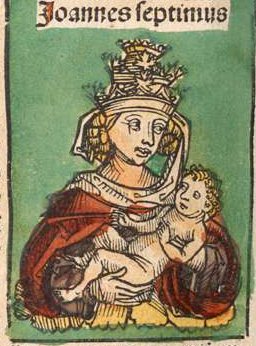
Pope Joan illustrated in the Nuremberg Chronicle (1493)
Still, dramatic performance may arouse more complex responses than prose propaganda can, and one cannot help wondering what the central performance (presumably by a talented boy actor rather than Edward Alleyn) was like. If Joan was presented as demonic or as a source of carnivalesque chaos, she might have been a theatrically exciting and entertaining character - a female Barabas, perhaps? Could Pope Joan be one of the great lost female roles in Elizabethan drama?
FURTHER READING
Pope Joan information
Craig M. Rustici, The Afterlife of Pope Joan: Deploying the Popess Legend in Early Modern England (University of Michigan Press, 2006), ch. 2.
Martin Wiggins, British Drama, 1533-1642: A Catalogue, vol. 3 (Oxford University Press, 2013), entry 894.
Sally-Beth MacLean and Lawrence Manley, Lord Strange's Men and their Plays (Yale University Press, 2014), 144-7.






.jpg/909px-Stonehenge_-_Wiltonia_sive_Comitatus_Wiltoniensis%3B_Anglice_Wilshire_(Atlas_van_Loon).jpg)