Showing posts with label Harry of Cornwall. Show all posts

Tuesday, 1 August 2017

1 August, 1593 - a letter from Alleyn in Bristol

Welcome back! After yet another lengthy hiatus, this blog is now reawakening a little more enthusiastically for the next couple of weeks. That's because a series of letters survives that were exchanged in the first half of August 1593 between Edward Alleyn, the leading actor of Lord Strange's Men, his wife Joan, and Philip Henslowe, owner of the Rose playhouse. As you may recall, Henslowe and Joan were still living in plague-stricken London, while Lord Strange's Men were engaged in a long enforced tour of England because London's theatres were closed.

So, on this day, 424 years ago, Alleyn wrote to Joan from Bristol, a large port city in southwestern England.The letter was carried to London by a relative of one of the actors in the company, and along with it, Alleyn sent his white waistcoat, explaining, "it is a trouble to me to carry it", and asking Joan to "lay it up for me till I come". As in his previous letter to her, Alleyn calls Joan his "good sweet mouse".
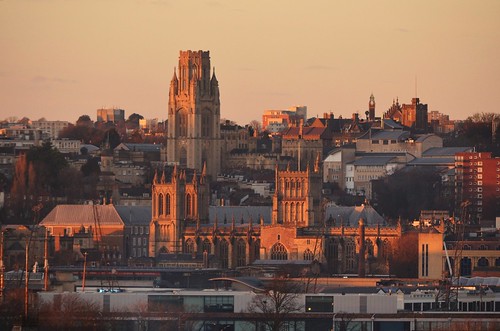
Bristol

Fears of the plague


When writing to Joan back in May, shortly after the tour had begun, Alleyn had made light of his absence, but this time he expresses directly his fears about the plague that was gripping London. He tells Joan he hopes that although "the sickness be round about you yet by [God's] mercy it may escape your house". He advises her to "keep your house fair and clean, which I know you will and every evening throw water before your door and in your backside [I assume he means back yard...] and have in your windows good store of rue and herb of grace"; he feels that this, along with praying, will protect her. As Carol Chillington Rutter observes, these preventative methods may seem unconvincing today, but Alleyn is at least recommending cleanliness, which was the best solution available in an age when the causes of the plague were unknown.

Touring


Alleyn gives us a glimpse of the company's future touring plans when he tells Joan "if you send any more letters, send to me by the carriers of Shrewsbury or to Westchester [an old name for Chester] or to York, to be kept till my Lord Strange's Players come". It looks as though they were planning a great sweep through the North of England, but although there is indeed a record of them reaching Shrewsbury, we do not know if they continued with their plan.


Alleyn signs off by saying that he is in "Bristol, this Wednesday after St James's Day, being ready to begin the play of Harry of Cornwall". In their book on Lord Strange's Men, Lawrence Manley and Sally-Beth Maclean observe that St James's Day was 25 July and that Bristol held an annual 9-day St James's Fair around that date; the company was presumably there in the hopes of large audiences. Since Bristol is in the west country, perhaps Harry of Cornwall was chosen for its local colour?

Homesickness and thoughts of return


Alleyn then adds a rather sad postscript, which suggests intense homesickness (understandable after months of touring): "Mouse, you send me no news of anything. You should send of your domestical matters: such things as happens at home, as how your distilled water proves, or this or that, or anything. What you will."

But Alleyn hasn't finished. Running out of space, he writes in the left-hand margin,
And Jug, I pray you, let my orange-tawny stockings of woolen be dyed a very good black against I come home to wear in the winter. You sent me not word of my garden, but next time you will, but remember this in any case: that all that bed which was parsley in the month of September you sow it with spinach, for then is the time. I would do it myself, but we shall not come home till Allhallowtide. And so, sweet mouse, farewell, and brook our long journey with patience.
Allhallowtide was the 3-day holiday period that began on October 31 (now Hallowe'en). Alleyn was thus expecting to remain on the road at least another two months.

Špenát / spinach


What's next?


A follow-up letter from Henslowe will be described in a post to appear next week.

Further reading


  • Facsimile of the letter, from the Henslowe-Alleyn Digitisation Project. (Unless I'm missing something, they're in error when they date it 24th July).
  • Carol Chillington Rutter, Documents of the Rose Playhouse (Manchester University Press, 1984), 73-5.
  • Lawrence Manley and Sally-Beth MacLean, Lord Strange's Men and their Plays (Yale University Press, 2014)

Friday, 20 May 2016

20 May, 1592 - Harry of Cornwall

Here's what Lord Strange's Men performed at the Rose playhouse on this day, 424 years ago...

Henslowe writes: R at harey of cornwell the 18 of maye 1592 ... xxxjs

In modern English: Received at Harry of Cornwall, 20th May, 1592 ... 31 shillings

Gustav Doré's 1875 illustration
of the murder of Henry
Today, Lord Strange's Men returned to Harry of Cornwall, a play that they have been performing approximately once a month. This lost play was about the revenge of the De Montfort brothers upon the eponymous Henry; you can read more about it in the entry for 25th February.

Harry of Cornwall continues to prove itself a play of merely average popularity. I wonder what causes the company to perform this play once a month, while they perform other 'average' plays, like Muly Molocco, almost every week?


  • Friday, 25th February - 33 shillings
  • Thursday, 23rd March - 13 shillings and sixpence (Holy Week)
  • Saturday, 29th April - 26 shillings
  • Saturday, 20th May - 31 shillings

What's next?


There will be no blog entry tomorrow because 21 May was a Sunday in 1592. Henslowe's Diary ... as a Blog! will thus return on 22 May for a week that will include an enigmatic new play alongside the usual suspects...

Henslowe links


Comments?


Did I make a mistake? Do you have a question? Have you anything to add? Please post a comment below!

Friday, 29 April 2016

29 April, 1592 - Harry of Cornwall

Here's what Lord Strange's Men performed at the Rose playhouse on this day, 424 years ago...

Henslowe writes: R at harey of cornwell the 29 of aprell 15912 ... xxvjs

In modern English: Received at Harry of Cornwall, 29th April, 1592 ... 26 shillings

Gustav Doré's 1875 illustration
of the murder of Henry
Today, Lord Strange's Men returned to Harry of Cornwall, a play that they have been performing only once a month. This lost play was about the revenge of the De Montfort brothers upon the eponymous Henry; you can read more about it in the entry for 25th February.

Harry of Cornwall had received disappointing audiences on its last outing, but that was most likely due to its being staged during Holy Week. This time, it was back to a similar level as its first outing, proving itself a reliably solid but unspectacular performer.


  • Friday, 25th February - 33 shillings
  • Thursday, 23rd March - 13 shillings and sixpence
  • Saturday, 29th April - 26 shillings

What's next?


There will be no blog entry tomorrow because 30 April was a Sunday in 1592. Henslowe's Diary ... as a Blog! will thus return on 1 May...

Henslowe links


Comments?


Did I make a mistake? Do you have a question? Have you anything to add? Please post a comment below!

Wednesday, 23 March 2016

23 March 1592 - Harry of Cornwall

Here's what Lord Strange's Men performed at the Rose playhouse on this day, 424 years ago...

Henslowe writes: R at harey of cornwell the 23 of marche 1591 ... xiijs vjd
  

In modern English: Received at Harry of Cornwall, 23rd March, 1592 ... 13 shillings and sixpence

Gustav Doré's 1875 illustration
of the murder of Henry
Today, Lord Strange's Men returned to a play that they had not performed for nearly a month, Harry of Cornwall. This lost play was about the revenge of the De Montfort brothers upon the eponymous Henry; you can read more about it in the entry for 25th February.

The performance was not impressive at the box office, receiving less than half what it did on its previous outing. This was only the latest of several disappointing returns in the past couple of weeks from plays that might have seemed reliable stalwarts of the repertory. I wonder if Henslowe was getting nervous? And I wonder what caused this slump in audiences? Was the fact that this was Holy Week causing a decline in audiences? Were audiences growing bored with the plays on offer? Or was a period of bad weather making the open-air Rose unappealing?


What's next?


There will be no blog entry tomorrow because Henslowe records no performance on the 24th March, which was Good Friday. Henslowe's Diary ... as a Blog! will thus return on 25th March with a performance of an old favourite!


Henslowe links


Comments?


Did I make a mistake? Do you have a question? Have you anything to add? Please post a comment below!

Thursday, 25 February 2016

25 February, 1592 - Harry of Cornwall

Here's what Lord Strange's Men performed at the Rose playhouse on this day, 424 years ago...

Henslowe writes: R at harey of cornwell the 25 of febreary 1591 ... xxxijs

In modern English: Received at Harry of Cornwall, 25th February 1592 ... 32 shillings.
(You may be wondering why Henslowe records the year as 1591, not 1592. It's because he's using the old style of dating in which the year begins on 25th March.)

The Assassination of Henry of Germany,
by Gustav Doré (1875)
Today's play, Harry of Cornwall, provided Henslowe with his most impressive box office so far: it made more than twice as much as Sir John Mandeville did yesterday. Unfortunately, it is another lost play that we can only reconstruct via guesswork.

The titular character was presumably Henry of Cornwall, better known as Henry of Almain or Henry of Germany (1235-1271). If so, this play would have been a tale of betrayal and revenge. Henry dithered over whether or not to support Simon de Montfort in his rebellion against King Henry III, and eventually abandoned him. De Montfort was subsequently defeated at the Battle of Evesham. Henry joined the Crusades. Later, he ended up in Italy, where he encountered de Montfort's sons, Guy and Simon, in the church of San Silvestro at Viterbo; there, they stabbed him, dragged him from the church and murdered him, while a bystander shouted "Remember Evesham!"  For this shocking crime in a holy place, Guy was excommunicated. After various escapades, he died in a Sicilian prison.

Sinners submerged
in boiling blood; detail
from an illustration
of Inferno XII
by Gustav Doré (1861)
Henry's murder may seem a footnote in history, but his death in a church was enough of a scandal for Dante to place Guy de Montfort in the seventh circle of the Inferno, where we find him sunk up to his throat in boiling blood. The Italians apparently believed that Henry's heart had been placed in a golden cup on London Bridge, where it still dripped blood into the Thames because Henry had not been avenged. So Virgil tells Dante,
There stands the one who, in God's keep, murdered
The heart still dripping blood above the Thames. (XII.119-20).

I wonder what the author of Harry of Cornwall did with this material. Was the tragic hero Henry, the indecisive murder victim? Or Guy, the hot-headed revenger? The latter does sound more like an Edward Alleyn role, so perhaps the play's protagonist was Guy, despite the title?

FURTHER READING


Harry of Cornwall information

  • Dante's Inferno: The Indiana Critical Edition, trans. Mark Musa (Indiana University Press, 1995)
  • Nicholas Vincent, ‘Henry of Almain (1235–1271)’, Oxford Dictionary of National Biography, (Oxford University Press, 2004; online edn, Jan 2009) 
  • J.R. Maddicott, ‘Montfort, Guy de (1244-1291/2)’, Oxford Dictionary of National Biography, (Oxford University Press, 2004; online edn, Jan 2009) 
  • Martin Wiggins, British Drama, 1533-1642: A Catalogue, vol. 3 (Oxford University Press, 2013), entry 905.
  • Sally-Beth MacLean and Lawrence Manley, Lord Strange's Men and their Plays (Yale University Press, 2014), 135-8.


Henslowe links


Comments?


Did I make a mistake? Do you have a question? Have you anything to add? Please post a comment below!