Showing posts with label Greene (Robert). Show all posts

Thursday, 28 December 2017

28 December, 1593 - George a Greene

Here's what the Earl of Sussex's Men performed at the Rose playhouse on this day, 424 years ago...

Henslowe writes: R at gorge a gren the 29 of desembȝ 1593 ... iijll xs

In modern English: Received at George a Greene, 28th December ... £3 and 10 shillings

Today, Sussex's Men continued their run of success, performing yet another play to a packed theatre! This time it was George a Greene, the Pinner of Wakefield George a Greene was a plebeian Northern hero from popular folklore, famed for his quick wit and his talent for winning fights. The play itself is a silly but entertaining piece of English patriotism, in which George repels a Scottish invasion. A couple of years after these performances, the text of George a Greene was published, making it one of the few plays of Sussex's Men that we can actually read.


Who wrote this play?


The Folger copy of George a Greene,
with Buc's note on its authorship
Before we dig into the plot of George a Greene, it's worth looking at an intriguing puzzle over who wrote it. The play was popular enough for several editions of it to be published during the sixteenth and seventeenth centuries. One copy, now in the Folger Shakespeare Library in Washington, DC, has a note on it in the handwriting of Sir George Buc, Master of the Revels, who was in charge of censoring plays and arranging entertainments for the Queen. The note reads:

Written by .......... a minister, who ac[ted] the pinner's part in it himself. Test[ified by] W. Shakespeare.
Ed. Juby sayeth that this play was made by Ro. Gree[ne]. 

From the note, it seems that Buc asked two people who wrote George a Greene: William Shakespeare and the actor Edward Juby. Shakespeare said it was a churchman who played George a Greene himself, but apparently couldn't remember his name, so Buc left a blank. But then Juby said it was Robert Greene, a well-known playwright whom we've met several times already in the course of this blog, as he wrote some of the plays performed by Lord Strange's Men: Orlando FuriosoA Looking-Glass for London and England and possibly Friar Bacon.

This note is of great interest to scholars of the enigmatic Shakespeare, as it's a rare early reference to a conversation with him. Still, the bard's recollection of a performing cleric-playwright seems rather odd, so George a Greene is more often regarded today as a play by Robert Greene, even though it's not much like his other work. We'll probably never know who really wrote it, but it's an intriguing little mystery.

Of pinners and Wakefield


A medieval pinfold in Capenhurst, Cheshire
So, George a Greene is a pinner, but what does that mean? A pinner (or, sometimes, a pinder) is someone employed to round up stray livestock such as sheep and cows, and pen them in a pound (in northern England, these pounds were often called 'pinfolds', and some of them still stand to this day).  The pinner would then make money by charging the owners for their release or selling unclaimed animals at market. Pinning may not seem like much of a livelihood, but in the town of Wakefield, a centre of the English wool trade, the town pinner was likely kept busy chasing after stray sheep.

However, the work of the pinner is not actually important to the plot of this play. What is important is that George-a-Greene is a pinner of Wakefield because Wakefield is in northern England, and in this play that means it's on the frontline of a Scottish invasion. King James of Scotland is at loggerheads with King Edward of England. Which James and which Edward? Technically, it must be James II and Edward IV but to be quite honest, historical accuracy is the last thing on this author's mind.


The play


Wakefield's medieval bridge and Chantry Chapel
George a Greene begins with the Earl of Kendal joining with King James of Scotland in his planned invasion, and trying to raise an army in northern England. His treasonous plans do not impress the patriotic people of Wakefield. George a Greene, the eponymous pinner, is the leader of the popular resistance, telling his fellows, "We are English born, and therefore [King] Edward's friends, / Vowed unto him even in our mother's wombs". Through trickery, George captures Kendal and hands him over to the authorities. Meanwhile, King James's invasion collapses when a siege is broken by an elderly war veteran and his son, who takes James prisoner and bring him before King Edward.

George's contribution to the defeat of the invasion sums up his essential characteristics: he's smart, he's tough, and although he's a poor man and a commoner, he's a patriot and he loves his king. But being a commoner causes problems for George, because his girlfriend, Bettris, has a domineering father named Grime who wants her to marry someone of higher status than a mere pinner, and locks her up in his house. George, using his brains again, sends his boy, Willy, disguised as a woman, to rescue Bettris from her father's house where she is kept. Bettris escapes by swapping clothes with Willy, but she still won't marry George without her father's permission, and what's worse, Willy is now trapped in the house, in women's clothing, and Grime has fallen in love with him! The life of a pinner is clearly more complicated than you might expect.

Robin Hood, from a 16th century edition of the
ballad A Jest of Robin Hood
Being a folk hero isn't easy either. Down in Sherwood Forest, Maid Marian is jealous of George a Greene, feeling that his reputation now outshines that of her own Robin Hood. She nags Robin into proving his superiority over his northern counterpart, so Robin, Will Scarlett and Much the Miller's Son trek up to Wakefield and fight George with staves. This fight must have been quite spectacular on the stage:

George. Sirrah, darest thou try me?
Will Scarlet. Aye, sirrah, that I dare!
   They fight, and George a Greene beats him.
Much the Miller's Son. How now! What, art thou down? Come sir, I am next!
   They fight, and George a Greene beats him.
Robin Hood. Come sirrah, now to me: spare me not,
For I'll not spare thee.
George. Make no doubt I will be as liberal to thee.
   They fight; Robin Hood stays.
Robin Hood. Stay, George, for here I do protest,
Thou art the stoutest champion that ever I laid hands upon!
George beats Much and Will Scarlett, but his fight with Robin ends in a draw. Having gained respect for one another, the two heroes feast together instead.

Fighting with staves, from a German fighting
manual published by Christian Egenolff
But this isn't the only fight that George gets into. In Bradford, a shoemaker enforces a custom known as "vail staff" (vail is an archaic word meaning the lowering of a weapon), according to which men must not carry their staves on their shoulders but rather trail them on the ground, or else they must fight the shoemakers. The two kings, James and Edward, come through the town, disguised as commoners, and they oblige when a shoemaker warns them to vail their staffs. But George and Robin Hood are passing through at the same time and scoff at Edward and James for being so docile. Seeing this derision, the local shoemakers attack them, but George beats them all up and then demands that they serve drinks to welcome Robin Hood, resulting in the delightful stage direction "They bring out the stands of ale and fall a-drinking". The kings then reveal their identities.

King Edward IV
At the end of the play, all these threads are tidied up. At George's request, King Edward orders Grime to let George marry Bettris; Grime agrees as long as he can marry the "lovely lass" he found in his house. With this agreed, Willy throws off his disguise, to Grime's anger. King Edward then offers George a knighthood, but he refuses it, insisting that a man's deeds are more important than his social status:

Then let me live and die a yeoman still:
So was my father, so must live his son,
For 'tis more credit to men of base degree,
To do great deeds, than men of dignity.
Instead, George requests that King James' release be contingent on him paying reparations to the war's victims. In the play's last lines, King Edward proposes to have supper with George and concludes,
And for the ancient custom of "vail staff", keep it still,
Claim privilege from me;
If any ask a reason why or how,
Say "English Edward vailed his staff to you".
As you can see, this is a silly and episodic play, but it has some amusing moments. Readable texts of it are hard to come by, but see if you can track down a copy of J. Churton Collins' 1910 edition of the plays of Robert Greene.


What we learn from this


George-a-Greene contains many of the qualities that we've come to expect from popular plays at the Rose: violence and patriotism. However, the heroes of the plays we've seen previously tended to be chivalric knights. In contrast, the hero of this play is a working class man of the people. What's more, it's full of imagery associated with the activities of common people during festivals and holidays, including feasting and stave-fighting competitions. Lots of other plays of this period tap into this imagery (Thomas Dekker's The Shoemaker's Holiday is perhaps the best and most famous), but this is our first encounter with this popular subgenre in our journey through the Rose repertory, and it may suggest that the repertory of Sussex's Men included different kinds of hero than those of Lord Strange's.


Further reading


George-a-Greene information

  • Alan Nelson. "George Buc, William Shakespeare, and the Folger George a Greene", Shakespeare Quarterly 49 (1998): 74-83.
  • Erika Lin, "Popular Festivity and the Early Modern Stage: The Case of George a Greene", Theatre Journal 61 (2009): 271-97
  • Martin Wiggins, British Drama, 1533-1642: A Catalogue, vol. 3 (Oxford University Press, 2013), entry 893.


Henslowe links


Comments?


Did I make a mistake? Do you have a question? Have you anything to add? Please post a comment below!

Tuesday, 8 March 2016

8 March, 1592 - A Looking-Glass for London and England

Here's what Lord Strange's Men performed at the Rose playhouse on this day, 424 years ago...

Henslowe writes: R at the lookinglasse the 8 of marche 1591 ... vijs 

In modern English: Received at The Looking-Glass, 8th March 1592 ... 7 shillings

Today Lord Strange's Men performed A Looking-Glass for London and England by Robert Greene and Thomas Lodge (we've already met Greene as the author of Friar Bacon and Friar Bungay and Orlando Furioso). The play is a Biblical tale about the sins of the city of Nineveh; its title means 'this play is a mirror in which London and England may see themselves'.

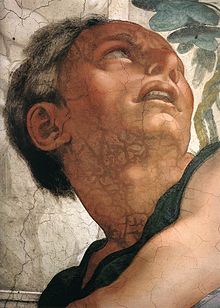
 Michelangelo's Jonah, from
the Sistine Chapel
A Looking-Glass for London and England is an adaptation of the Book of Jonah from the Old Testament. The Bible relates that Jonah was summoned by God to go to the debauched city of Nineveh to preach against its sins. Jonah refused and sailed for Tharsus instead, but was thrown overboard in a storm and swallowed by a whale. Belched out after three days, Jonah accedes to the will of God and goes to Nineveh, where he warns the people that God will destroy their city if they do not reform. He successfully persuades them to be penitent for their sins. Jonah then climbs a mountain to watch the city from afar and see whether or not God will destroy it; as he waits, he becomes angry when a vine sheltering him from the sun is killed by a worm; God then teaches him a moral about mercy, noting that Jonah is more upset about the destruction of a vine than he is about the destruction of Nineveh.

In adapting this story, Greene and Lodge broaden the scope of the Biblical text (which is short and focused almost entirely on Jonah's experience) to create a spectacular depiction of the inhabitants of this city of sin, repeatedly drawing attention to its parallels with London. The play features a range of impressive special effects, and I've quoted a number of its wonderful stage directions in the summary below.

The story and the spectacle


A Looking-Glass for London and England is set in the city of Nineveh, a disgusting sink of vice and sin. To it, an angel brings the prophet Hosea who is "set down over the stage in a throne", from which he watches and comments on the entire action of the play, occasionally pointing out to the audience its relevance to modern England ("London, take heed, these sins abound in thee!").


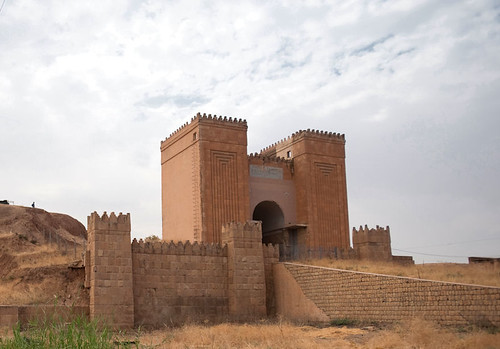
Nineveh
The sins of Nineveh, and God's repeated warnings to its people, are depicted at all levels of society. The king, Rasni, is an egomaniac who revels in pomp and luxury and wants to marry his own sister, but when she is blasted by a lightning bolt ("he finds her strucken with thunder, black"), Rasni ignores the warning and takes the lecherous murderess Alvida as his lover instead.

Rasni's flattering adviser, Radagon, is so ambitious that he refuses to help his own family, who are starving because a usurer has cheated them. Radagon's mother curses him, and "a flame of fire appeareth from beneath and Radagon is swallowed". But the court of Nineveh still doesn't take the hint, dismissing it as a natural phenomenon.

Meanwhile, among the underclass, Adam the clown (presumably played by the comic actor Will Kemp) is a smith's man who is found drunk next to a corpse (killed by someone else in a drunken quarrel). Fortunately for him, King Rasni considers crimes committed by drunks to be unworthy of interest and takes no action.

That's the kind of thing that goes on in Nineveh every day, so something needs to be done! In the middle of the play, an angel tells Jonah to go to Nineveh and preach against its sinfulness. Jonah refuses and instead takes ship to Tharsus.

Jonah and the Whale by Pieter Lastman (1621)
At this point, the playwrights are faced with the challenge of dramatizing the 'Jonah and the Whale' story. Here's how they do it. First, we see a group of sailors describing how, when a storm blew up, Jonah recognised God's anger and had himself thrown overboard. Then we see "Jonah the prophet cast out of the whale's belly upon the stage" whereupon he describes his cetacean adventures in a long speech. Presumably the "whale's belly" was represented by the large central opening in the theatre facade (the 'discovery space'). It's possible that the players used the 'hell-mouth' (a hideous mouth-shaped prop used to represent the entrance to Hell in Dr Faustus) to serve as the whale's mouth.

When Jonah arrives in Nineveh and prophesies its destruction, King Rasni orders forty days of penance and the entire city fasts and dons sackcloth.  Adam doesn't obey the order to fast, and is taken away to be hanged.

Maarten van Heemskerck, Jonah
Contemplates Nineveh (1566)
We then get a dramatization of the tale of Jonah and the vine on the mountain-top. Afterward, Jonah returns to the city and tells King Rasni of God's mercy. Rasni reforms, and Nineveh becomes a virtuous and holy city; Radagon's family is saved from poverty when the evil usurer repents.

At the end of the play, Jonah informs the audience that London too must repent. While he's about it, he manages to praise Queen Elizabeth and bash Catholicism too:

Oh turn, oh turn, with weeping to the Lord,
And think the prayers and virtues of thy Queen
Defers the plague which otherwise would fall.
Repent, oh London, lest for thine offence
Thy shepherd fail (whom mighty god preserve
That she may bide the pillar of His church
Against the storms of Romish Antichrist!).
The hand of mercy overshade her head
And let all faithful subjects say 'Amen'.

If you would like to read A Looking-Glass for London and England, there are old-spelling editions with useful introductions by J. Churton Collins' (in The Plays and Poems of Robert Greene, 1905)  or by George Allan Clugston (published by Garland in 1980).

What we learn from this


A Looking-Glass for London and England is more overtly moralistic than the other plays that we've seen so far. Looked at it in the context of the other plays we've seen, it feels rather hypocritical of the players to perform such a finger-wagging play so soon after the amoral bawdy fun of Bindo and Ricciardo and the complex religious satire of The Jew of Malta. And its dismal financial returns (a paltry 7 shillings, by far the worst box office of any play so far) implies that London did not want to be lectured about its sins.

When you think of this play being performed to a mostly empty theatre, its spectacular stage directions read rather sadly; populist effects such as lightning blasts, firey deaths and whale's mouths may have felt rather hollow when deployed to entertain only a small huddle of spectators. When one adds the constant berating of the immorality of Londoners, one cannot help but feel that the atmosphere in the Rose this day may have been rather awkward and embarrassing.


FURTHER READING


A Looking-Glass for London and England information

  • The Plays and Poems of Robert Greene, ed. J. Churton Collins (Clarendon Press, 1905), 1:137-42.
  • Martin Wiggins, British Drama, 1533-1642: A Catalogue, vol. 2 (Oxford University Press, 2012), entry 829.
  • Sally-Beth MacLean and Lawrence Manley, Lord Strange's Men and their Plays (Yale University Press, 2014), 101-3.


Henslowe links


Comments?


Did I make a mistake? Do you have a question? Have you anything to add? Please post a comment below!
Monday, 22 February 2016

22 February 1592 - Orlando Furioso

Here's what Lord Strange's Men performed at the Rose playhouse on this day, 424 years ago...
Henslowe writes: R at orlando the 21 of febreary ... xvjs vjd

In modern English: Received at Orlando the [22nd] of February, 16 shillings and sixpence
Yes, Henslowe wrote the date wrong again today; by 21st he probably meant meant the 22nd. Don't worry, he gets back on track tomorrow...

Anyway, on this day 424 years ago, the audience at the Rose saw Robert Greene's play The History of Orlando Furioso, One of the Twelve Peers of France. This is the only performance of Orlando that Henslowe will record in his diary; it may have been an old play that was being phased out because it was no longer profitable.

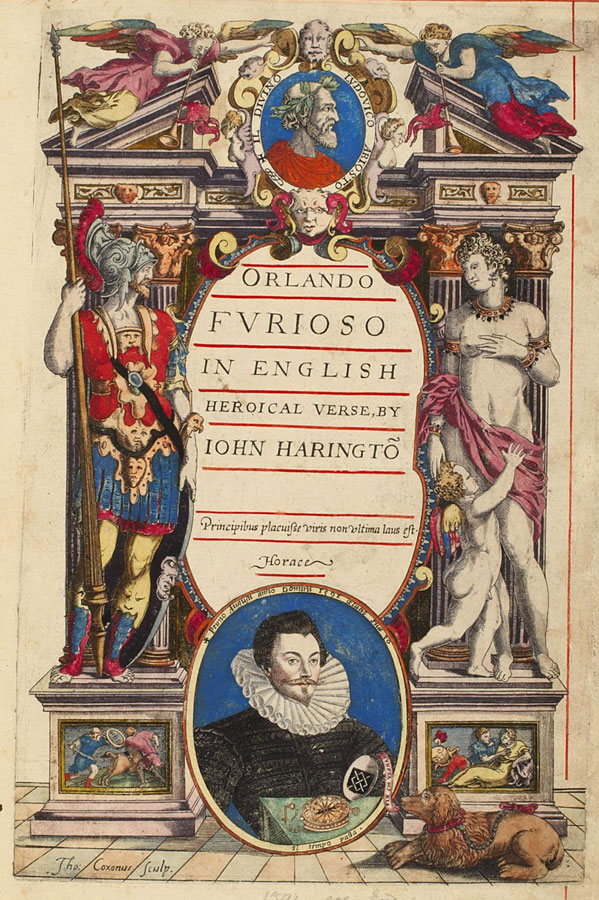
Sir John Harington's 1591 translation
of Ariosto

The play survives as a printed text published in 1594. It is a very loose adaptation of Orlando Furioso, the epic Italian poem by Ludovico Ariosto, which tells stories associated with the legendary hero Orlando (who originates in French literature as Roland, hero of the Chanson de Roland). Orlando is a knight during Charlemagne's wars with the Moors of Spain and Ariosto spins fabulous tales about his adventures. There is a famous 1591 English translation of Ariosto's poem by Sir John Harington, but scholars debate whether or not Greene used it.

The play also survives in a much rarer form. Edward Alleyn's 'part' for the role of Orlando is miraculously preserved at the Dulwich College archives. An actor's 'part' was the scroll on which was written the lines of his character, with cues indicated; from this scroll, the actor learned his lines. No other such parts have survived from the Elizabethan theatre, so this document is extremely valuable to theatre historians. You can read more about the part here, and can explore an online facsimile here.


The story


Angelica and Medor writing love
poetry on trees (by Jacques
Blanchard, 1630s). In
Ariosto's poem, this really
happens; in Greene's play,
Orlando is tricked into 
believing it has happened.
Greene's Orlando Furioso is a tale of love, madness and revenge. Orlando has arrived in an far-off land (a vague mish-mash of Africa and India), where he is attempting, alongside various exotic kings, to win the hand of the beautiful princess Angelica. She chooses Orlando and all seems well. But a jealous rival hangs love poems on trees in order to fool Orlando into believing that Angelica loves the peasant Medor. Orlando is consumed with jealousy and later comes to believe that Angelica and Medor are dead. He goes insane and tries to follow the pair to Hell in order to get revenge, recruiting an army of comic yokels to aid him.

Various comic and violent adventures ensue as the mad Orlando kills a rival and beats up a clown disguised as Angelica. Eventually, Orlando's madness is cured by a witch, and he learns that Angelica is innocent and alive. Due to the slanders on her name, Angelica is being tried for adultery by the Twelve Peers of France, but Orlando saves the day by fighting as her champion in disguise, and he and Angelica are reunited. And so, in the play's final lines, Orlando announces to the French lords that they will all return to France:

Thus, lordings, when our banquetings be done,
And Orlando espousèd to Angelica,
We'll furrow through the moving ocean,
And cheerly frolic with great Charlemagne.

Greene seems to have liked a good frolic at the end of a play; you may recall King Henry encouraging the crowned heads of Europe to frolic at the end of his Friar Bacon and Friar Bungay.

If you would like to read Orlando Furioso, here is an online transcript of Alexander Dyce's 1861 edition. No modern printed editions exist, but there are some old ones available, such as the one in J. Churton Collins' Plays and Poems of Robert Greene (1905).

What we learn from this


Orlando Furioso is almost an amalgam of everything we've seen at the Rose so far. It has the violent battles and the exoticism that we saw in Muly Molocco, combined with the comical and magical spectacle that we saw in Friar Bacon. Perhaps it is the ultimate Rose play?

We're also starting to recognize the typical roles played by Edward Alleyn, the leading actor of Lord Strange's Men. The role of Orlando requires an actor who is larger-than-life and physically powerful while also romantic, and who is able to shift through different psychological states (distinguishing the brave warrior at the beginning of the play from the deranged revenger that he becomes). Alleyn was clearly an actor of many talents and must have been an astonishing stage presence in this role. What will he play tomorrow? Wait and see...

By the way, if you experienced déjà vu when you read about love poems being hung on trees to fool Orlando, it may be because of Shakespeare's As You Like It, in which a lover named Orlando defaces trees with his poetry (watch the young Laurence Oliver doing so in the 1936 film below). This is presumably Shakespeare's little joke, and it's a reminder that Orlando Furioso, though forgotten in our own time, was a familiar part of the theatrical world that Shakespeare and his audience lived and breathed.


FURTHER READING


Orlando Furioso information

Henslowe links

Comments?


Did I make a mistake? Do you have a question? Have you anything to add? Please post a comment below!

Friday, 19 February 2016

19 February, 1592 - Friar Bacon

Welcome to the first post in a day-by-day journey through the life of an Elizabethan theatre! In this blog, I'll be using the records preserved in Philip Henslowe's diary to post daily information on the plays performed at the Rose playhouse, 424 years ago. The aim is for you to experience a little of how it felt to be a playgoer or actor in Shakespeare's London by glimpsing the daily parade of plays performed at just one theatre. You can read more about the project here.

This blog is founded on a list of box office takings from the Rose playhouse, written by its owner, the businessman Philip Henslowe. His list begins on this very day, 19 February, in 1592. So, let's see what was performed at the Rose that day:

Henslowe writes: R at fryer bacvne the 19 febrary satterdaye ... xvijs iijd

In modern English: Received at Friar Bacon, 19th February (Saturday) ... 17 shillings and threepence.

Once we translate Henslowe's arcane spelling, we can see that on this day in 1592, the audience at the Rose was entertained with a play about Friar Bacon, a fantastical version of the real-life medieval scholar Roger Bacon, who was often portrayed as a wizard in popular culture.

Today's post will be more long-winded than most, because two plays about Friar Bacon have survived from the Elizabethan theatre and we don't know which was performed at the Rose on this day. Was it Friar Bacon and Friar Bungay or was it John of Bordeaux? I'll have to tell you about both...

If the play was Friar Bacon and Friar Bungay...


Robert Greene's Friar Bacon and Friar Bungay portrays Bacon as an academic experimenting with magic. Bacon repeatedly demonstrates his skills by bamboozling sceptics and out-performing rival magicians, who include the eponymous Friar Bungay and a German named Vandermast. This results in a great deal of onstage spectacle, including a a magic mirror that can show far-off events, and the summoning of Hercules to pull down a golden tree. A romantic subplot tells of Bacon assisting Prince Edward in his wooing of a country girl named Margaret, but Edward eventually marries Eleanor of Castile.

From the title page of a prose tale of Friar Bacon, 1629,
which was re-used for the 1630 edition of the play.
In the play's most famous scene (depicted in the illustration on the right), Bacon makes a bronze head, which he hopes will give lectures in philosophy. He stays up all night but the head says nothing, so the sleepy Bacon orders his comic servant, Miles, to wake him if it speaks. Miles watches the head, which suddenly utters mysterious words ("Time is ... Time Was ... Time is Past"), but Miles doesn't wake Bacon in time, and the head self-destructs. The angry Bacon summons a demon who carries Miles to Hell on his back, with the fabulous stage direction "Exeunt, roaring".

The play ends with Bacon renouncing magic after two men die as a result of what they see in his magic mirror. Bacon's final act is to predict England's future: war followed by peace.The last lines of the play are spoken by King Henry III, who tells the King of Castile and the Emperor of Germany,
You shall have welcome, mighty potentates.
It rests to* furnish up this royal feast:
Only your hearts be frolic, for the time
Craves that we taste of naught but jouissance.
Thus glories England over all the West!
 *i.e. All that is left is for us to
Why am I quoting the last lines? I'll do this for all of the plays I describe, because their closing lines offer a glimpse of the imagery that would have rung in the audience's ears as they left the theatre. Here, as you can see, the climactic tone is one of joyous patriotism in the aftermath of Bacon's prophecy.


If you would like to read Friar Bacon and Friar Bungay, there is an online, old-spelling edition produced by the Queen's Men Editions. For a more reader-friendly experience, track down the modern-spelling annotated editions published in the 1960s by New Mermaids or by Regents Renaissance Drama; alternatively, you can find it in anthologies such as English Renaissance Drama: A Norton Anthology (2002).

It is even possible to watch a recording of the play in performance. In 2006, a team of scholars, actors, and directors created an experimental production of Friar Bacon and Friar Bungay that attempts to reproduce as closely as possible some Elizabethan performance practices. The videos can be found at the Performing the Queen's Men website; here is a direct link to Friar Bacon, but the videos are password-protected, so you must first obtain the password by contacting the webmasters.

If the play was  John of Bordeaux...


This play is a sequel to Friar Bacon and Friar Bungay. It is of unknown authorship and survives only in a manuscript now held at Alnwick Castle.The manuscript is untitled; most scholars call it John of Bordeaux, but others call it The Second Part of Friar Bacon or Friar Bacon and John of Bordeaux

In the play, Friar Bacon has returned to his study of magic, and gets involved with battles around the Italian city of Ravenna, which is being beseiged by the Turks and defended by the stalwart Sir John of Bordeaux. But Bacon's old enemy, the German magician Vandermast, is trying to discredit Sir John in order to aid the Emperor's son in his seduction of Sir John's wife. Magical adventures ensue, including demons and compulsive dancing. Far from relinquishing magic, Bacon this time uses it to save the day: after many reversals he proves to the Emperor his son's villainy using a magical show of the rape of Lucrece, and the play ends with Sir John of Bordeaux back in the Emperor's favour.

I wish I could tell you the last lines of the play, but unfortunately the final page of the manuscript is damaged. I will quote the fragments anyway, as they read like avant-garde poetry and make a rather groovy shape:

You will expect him
And since Sir John of B
Receive thy loyal subject
                    John to make
                            rossacl
                                tre a
                                    er
                             renids
                             a leav
                         st not stale
                        come this way
                         fs
                         wrongs

If you would like to read John of Bordeaux, there is no modern-spelling edition available, so you'll need to struggle through the Malone Society's transcript of the damaged manuscript.

What we learn from this


One obvious thing we have learned here, at the beginning of our journey through Henslowe's Diary, is that Elizabethan audiences loved plays about magic: even if their magician hero virtuously renounces his spells in one play, he will be obliged to pick up his wand again in a sequel. No doubt they liked magic because these plays take every opportunity to use the special effects capabilities of English Renaissance theatres. Look at some of these examples:
 Bungay conjures, and the tree appears with the dragon shooting fire (from Friar Bacon, Scene 9)
Here the Head speaks, and a lightning flasheth forth, and a hand appears that breaketh down the Head with a hammer (from Friar Bacon, Scene 11)
Thunder and lightning; enter [the demons] Asteroth and Rabsack (from John of Bordeaux, fol. 12)
 Plays like these are contemporary with Christopher Marlowe's famous Dr Faustus and are full of the same imagery of devils and magic. The Harry Potter films are a good example of how this delight in magical special effects persists to the present day. And of course, duelling wizards are always popular:


What's next?


There will be no post tomorrow because 20 February was a Sunday in 1592 and the actors did not perform. So, the next post in Henslowe's Diary... as a Blog! will be on February 21. See you then.

FURTHER READING


Friar Bacon information

  • Martin Wiggins, British Drama, 1533-1642: A Catalogue, vols. 2 and 3 (Oxford University Press, 2012-13), entries 822 and 908.
  • Sally-Beth MacLean and Lawrence Manley, Lord Strange's Men and their Plays (Yale University Press, 2014), 93-6.


Henslowe links


Comments?


Did I make a mistake? Do you have a question? Have you anything to add? Please post a comment below!