Henslowe writes: ye 11 of June 1594 ... R at the tamynge of A shrowe ... ixs
In modern English: 13th
June, 1594 ...Received at The Taming of a Shrew ... 9 shillings
Whoah! You wait ages for a Shakespeare play and then two come along (almost) at once! Following on from their staging of the ur-Hamlet a couple of days ago, the players at Newington Butts today performed The Taming of the Shrew, Shakespeare's famous comedy about a headstrong wife. Of course there is a complication, as always, but this time only a small one.
Shakespeare's play is entitled The Taming of the Shrew. However, today's play was recorded by Henslowe as The Taming of a Shrew, which is the title of an enigmatic, anonymous play from the same period. That play essentially rewrites Shakespeare's with different words and some different character names, but relatively few plot differences.
So, if taken literally, Henslowe's entry refers to a Shrew, the rewrite. But let's be honest: accurate titling was hardly Henslowe's strong point. And since one of the companies sharing the Newington Butts theatre was the Chamberlain's Men, the company to whom Shakespeare belonged, most scholars assume that Shakespeare's the Shrew was indeed the play staged today.
The story of the shrew
Shakespeare's play begins with a framing device: a drunken tinker named Sly falls deeply asleep and is found by a lord who takes him to his house and tricks him into believing himself to be a lord when he wakes. Sly is then entertained with the play of The Taming of the Shrew.
The play that unfolds is set in Italy. A rich man, Baptista, has two daughters: Bianca, the young and docile one, and Katharina, or 'Kate', who is disobedient (in the parlance of the time, a 'shrew'). All the bachelors in town want to marry Bianca, but her father insists that she may not marry until Kate is wedded first.
To get a sense of the challenge Kate poses to potential husbands, look no further than this fantastic clip from D.W. Griffith's 1908 silent film adaptation, starring the great Florence Lawrence - it's 90 seconds of sheer badassery:
So, the bachelors search for a husband for Kate, and discover that their friend Petruccio is prepared to accept the challenge and win her large dowry. Shenanigans ensue as the young men don disguises and plan stratagems to get close to the two secluded daughters. But the key to everything is whether Petruccio will succeed in wooing Kate. He does so by praising her beauty and by not getting angry at her disobedience. He then cunningly tells her father that she has agreed to marry him but intends to remain contrary until the wedding; when Kate responds that this is a lie, her father thus assumes that she is disagreeing for the sake of it.
The wedding goes ahead, and when it does, Petruccio's personality changes from indulgent to domineering. He wears outrageous clothing at the wedding and when he takes Kate home, he tries to tame her. He is violent and abusive, refusing to let her eat or sleep. When the couple prepare to attend the weddings of the other two bachelors - to Bianca and a rich widow - Petruccio refuses to leave until Kate declares that the sun is the moon, entirely submitting herself to him against the evidence of her own eyes.
At the double wedding, the men get into an argument over which of their wives is the most obedient, each insisting that their spouses will come when they are called. But when they test their beliefs, only Kate responds to her husband's call, and she delivers a speech about the obedience a wife owes to her husband.
In the play's final lines, the other two husbands comment on Petruccio's success:
Hortensio. Now, go thy ways. Thou hast tamed a cursed shrew. Lucentio. 'Tis a wonder, by your leave, she will be tamed so.
What are we to make of this today? The play's gender politics are antiquated, to put it mildly. But whatever the original intentions, it's possible for modern performers to extricate a less oppressive tone out of the ending. For example, here's Mary Pickford in 1929, delivering Kate's speech of obedience in a tone of extreme sarcasm to a disorientated Petruccio suffering from concussion; keep watching for one of the most famous winks in film history:
What we learn from this
On the face of it, The Taming of the Shrew, being a comic farce, doesn't have a lot in common with the plays we've been seeing in the Diary of late, which have been largely about war, revenge and bloodshed. But I do wonder how much it had in common with the lost Fair Maid of Italy, which received a few performances a while back.
More intriguingly, it's hard not to notice parallels with Esther and Ahasuerus, the lost Biblical play performed yesterday. Bothhighlight the theme of wifely subordination, featuring contrasts between disobedient and obedient wives. Could they have been performed one after another as kind of themed pair?
FURTHER READING
Taming of the Shrew information
Barbara Hodgdon, ed., The Taming of the Shrew, Arden Shakespeare (Methuen, 2010), 7-15
Martin Wiggins, British Drama, 1533-1642: A Catalogue, vol. 3 (Oxford University Press, 2013), entry 916.
Henslowe writes: ye 9 of June 1594 ... R at hamlet ... viijs
In modern English: 11th June, 1594 ...Received at Hamlet ... 8 shillings.
Well, here's a surprise! Today, Hamlet, one of the most famous plays of the English Renaissance, was performed at Newington Butts. But as always with Henslowe's Diary, things are more complicated than they seem. Shakespeare's Hamlet is normally dated to circa 1600, so what is it doing here 6 years previously?
The answer is that today's play was probably not the Hamlet that we know today. Shakespeare did not invent the story of Prince Hamlet: it is based on a Scandinavian legend, retold in many forms over the centuries, in which a young man fakes madness in order to exact revenge upon the murderer of his father. So, this play may be an older, lost dramatization of the story (rather like the early King Leir play that we saw in April).
Scholars call this hypothetical lost play "the ur-Hamlet". Let's go through exactly what we know about this early Hamlet and the intriguing question of who wrote it.
1. Thomas Nashe and the English Senecas
In 1589, the satirist Thomas Nashe wrote the preface to a prose tale called Menaphon by his friend, the playwright Robert Greene. In it, Nashe writes facetiously about English writers who attempt to imitate ancient Roman authors. In particular, he refers to a fashion for emulating Seneca, a Roman dramatist whose tragedies are known for their long, rhetorical speeches and gruesome horrors.
Seneca's Ten Tragedies Translated into English (1581), an example
of the vogue for Senecan drama
Despite his mocking tone, Nashe does admit that "English Seneca read by candlelight yields many good sentences, as 'Blood is a beggar!' and so forth". And then he adds that these plays "will afford you whole Hamlets - I should say handfuls - of tragical speeches".
This is not a very funny joke. But what's important is that Nashe gratuitously brings the word 'Hamlet' into a discussion of English Senecan tragedies. This implies that a play about Hamlet already existed, and that it was in the Senecan mode.
Was this early Hamlet written by the young William Shakespeare? We simply don't know, because the historical record tells us nothing about what Shakespeare was doing in the late 1580s.
Nashe hints at an alternative author. Continuing to scoff at Seneca's English followers, he says they "imitate the Kid in Aesop, who, enamoured with the Fox's newfangles, forsook all hopes of life to leap into a new occupation". This refers to Aesop's fable of the Fox and the Goat, but Nashe's use of the word "Kid" to refer to the foolish animal could be a pun on the playwright Thomas Kyd. After all, Kyd's Spanish Tragedy, one of the most popular plays at the Rose, is a perfect example of a Senecan tragedy, and shares several plot elements with Hamlet. So could Nashe be jokingly referring to Kyd as the author of the Hamlet play too? We don't know.
2. Henslowe's diary
Five years later, we find today's entry in Henslowe's Diary: a performance of Hamlet at Newington Butts. Is this the same play that Nashe was referring to? Probably, since Henslowe does not label it as new.
Henslowe's entry answers some questions but raises more. If you recall, two playing companies are currently sharing the Newington Butts playhouse: the Admiral's Men and the Chamberlain's Men. Hamlet probably belonged to the Chamberlain's, because it never appears in the repertory of the Admiral's when they are working separately. This is significant because Shakespeare is believed to have been acting with the Chamberlain's Men at this time.
In other words, in 1594, Shakespeare was probably acting in an old play called Hamlet. Was he its author? Or was he inspired by it to write his own version of the story? We don't know.
3. Thomas Lodge and the miserable ghost
Two years later, in 1596, Thomas Lodge wrote a satirical piece entitled Wit's Misery in which he categorized the devils who lurk around London. One devil is called 'Hate-Virtue' and Lodge describes him thus: he "looks as pale as the vizard of the ghost which cried so miserably at the Theatre, like an oyster-wife, 'Hamlet, revenge!'".
Henry Fuseli's illustration of the ghost calling
Hamlet to revenge (1796)
A vizard is a mask. The Theatre was the playhouse in London where the Chamberlain's Men were performing in 1596. An oyster-wife is a woman who sells oysters at the market, calling out loudly to potential customers. Lodge is therefore recalling a play in which a ghost in a white mask called on Hamlet for revenge in a voice like an oyster-wife's - clearly, he was not impressed by the actor playing the ghost.
The line "Hamlet, revenge!" does not appear in this exact form in any surviving version Shakespeare's play, and may thus hint at the existence of an earlier version. Overall, Lodge's comments could suggest that Shakespeare's company was still performing an old Hamlet play in 1596.
4. Hamlet by Shakespeare
An unfamiliar version of the "To be or not to be"
speech from the Q1 version of Hamlet
Finally, in 1603, evidence appears for a Hamlet by Shakespeare: a play was published entitled The Tragical History of Hamlet, Prince of Denmark and clearly attributed to William Shakespeare. But this text, known as "Q1", is not quite the Hamlet we know. It's shorter, some of the characters have different names, and the writing is often different (one speech begins "To be or not to be, aye, there's the point!").
Then, in 1604 and in 1623, two more texts were published; despite some differences between them, they together represent the play that we think of as Hamlet.
None of these texts read as though they were written in the 1580s, and a lot of internal and external evidence suggests that they were written around 1599-1601 (for a recent summary, see the introduction to the 2006 Arden edition). That is why scholars assume that the Hamlet play mentioned by Nashe, Henslowe and Lodge was probably a different one. But Q1 is a puzzle of its own. Is it a bowdlerized version of Shakespeare's play? Or some kind of halfway point in the transformation of the ur-Hamlet into Hamlet? We don't know.
So, what was the ur-Hamlet?
The short answer is, we don't know. Perhaps Thomas Kyd wrote an early Hamlet play and Shakespeare, acting in it, was inspired to create his own version a few years later. Or perhaps the young Shakespeare first wrote Hamlet back in the 1580s and gradually rewrote it into the version we know today. There is a vast amount of scholarly debate on these questions, but I'm not convinced that we'll ever know the truth.
And since Henslowe will never mention Hamlet again, I think we have the right to shrug and move on!
Emma Smith, "Ghost Writing: Hamlet and the Ur-Hamlet", in The Renaissance Text: Theory, Editing, Textuality, ed. Andrew Murphy (Manchester University Press, 2000), 177-90
Ann Thompson and Neil Taylor, eds., Hamlet, The Arden Shakespeare (Methuen, 2006), 44-7.
Henslowe writes: ne ... R at titus & ondronicus the 23 of Jenewary ... iijll viijs
In modern English: New. Received at Titus Andronicus, 24th January ... £3 and 8 shillings
Today, Sussex's Men performed a play by William Shakespeare! This is only the second Shakespeare play that we have seen in Henslowe's Diary so far (the other was The First Part of Henry VI, one of the Rose's most popular plays last year). Now, the company is offering Titus Andronicus, a gruesome tragedy set in a fantastical version of Ancient Rome. This play is on the fringes of Shakespeare's canon (parts of it may have been written by another playwright, George Peele, and its extremely violent plot encourages Shakespeare's more squeamish fans to dismiss it as early hackwork) but the Rose audience was not interested in such fussiness, and they packed the playhouse to see it.
The large audience may have been because Titus Andronicus was a brand new play. At least, Henslowe thought it was new, since he marked it as "ne" in the Diary, an annotation that normally means a performance was a premiere. There is in fact some uncertainty as to whether Titus Andronicus really was new when it was staged today, but the performance certainly achieved the high box office typically associated with premieres.
Whether or not the play was a new one, today may have been a transformative moment at the Rose. According to one theory, the arrival of Titus Andronicus marks the moment at which Sussex's Men were joined at the Rose by members of Pembroke's Men (the company to which Shakespeare belonged). Certainly, Titus is written for an unusually large number of actors, whereas George a Greene (the only surviving play from earlier in the season) requires a much smaller number. So, even if Shakespeare himself was not among the new arrivals, the Rose audience may have seen the performances there suddenly become bigger and more spectacular.
Was Titus really new?
Title page of the 1594 quarto publication of Titus Andronicus
Henslowe labels Titus Andronicus "ne", but there are reasons to suspect that it was actually about two years old. As you may recall from last year, one of the plays of Lord Strange's Men, A Knack to Know a Knave, seems to allude to the opening scene of Titus. Does that prove Titus was written first, or could there be another explanation?
Complicating matters further is the puzzling title page of the 1594 printed text. It describes the play has having been performed by Derby's Men (another name for Strange's Men), Pembroke's Men and Sussex's Men. Does this refer to the three companies working together (which may have been what was happening at the Rose) or does it refers to performances by each company in succession (which is also plausible).
The debate is complex, but if we are trying to imagine today's performance, it boils down to the question: was this a famous old play being performed at the Rose to an audience that already knew it, or was it a new and unknown work? It's hard to be sure, but the difference must have affected the atmosphere in the Rose before the show began. If you would like to read more about the debate, an excellent up-to-date summary is provided by Jonathan Bate in his 2018 revised edition for the Arden Shakespeare.
Adding to the complication is the question of authorship. Stylistic analysis by modern scholars suggests that Act 1 was written by George Peele (whom we've already met as the possible author of Muly Molocco). Perhaps these two puzzles are related: Titus Andronicus could be a rewriting by Shakespeare of an earlier play by Peele, so drastic that Henslowe considered it a new play.
The story
Titus Andronicus is famous for one thing: violence. Although Shakespeare was not averse to extreme violence in his other plays (think of the onstage eyeball-gouging in King Lear, for example, or the assassination of Julius Caesar), the sheer number of horrific events in Titus Andronicus means that any plot summary sounds rather comical. Although the play does at times introduce a warped form of humour during some of its most gruesome moments, productions that are brave enough to take it seriously often reveal Titus to have a majestic and sombre quality that belies its surface trashiness.
(Just for fun, I'll illustrate this synopsis with woodcuts from 17th century printed versions of a ballad of Titus Andronicus. Its exact relationship with the play is unclear, but it was most likely inspired by it, not vice versa. If you like, you can listen to the ballad being sung thanks to the English Broadside Ballad Archive.)
The play begins with Rome in crisis after the Emperor has died and his two sons - the virtuous Bassianus and the evil Saturninus - are vying for power. Into this maelstrom arrives Titus Andronicus, an aged general returning to Rome after a long war against the Goths during which most of his sons have been killed. He has brought to Rome the captive Queen of the Goths, her three sons, and a Moor named Aaron, who is her secret lover. Titus ritualistically executes one of Tamora's sons in front of her. It is a violent act that will breed a cycle of vengeance.
Titus's deference to tradition is one of the seeds of his tragedy. The senate of Rome elects Titus emperor but he declines the honour and instead follows custom in nominating Saturninus, the eldest son of the dead emperor. He even submits when Saturninus demands to marry Titus's daughter, Lavinia despite her existing betrothal to Bassianus. Titus's decisions infuriate his sons, who help Bassianus and Lavinia escape, and end up fighting their father, who kills one of them. And yet Saturninus then spurns Titus anyway, deciding that Tamora is a better match for him, and he marries her, to Titus's horror.
The 'Peacham drawing', an illustration from the 16th or early 17th century that depicts characters from Titus Andronicus. It's the only illustration of a scene from Shakespeare created during his own lifetime.
Things get nastier when Tamora uses her new position of power to exact revenge upon Titus. With the assistance of Aaron the Moor, Tamora's two remaining sons, Chiron and Demetrius, kill Bassianus and rape Lavinia, cutting off her hands and tongue to prevent her from communicating their guilt; they also capture two of Titus's sons and frame them for Bassianus's murder, so that the Emperor imprisons them. When Titus and his family find the brutalized Lavinia, they are shocked to the core, but are unable to act, as they do not know who the perpetrators were.
At this point, Shakespeare begins blending genres to dazzling effect: the violence increases, but to a degree that becomes almost farcical. Aaron informs Titus that the Emperor will free his two accused sons if Titus sends him his own severed hand. Titus permits Aaron to cut off his hand and take it. But the Emperor's response is to return Titus's hand accompanied by the decapitated heads of the sons. Seeing this, Titus laughs. "Why does thou laugh?" asks his brother Marcus, "It fits not with this hour." Titus replies, "Because I have not one more tear to shed."
The turning point comes when Lavinia manages to communicate with her father. Using a page from Ovid's Metamorphoses about the rape of Philomel, and writing in sand with a staff, she identifies Chiron and Demetrius as her abusers. Titus resolves to be revenged on them and their mother, and to overthrow the Emperor by inviting the Goths to invade. His task is made easier when Aaron is forced to flee after Tamora gives birth to a dark-skinned child that is obviously his and not the Emperor's; refusing to kill the baby, Aaron utters a powerful speech about black being better, and escapes into the wilderness with his newborn child.
Titus and Lavinia kill Tamora's sons: illustration from the Pepys Collection's copy of a ballad of Titus
Andronicus (1680s)
Meanwhile, Titus plots revenge and pretends to be mad. In order to torment him, Tamora and her sons dress up as the spirits of Revenge, Murder and Rape and haunt his house. But Titus captures Chiron and Demetrius and slits their throats, while Lavinia catches their blood in a bowl. As they die, Titus tells them that he will make their flesh and bones into pies. an idea drawn from the Greek legend of Thyestes.
Tamora and Saturninus eat the pies: illustration from
the Pepys Collection's copy of a ballad of Titus
Andronicus (1680s)
The play thus ends in full-on grand guignol, as the Emperor, Tamora, and various Roman and Goth envoys gather for a banquet at Titus's house, humouring his 'madness' when he arrives dressed as a cook. Titus serves meat pie to his guests, and as they eat, he suddenly announces the crime done to his daughter and kills her for the sake of honour. He then reveals that the pie is made from Tamora's sons. In a flurry of violence, Tamora, the Emperor, and Titus murder each other.
Titus's son Lucius becomes the next Emperor and resolves to bring peace. He sentences Aaron - who has been captured - to death by being buried up to his neck in earth. The unrepentant Aaron says, "If one good thing I did in all my life, / I do regret it, to my very soul." And in the play's closing lines, Lucius recommends that Tamora's body be left to be eaten by birds:
As for that heinous tiger, Tamora,
No funeral rite, nor man in mourning weeds,
No mournful bell shall ring her burial;
But throw her forth to beasts and birds of prey:
Her life was beast-like, and devoid of pity;
And, being so, shall have like want of pity.
And on that bleak note, this exhausting play ends.
The play today
Titus Andronicus is rarely staged, but of all the plays we've looked at in this blog so far, it's the one of which you have the best chance of seeing on the stage some day. It was largely ignored after the seventeenth century, as its violent content clashed with the tastes of more refined eras. But in 1955, Peter Brook staged a groundbreaking RSC production starring Laurence Olivier. This paved the way for many other productions that experimented with different ways of dealing with the play's challenges. If you'd like to look at images from different productions, the Designing Shakespeare website from Royal Holloway University is a great way of doing so. Some productions go for a camp comedy approach, but others find ways to extract gravitas and profoundity from the play. This trailer for the 2017 RSC production seems to be going for the latter approach:
Two major films also exist. In 1985, Jane Howell filmed Titus Andronicus as a studio-bound TV movie for the BBC's complete works of Shakespeare project. It is one of the better films in the series, and draws special attention to the presence of Titus's grandson, Young Lucius, who is presented as an innocent child increasingly traumatized by what adults are capable of doing to each other.
In 2000, Julie Taymor created a big-budget cinematic adaptation, called simply Titus,starring Anthony Hopkins as Titus, Jessica Lange as Tamora, and Alan Cumming as Saturninus. It borrows several ideas from the BBC film, most notably the idea of framing the story through the eyes of Young Lucius, but Taymor expands the concept further by framing the film through the eyes of a small boy playing violent games with his toys, and by making the world of the play a mishmash of costumes and settings from different historical periods, blurring ancient Rome with the twentieth century.
Taymor's film is full of imaginative visuals - such as Young Lucius buying wooden hands for Lavinia at a puppet shop - and interesting acting choices - for example, Harry Lennix finds ways to make Aaron the Moor a strangely moving and tender figure by the end. The film isn't perfect, but it contains many moments that deftly juggle the play's comedy and tragedy, and many others that give it an epic grandeur.
What we learn from this
Titus Andronicus looks quite unusual amid the rest of Shakespeare's works, but if we think of it as a Rose play it looks less incongrous. As we saw last year, violence was a popular component of the repertories of the performers at the Rose, and although a lot of that violence involved fight scenes rather than gore, horror has not been absent from the stage, if our hypotheses about the plot of Titus and Vespasianare correct.
But the most striking thing that comes out of reading Titus as a Rose play is its close relationship with Christopher Marlowe's The Jew of Malta, the most popular play of last year. The mixture of comedy and tragedy is similar (although The Jew is more consistently comic throughout), and Shakespeare's inspiration from Marlowe is very obvious. In my description of the play, I quoted Barabas's gloriously sadistic speech about his violent hobbies, but Shakespeare's Aaron has a speech that seems designed to outdo his predecessor's: he boasts,
Oft have I digged up dead men from their graves
And set them upright at their dear friends' door,
Even when their sorrows almost was forgot,
And on their skins, as on the bark of trees,
Have with my knife carved in Roman letters,
"Let not your sorrow die though I am dead."
Tut, I have done a thousand dreadful things
As willingly as one would kill a fly,
And nothing grieves me heartily indeed,
But that I cannot do ten thousand more. (V.i)
It's interesting to imagine these words being spoken at the Rose theatre, where, less than a year earlier, the audience had seen the Marlowe play that had inspired them. And very soon, The Jew of Malta will return to the Rose, so that the two plays will be performed in tandem. Stay tuned...
What's next?
For some reason, there are no records of any performances tomorrow (a Friday) or over the weekend. Henslowe's list becomes elliptical from this point on, and it's hard to be sure whether there really were no performances on some days, or whether he simply failed to record them. Either way, Henslowe's Diary ... as a Blog! will return on 28th January.
FURTHER READING
Titus Andronicus information
Scott McMillin, "Sussex's Men in 1594: The Evidence of Titus Andronicus and The Jew of Malta", in Theatre Survey 32.2 (1991): 214-23
Martin Wiggins, British Drama, 1533-1642: A Catalogue, vol. 3 (Oxford University Press, 2013), entry 928.
Lawrence Manley and Sally-Beth MacLean, Lord Strange's Men and their Plays (Yale University Press, 2014), 106-10.
Jonathan Bate, ed. Titus Andronicus, revised edition (Bloomsbury, 2018)
Henslowe writes: R at gorge a gren the 29 of desembȝ 1593 ... iijll xs
In modern English: Received at George a Greene, 28th December ... £3 and 10 shillings
Today, Sussex's Men continued their run of success, performing yet another play to a packed theatre! This time it was George a Greene, the Pinner of Wakefield. George a Greene was a plebeian Northern hero from popular folklore, famed for his quick wit and his talent for winning fights. The play itself is a silly but entertaining piece of English patriotism, in which George repels a Scottish invasion. A couple of years after these performances, the text of George a Greene was published, making it one of the few plays of Sussex's Men that we can actually read.
Who wrote this play?
The Folger copy of George a Greene,
with Buc's note on its authorship
Before we dig into the plot of George a Greene, it's worth looking at an intriguing puzzle over who wrote it. The play was popular enough for several editions of it to be published during the sixteenth and seventeenth centuries. One copy, now in the Folger Shakespeare Library in Washington, DC, has a note on it in the handwriting of Sir George Buc, Master of the Revels, who was in charge of censoring plays and arranging entertainments for the Queen. The note reads:
Written by .......... a minister, who ac[ted] the pinner's part in it himself. Test[ified by] W. Shakespeare.
Ed. Juby sayeth that this play was made by Ro. Gree[ne].
From the note, it seems that Buc asked two people who wrote George a Greene: William Shakespeare and the actor Edward Juby. Shakespeare said it was a churchman who played George a Greene himself, but apparently couldn't remember his name, so Buc left a blank. But then Juby said it was Robert Greene, a well-known playwright whom we've met several times already in the course of this blog, as he wrote some of the plays performed by Lord Strange's Men: Orlando Furioso, A Looking-Glass for London and England and possibly Friar Bacon.
This note is of great interest to scholars of the enigmatic Shakespeare, as it's a rare early reference to a conversation with him. Still, the bard's recollection of a performing cleric-playwright seems rather odd, so George a Greene is more often regarded today as a play by Robert Greene, even though it's not much like his other work. We'll probably never know who really wrote it, but it's an intriguing little mystery.
Of pinners and Wakefield
A medieval pinfold in Capenhurst, Cheshire
So, George a Greene is a pinner, but what does that mean? A pinner (or, sometimes, a pinder) is someone employed to round up stray livestock such as sheep and cows, and pen them in a pound (in northern England, these pounds were often called 'pinfolds', and some of them still stand to this day). The pinner would then make money by charging the owners for their release or selling unclaimed animals at market. Pinning may not seem like much of a livelihood, but in the town of Wakefield, a centre of the English wool trade, the town pinner was likely kept busy chasing after stray sheep.
However, the work of the pinner is not actually important to the plot of this play. What is important is that George-a-Greene is a pinner of Wakefield because Wakefield is in northern England, and in this play that means it's on the frontline of a Scottish invasion. King James of Scotland is at loggerheads with King Edward of England. Which James and which Edward? Technically, it must be James II and Edward IV but to be quite honest, historical accuracy is the last thing on this author's mind.
The play
Wakefield's medieval bridge and Chantry Chapel
George a Greene begins with the Earl of Kendal joining with King James of Scotland in his planned invasion, and trying to raise an army in northern England. His treasonous plans do not impress the patriotic people of Wakefield. George a Greene, the eponymous pinner, is the leader of the popular resistance, telling his fellows, "We are English born, and therefore [King] Edward's friends, / Vowed unto him even in our mother's wombs". Through trickery, George captures Kendal and hands him over to the authorities. Meanwhile, King James's invasion collapses when a siege is broken by an elderly war veteran and his son, who takes James prisoner and bring him before King Edward.
George's contribution to the defeat of the invasion sums up his essential characteristics: he's smart, he's tough, and although he's a poor man and a commoner, he's a patriot and he loves his king. But being a commoner causes problems for George, because his girlfriend, Bettris, has a domineering father named Grime who wants her to marry someone of higher status than a mere pinner, and locks her up in his house. George, using his brains again, sends his boy, Willy, disguised as a woman, to rescue Bettris from her father's house where she is kept. Bettris escapes by swapping clothes with Willy, but she still won't marry George without her father's permission, and what's worse, Willy is now trapped in the house, in women's clothing, and Grime has fallen in love with him! The life of a pinner is clearly more complicated than you might expect.
Robin Hood, from a 16th century edition of the ballad A Jest of Robin Hood
Being a folk hero isn't easy either. Down in Sherwood Forest, Maid Marian is jealous of George a Greene, feeling that his reputation now outshines that of her own Robin Hood. She nags Robin into proving his superiority over his northern counterpart, so Robin, Will Scarlett and Much the Miller's Son trek up to Wakefield and fight George with staves. This fight must have been quite spectacular on the stage:
George. Sirrah, darest thou try me? Will Scarlet. Aye, sirrah, that I dare! They fight, and George a Greene beats him. Much the Miller's Son. How now! What, art thou down? Come sir, I am next! They fight, and George a Greene beats him. Robin Hood. Come sirrah, now to me: spare me not,
For I'll not spare thee. George. Make no doubt I will be as liberal to thee. They fight; Robin Hood stays. Robin Hood. Stay, George, for here I do protest,
Thou art the stoutest champion that ever I laid hands upon!
George beats Much and Will Scarlett, but his fight with Robin ends in a draw. Having gained respect for one another, the two heroes feast together instead.
Fighting with staves, from a German fighting
manual published by Christian Egenolff
But this isn't the only fight that George gets into. In Bradford, a shoemaker enforces a custom known as "vail staff" (vail is an archaic word meaning the lowering of a weapon), according to which men must not carry their staves on their shoulders but rather trail them on the ground, or else they must fight the shoemakers. The two kings, James and Edward, come through the town, disguised as commoners, and they oblige when a shoemaker warns them to vail their staffs. But George and Robin Hood are passing through at the same time and scoff at Edward and James for being so docile. Seeing this derision, the local shoemakers attack them, but George beats them all up and then demands that they serve drinks to welcome Robin Hood, resulting in the delightful stage direction "They bring out the stands of ale and fall a-drinking".The kings then reveal their identities.
King Edward IV
At the end of the play, all these threads are tidied up. At George's request, King Edward orders Grime to let George marry Bettris; Grime agrees as long as he can marry the "lovely lass" he found in his house. With this agreed, Willy throws off his disguise, to Grime's anger. King Edward then offers George a knighthood, but he refuses it, insisting that a man's deeds are more important than his social status:
Then let me live and die a yeoman still:
So was my father, so must live his son,
For 'tis more credit to men of base degree,
To do great deeds, than men of dignity.
Instead, George requests that King James' release be contingent on him paying reparations to the war's victims. In the play's last lines, King Edward proposes to have supper with George and concludes,
And for the ancient custom of "vail staff", keep it still,
Claim privilege from me;
If any ask a reason why or how,
Say "English Edward vailed his staff to you".
As you can see, this is a silly and episodic play, but it has some amusing moments. Readable texts of it are hard to come by, but see if you can track down a copy of J. Churton Collins' 1910 edition of the plays of Robert Greene.
What we learn from this
George-a-Greene contains many of the qualities that we've come to expect from popular plays at the Rose: violence and patriotism. However, the heroes of the plays we've seen previously tended to be chivalric knights. In contrast, the hero of this play is a working class man of the people. What's more, it's full of imagery associated with the activities of common people during festivals and holidays, including feasting and stave-fighting competitions. Lots of other plays of this period tap into this imagery (Thomas Dekker's The Shoemaker's Holiday is perhaps the best and most famous), but this is our first encounter with this popular subgenre in our journey through the Rose repertory, and it may suggest that the repertory of Sussex's Men included different kinds of hero than those of Lord Strange's.
Further reading
George-a-Greene information
Alan Nelson. "George Buc, William Shakespeare, and the Folger George a Greene", Shakespeare Quarterly 49 (1998): 74-83.
Erika Lin, "Popular Festivity and the Early Modern Stage: The Case of George a Greene", Theatre Journal 61 (2009): 271-97
Martin Wiggins, British Drama, 1533-1642: A Catalogue, vol. 3 (Oxford University Press, 2013), entry 893.
Henslowe writes: ne ... R at harey the vj the 3 of marche 1591 ... iijll xvjs 8d
In modern English: New. Received at Harry VI, 3rd March 1592 ... £3, 16 shillings and eightpence.
Today, we have the first appearance of William Shakespeare in Henslowe's Diary! Well, sort of. The extent to which Shakespeare was actually involved in Harry VI is unclear, but this entry sheds some interesting light on his early career successes.
There are a couple of things to say about what Henslowe wrote today. First, notice that he writes "ne" next to the entry. Henslowe will add these letters to a few other plays in the future, and scholars have determined that he probably means "new"; in other words, he's noting the first performance of a new play. Secondly, you can see that London's theatregoers were very excited about this new play called Harry VI, because Henslowe achieved his best box office so far. There are twenty shillings in a pound, so he made 75 shillings today, far more than the 50 he made with The Jew of Malta a few days ago).
So, what was this instant blockbuster called Harry VI? It was almost certainly the play we know today as Shakespeare's The First Part of Henry VI (most likely written in collaboration with others). To understand how we know this, it's easiest to begin by looking at the story of Shakespeare's play and then at the evidence connecting it with Harry VI.
What happens in The First Part of Henry VI...
1540s portrait of King Henry VI
The First Part of Henry VI is set in the 15th century, in the aftermath of the early death of the heroic King Henry V, and the coronation of his son, a mere child, as Henry VI.
England is losing its lands in France to a rebellion. The French army is aided by Joan of Arc (called Joan la Pucelle in the play), who is presented as a sinister, witch-like figure who can conjure devils. But the English have their own weapon of mass destruction: the great warrior Lord Talbot, who triumphs at Orléans and Rouen.
Meanwhile, civil war is brewing in England, emerging out of a quarrel between Richard, Duke of York, and the Duke of Somerset. The two factions show their allegiance by choosing red or white roses from a bush. The tensions undermine Talbot's successes in France when rivalry between York and Somerset causes reinforcements to be delayed and Talbot to be killed in battle at Bordeaux.
Joan at the stake; detail from Vigiles du roi Charles VII (1484)
The play ends with uneasy optimism: Joan is captured and Richard has her burned at the stake; and the French and English agree to forge peace by marrying King Henry to a Frenchwoman. The Earl of Suffolk has captured Margaret of Anjou, a French noblewoman, and persuades Henry to marry her.
But Suffolk, who has fallen in love with Margaret, is not trustworthy: in the play's last lines, he tells the audience,
Margaret shall now be queen, and rule the king:
But I will rule both her, the king, and realm.
And on this cliffhanger ending, the play seems designed to make us want to see The Second Part of King Henry VI...
Is Harry VI another name for Shakespeare's The First Part of Henry VI?
The evidence for Harry VI being Shakespeare's play is pretty strong. In his 1592 book Piers Penniless's Supplication to the Devil, Thomas Nashe described the popular success of a patriotic play featuring Lord Talbot:
How would it have joyed brave Talbot, the terror of the French, to think that after he had lain two hundred years in his tomb, he should triumph again on the stage and have his bones new-embalmed with the tears of 10,000 spectators at least (at several times), who, in the tragedian that represents his person, imagine they behold him fresh bleeding.
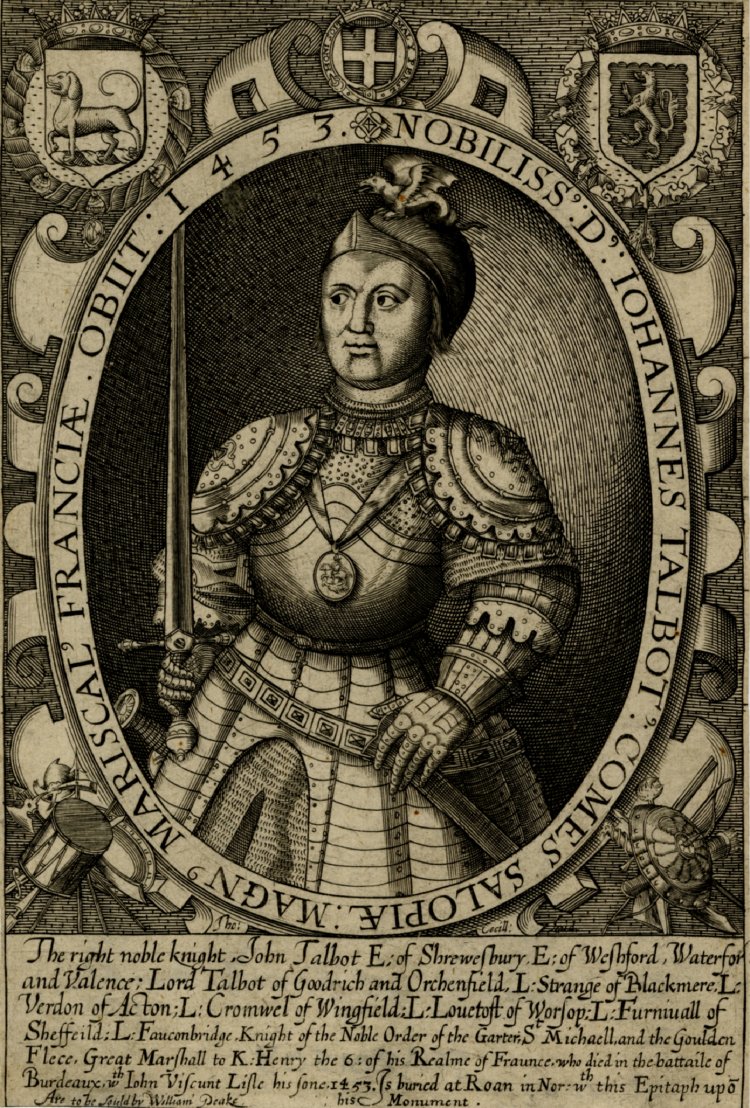
Imaginary portrait of Talbot
by Thomas Cecil, c.1626-32
The play Nashe describes featured the triumphs and death of the famous Lord Talbot, just as Shakespeare's play does. And the apparent popularity of this play (with its "ten thousand spectators") fits with the box office receipts of Harry VI. Furthermore, Nashe's book is dedicated to Lord Strange - the patron of the company that performed Harry VI - and in it he praises the company's leading actor, Edward Alleyn.All of this suggests that Nashe is describing the Harry VI of Lord Strange's Men and that Harry VI has survived under the title The First Part of Henry VI.
That much is clear. More confusing is the play's relationship with the Second and Third parts; here we need to take things more slowly...
What exactly is The First Part of Henry VI?
The Second Part in the 1623 First Folio
1. In 1623, the first ever collected works of Shakespeare (the 'First Folio') was published. In it are three plays about the Wars of the Roses, entitled The First Part of Henry VI, The Second Part of Henry VI, and The Third Part of Henry VI. They are among Shakespeare's earliest plays. Along with his Tragedy of King Richard III they form a 'tetralogy' (a linked series of four plays).
The Second Part, published
in 1594 as The First Part of the Contention
2. But the Henry VI plays didn't always have those titles. In 1594, a version of The Second Part was printed under the title The First Part of the Contention betwixt the Two Famous Houses of York and Lancaster. And in 1595, a version of The Third Part was printed under the title The True Tragedy of Richard, Duke of York, and the Death of Good King Henry VI, with the Whole Contention between the Two Houses, Lancaster and York. These titles imply that in the 1590s, the Second and Third parts were thought of as a two-parter. And those two plays never refer back to the events of The First Part. So why does The First Part (which was never printed before 1623) even exist? 3. Another weird thing is that a 1592 book called Greene's Groatsworth of Wit alludes to The Third Part as if it was so well-known that readers were expected to recognize specific lines from it. If The Third Part was already well-known in 1592, why was TheFirst Part described by Henslowe in that year as "new"?
4. Because of all this, the general consensus among scholars is that Part One was written after the other two; it was a 'prequel' about the backstory of the already popular First Part of the Contention and True Tragedy of Richard Duke of York. The plays were then renamed the First, Second and Third partslater.
Choosing the Red and White Roses
by Henry Payne (1908)
5. That's why The First Part seems so detached from the other two. Indeed, it might not even have been written for the same company, because The First Part of the Contention and True Tragedy of Richard Duke of York never appear in Henslowe's Diary. One theory is that Lord Strange's Men observed the success of a rival company performing Shakespeare's two-parter about Henry VI's reign, and decided to piggyback on its popularity by creating their own prequel; later, Shakespeare's company acquired the play and the three plays were finally performed together. (That's only one of several alternative theories, but it gives you a sense of how complicated the background of this play may have been.)
6. But what of Shakespeare? Many modern scholars think Shakespeare didn't actually write much of TheFirst Part (different styles are detectable within it, and collaborative authorship was very common at the time) and there is a complex debate ongoing about exactly how much Shakespeare wrote and who his co-authors were. Does this mean that Strange's Men hired Shakespeare and others to quickly put together a prequel to his own work? Or perhaps Shakespeare had nothing to do with the original Harry VI and what we read today is a version that he reworked once his own company had got hold of it? Again, there are many theories.
If you've read this far and are still interested, I recommend the detailed reassessment of the evidence in Sally-Beth MacLean and Lawrence Manley's book (cited below). However, you may well feel by this point that the play's the thing and you no longer care when it was made and by whom! So, let's look instead at...
The play today
As we have seen, The First Part of Henry VI was extremely popular when it was first performed at the Rose (and would continue to be so for some time); we can speculate that Edward Alleyn was at his barnstorming best as the warrior Talbot, and we could even speculate that the demonic Joan of Arc was an attempt at recycling the fun of the demonic Pope Joan in the play performed two days previously.
For modern audiences and theatre practitioners, however, The First Part is much less appealing, and is rarely staged. It's easy to see why: the plot is episodic, and some of the writing is bland. As a result, The First Part is almost never performed by itself and is seen only on those rare occasions when ambitious theatre companies perform the entire trilogy (or the entire tetralogy including Richard III). If you'd like to look at images from different productions, the Designing Shakespeare website from Royal Holloway University is a great way of doing so. And look out for Kings of War, an upcoming postmodern adaptation by the amazing Toneelgroep Amsterdam.
Brenda Blethyn as Joan of Arc in the BBC Shakespeare film of The First Part of Henry VI (1981)
But even when it's performed within the trilogy, The First Part is often condensed or rearranged. This is evident in the few available film versions, all of which have been made for TV. The 1960 BBC series An Age of Kingscondensed the play into a 1-hour episode. The RSC's Wars of the Roses series, filmed by the BBC in 1965, shrunk it into two 50-minute episodes. [Update 7/5/16: the BBC's 2016 Hollow Crownadaptation is equally truncated.] The only (almost) uncut version is the 1981 TV film for the BBC Shakespeare series, directed by Jane Howell; a low-budget production with a deliberately artificial aesthetic, it offers the only opportunity most people will have to see The First Part of Henry VI in its entirety.
What we learn from this
One thing that the success of Harry VI demonstrates is that Elizabethan audiences liked prequels. We've already seen some possible prequels in Henslowe's Diary: Muly Moloccomay have been a prequel to The Battle of Alcazar, and The Spanish Comedymay have been a prequel to The Spanish Tragedy.
Prequels remain popular today, of course, as we, like the Elizabethans, desire to see what happened to the characters we enjoy before they became the characters we enjoy. It's a shame that the most famous modern examples - George Lucas's godawful prequels to the Star Wars trilogy - are as aesthetically problematic as TheFirst Part of Henry VI. But even those films manage to send occasional shivers down the spines of those who love the original works, as our knowledge of what the characters will become colours our experience of watching their formation...
A great example in The First Part of Henry VI is the penultimate scene, in which the Earl of Suffolk captures Lady Margaret. In Shakespeare's Second and Third parts, and in his Richard III, Margaret is an extraordinary character, the dynamic and powerful "she-wolf of France" who contrasts with the quiescent King Henry, and who ultimately becomes a vengeful widow spitting fury at the usurping Richard. The audience at the Rose would have been very familiar with this character, so when Margaret appears in The First Part as a fairly ordinary young noblewoman who nonetheless shows flashes of wit and strength, the audience might get a vertiginous thrill as they imagine the future that the character is as yet unaware of. And they will know that Suffolk's smug belief in his dominance over Margaret will prove horribly misguided.
FURTHER READING
Information on The First Part of Henry VI
Edward Burns, ed. King Henry VI, Part 1. The Arden Shakespeare (Thomson, 2000), 67-90.
Michael Taylor, ed. Henry VI, Part One. The Oxford Shakespeare (Oxford University, Press, 2005), 1-14.
Carol Chillington Rutter and Stuart Hampton-Reeves, Shakespeare in Production: The Henry VI Plays (Manchester University Press, 2009)
Martin Wiggins, British Drama, 1533-1642: A Catalogue, vol. 3 (Oxford University Press, 2013), entry 919.
Sally-Beth MacLean and Lawrence Manley, Lord Strange's Men and their Plays (Yale University Press, 2014), 96-99 and chapter 9.