Sunday, 13 March 2016

13 March, 1592 - The Comedy of Don Horatio

Here's what Lord Strange's Men performed at the Rose playhouse on this day, 424 years ago...

Henslowe writes: R at the comodey of doneoracio the 13 marche 1591 ... xxviiijs 

In modern English: Received at The Comedy of Don Horatio, 13th March, 1592 ... 29 shillings

Today, Lord Strange's Men gave another performance of The Spanish Comedy of Don Horatio, which they had previously performed just over two weeks ago. This lost play was most likely about the events leading up to those in Thomas Kyd's The Spanish Tragedy; you can read more about it in the entry for 23rd February.

On this outing, Don Horatio made twice as much money as it did on its previous performance. One reason may be that tomorrow, Lord Strange's Men will perform The Spanish Tragedy itself; it appears that the two plays were being staged on consecutive days to emphasize their linked narratives. Perhaps this increased the audience's interest in the comic precursor to the much-loved tragedy.

Henslowe links


Comments?


Did I make a mistake? Do you have a question? Have you anything to add? Please post a comment below!

Friday, 11 March 2016

11 March 1592 - Harry VI

Here's what Lord Strange's Men performed at the Rose playhouse on this day, 424 years ago...

Henslowe writes: R at harey the vj the 11 of marche 1591 ... xxxxvijs 

In modern English: Received at Harry VI, 11th March 1592 ... 47 shillings


1540s portrait of King
Henry VI
Today, Lord Strange's Men performed Harry VI again. This play was almost certainly Shakespeare's First Part of Henry VI; you can read more about it in the blog entry for 3rd March.

This is the company's third performance of their popular new play Harry VI in just over a week, a very unusual frequency of performance. Clearly, the players were keen to keep on performing this instant hit. However, the play made considerably less money this time. 47 shillings would be regarded as very good  box office for most of their plays, but it is just over half what the company had made with the previous performances of Harry VI.

What's next?


There will be no post tomorrow, because 12th March was a Sunday in 1592 and the players did not perform. Henslowe's Diary ... as a Blog! will thus return on 13th March for a week that will feature a mixture of familiar titles with still more new plays.


Henslowe links


Comments?


Did I make a mistake? Do you have a question? Have you anything to add? Please post a comment below!

Thursday, 10 March 2016

10 March, 1592 - The Jew of Malta

Here's what Lord Strange's Men performed at the Rose playhouse on this day, 424 years ago...

Henslowe writes: R at the Jewe of malta the 10 of marche 1591 ... lvjs 

In modern English: Received at The Jew of Malta, 10th March 1592 ... 56 shillings


Caravaggio's portrait of the Grand
Master of the Knights of Malta,
1607-8.
Today, Lord Strange's Men performed their satirical comic tragedy The Jew of Malta again. They had last performed this play just under a fortnight ago, receiving very strong box office returns. On this outing, the play was even more successful, making 6 shillings more. You can read more about The Jew of Malta in the blog entry for 26th February.

While we're here, this is a good moment to pause and reflect on the amazing lifestyle of these actors. Since February 19th, they have performed fifteen different plays over eighteen days. Their memory skills, their focus onstage, and their work ethic must have been phenomenal.

This blog has just crossed a line: from now on, the majority of posts will be short entries like this one about plays already described. However, you can still expect at least one or two lengthy descriptions of new plays every week, so do stay tuned!


Henslowe links


Comments?


Did I make a mistake? Do you have a question? Have you anything to add? Please post a comment below!

Wednesday, 9 March 2016

9 March, 1592 - Zenobia

Here's what Lord Strange's Men performed at the Rose playhouse on this day, 424 years ago...

Henslowe writes: R at senobia the 9 of marche 1591 ... xxijs vjd

In modern English: Received at Zenobia, 9th March, 1592 ... 22 shillings and sixpence.

Today, Lord Strange's Men performed Zenobia. This play has not survived, but it is based on a well-known story, so we can guess at its content. It would have been a spectacular tale about the exploits of the warrior queen Zenobia, who became Empress of the Orient and challenged the Roman Empire. This is the play's only appearance in Henslowe's Diary, so it may have been an old play that was being phased out.

Zenobia, from a c.1440 manuscript
of Boccaccio's On Famous Women 
Zenobia was a well-known and much-admired figure in the Renaissance; her story can be found, for example, in Chaucer's Canterbury Tales (within the Monk's Tale), and in Boccaccio's On Famous Women. She was praised by writers of the period for her military successes, her chastity, and her wisdom and learning.

I'm going to follow other scholars in assuming that the play of Zenobia was based on William Painter's retelling in his The Palace of Pleasure (1566), an anthology that was frequently used by Renaissance dramatists in search of a good story (it had already supplied the plot of Bindo and Ricciardo, performed last week).

The legend of Zenobia


In Novel 14 of Volume 2 of The Palace of Pleasure, William Painter describes the Roman forces in the East falling into disarray under the poor leadership of Emperor Galienus. But a brilliant Roman captain-general called Odenatus, King of the Palmerines (from the city of Palmyra in modern day Syria), restores order. The Roman army in the East is so impressed that they make Odenatus 'Emperor and Lord of All the Orient', in effect creating a separate empire from that of Galienus in the West. But then Odenatus is assassinated. The army chooses one of his sons as the new Emperor of the Orient, but since the boy is only a child, Odenatus's wife, Queen Zenobia, is chosen to be Protector.

Tiepolo, Queen Zenobia Addressing her Troops (c.1725)
Zenobia is a noblewoman descended from the Ptolemies of Egypt. She is both wise and beautiful, and finds herself, as Painter puts it, "regent of an empire, and captain-general of the army". Painter praises Zenobia at length for her hands-on approach in military adventures: she wears armour, is present during battles, and is tougher and braver than many men. Her only flaw is ambition; for example, she styles herself Empress rather than mere "governess or regent".

Back in Rome, Galienus dies and the more competent Aurelianus becomes Emperor. Aurelianus declares war on Zenobia in order to retake the Orient for Rome. But Zenobia's troops know the country well and repeatedly defeat the Roman army. Eventually, Aurelianus writes to Zenobia, offering gold and permitting her to remain Queen of Palmyra if she will give up her claim to be Empress of the Orient. But Zenobia writes a defiant reply, insisting that the gods have made her Empress, and challenging Aurelianus to defeat her in battle if he wants her land.

Aurelianus is so outraged by this letter that, despite the weariness of his troops, he is fired up and successfully defeats Zenobia's army. She is captured and humiliated by being led in triumph through Rome. But the women of Rome are impressed by her, and she lives the rest of her days "in the company of these noble matrons".

Zenobia Before Emperor Aurelianus by Tiepolo (1717)
If you would like to read William Painter's tale of Zenobia, you may do so here. Alternatively, if you prefer something more trashy, you could hunt down the obscure 1959 Italian film The Sign of Rome, which stars Anita Ekberg as Zenobia (incidentally, the English dubbed version is retitled Sheba and the Gladiator, even though it's not about the Queen of Sheba and there are no gladiators in it...).

Anita Ekberg as Queen Zenobia in Sheba and the Gladiator (1959)

What we learn from this


This is the first play in Henslowe's list to feature a female protagonist who was represented in a positive light. In their book on Lord Strange's Men, Lawrence Manley and Sally-Beth Maclean suggest that Zenobia may have been envisaged as a direct contrast to their play about the scandalous Pope Joan (indeed, the two women appear next to one another as contrasting opposites in Boccaccio's On Famous Women).

The 'Armada Portrait' of Queen Elizabeth I (1588)
Furthermore, Martin Wiggins observes that a tale about a warrior queen taking on an empire would have made for a very obvious parallel with Queen Elizabeth I's contest with Spain, and might conjure patriotic memories of the recent defeat of the Spanish Armada. However, Wiggins notes that if the company did emphasize this parallel, they would have needed to rewrite the ending...

FURTHER READING


Zenobia information

  • Christopher Matusiak, "Zenobia", Lost Plays Database (2012). 
  • Martin Wiggins, British Drama, 1533-1642: A Catalogue, vol. 3 (Oxford University Press, 2013), entry 889.
  • Sally-Beth MacLean and Lawrence Manley, Lord Strange's Men and their Plays (Yale University Press, 2014), 147-9.


Henslowe links


Comments?


Did I make a mistake? Do you have a question? Have you anything to add? Please post a comment below!

Tuesday, 8 March 2016

8 March, 1592 - A Looking-Glass for London and England

Here's what Lord Strange's Men performed at the Rose playhouse on this day, 424 years ago...

Henslowe writes: R at the lookinglasse the 8 of marche 1591 ... vijs 

In modern English: Received at The Looking-Glass, 8th March 1592 ... 7 shillings

Today Lord Strange's Men performed A Looking-Glass for London and England by Robert Greene and Thomas Lodge (we've already met Greene as the author of Friar Bacon and Friar Bungay and Orlando Furioso). The play is a Biblical tale about the sins of the city of Nineveh; its title means 'this play is a mirror in which London and England may see themselves'.
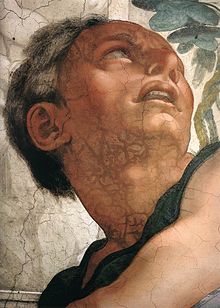
 Michelangelo's Jonah, from
the Sistine Chapel
A Looking-Glass for London and England is an adaptation of the Book of Jonah from the Old Testament. The Bible relates that Jonah was summoned by God to go to the debauched city of Nineveh to preach against its sins. Jonah refused and sailed for Tharsus instead, but was thrown overboard in a storm and swallowed by a whale. Belched out after three days, Jonah accedes to the will of God and goes to Nineveh, where he warns the people that God will destroy their city if they do not reform. He successfully persuades them to be penitent for their sins. Jonah then climbs a mountain to watch the city from afar and see whether or not God will destroy it; as he waits, he becomes angry when a vine sheltering him from the sun is killed by a worm; God then teaches him a moral about mercy, noting that Jonah is more upset about the destruction of a vine than he is about the destruction of Nineveh.

In adapting this story, Greene and Lodge broaden the scope of the Biblical text (which is short and focused almost entirely on Jonah's experience) to create a spectacular depiction of the inhabitants of this city of sin, repeatedly drawing attention to its parallels with London. The play features a range of impressive special effects, and I've quoted a number of its wonderful stage directions in the summary below.

The story and the spectacle


A Looking-Glass for London and England is set in the city of Nineveh, a disgusting sink of vice and sin. To it, an angel brings the prophet Hosea who is "set down over the stage in a throne", from which he watches and comments on the entire action of the play, occasionally pointing out to the audience its relevance to modern England ("London, take heed, these sins abound in thee!").
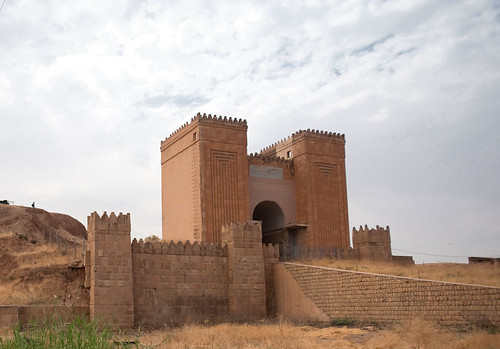

Nineveh
The sins of Nineveh, and God's repeated warnings to its people, are depicted at all levels of society. The king, Rasni, is an egomaniac who revels in pomp and luxury and wants to marry his own sister, but when she is blasted by a lightning bolt ("he finds her strucken with thunder, black"), Rasni ignores the warning and takes the lecherous murderess Alvida as his lover instead.

Rasni's flattering adviser, Radagon, is so ambitious that he refuses to help his own family, who are starving because a usurer has cheated them. Radagon's mother curses him, and "a flame of fire appeareth from beneath and Radagon is swallowed". But the court of Nineveh still doesn't take the hint, dismissing it as a natural phenomenon.

Meanwhile, among the underclass, Adam the clown (presumably played by the comic actor Will Kemp) is a smith's man who is found drunk next to a corpse (killed by someone else in a drunken quarrel). Fortunately for him, King Rasni considers crimes committed by drunks to be unworthy of interest and takes no action.

That's the kind of thing that goes on in Nineveh every day, so something needs to be done! In the middle of the play, an angel tells Jonah to go to Nineveh and preach against its sinfulness. Jonah refuses and instead takes ship to Tharsus.

Jonah and the Whale by Pieter Lastman (1621)
At this point, the playwrights are faced with the challenge of dramatizing the 'Jonah and the Whale' story. Here's how they do it. First, we see a group of sailors describing how, when a storm blew up, Jonah recognised God's anger and had himself thrown overboard. Then we see "Jonah the prophet cast out of the whale's belly upon the stage" whereupon he describes his cetacean adventures in a long speech. Presumably the "whale's belly" was represented by the large central opening in the theatre facade (the 'discovery space'). It's possible that the players used the 'hell-mouth' (a hideous mouth-shaped prop used to represent the entrance to Hell in Dr Faustus) to serve as the whale's mouth.

When Jonah arrives in Nineveh and prophesies its destruction, King Rasni orders forty days of penance and the entire city fasts and dons sackcloth.  Adam doesn't obey the order to fast, and is taken away to be hanged.

Maarten van Heemskerck, Jonah
Contemplates Nineveh (1566)
We then get a dramatization of the tale of Jonah and the vine on the mountain-top. Afterward, Jonah returns to the city and tells King Rasni of God's mercy. Rasni reforms, and Nineveh becomes a virtuous and holy city; Radagon's family is saved from poverty when the evil usurer repents.

At the end of the play, Jonah informs the audience that London too must repent. While he's about it, he manages to praise Queen Elizabeth and bash Catholicism too:

Oh turn, oh turn, with weeping to the Lord,
And think the prayers and virtues of thy Queen
Defers the plague which otherwise would fall.
Repent, oh London, lest for thine offence
Thy shepherd fail (whom mighty god preserve
That she may bide the pillar of His church
Against the storms of Romish Antichrist!).
The hand of mercy overshade her head
And let all faithful subjects say 'Amen'.

If you would like to read A Looking-Glass for London and England, there are old-spelling editions with useful introductions by J. Churton Collins' (in The Plays and Poems of Robert Greene, 1905)  or by George Allan Clugston (published by Garland in 1980).

What we learn from this


A Looking-Glass for London and England is more overtly moralistic than the other plays that we've seen so far. Looked at it in the context of the other plays we've seen, it feels rather hypocritical of the players to perform such a finger-wagging play so soon after the amoral bawdy fun of Bindo and Ricciardo and the complex religious satire of The Jew of Malta. And its dismal financial returns (a paltry 7 shillings, by far the worst box office of any play so far) implies that London did not want to be lectured about its sins.

When you think of this play being performed to a mostly empty theatre, its spectacular stage directions read rather sadly; populist effects such as lightning blasts, firey deaths and whale's mouths may have felt rather hollow when deployed to entertain only a small huddle of spectators. When one adds the constant berating of the immorality of Londoners, one cannot help but feel that the atmosphere in the Rose this day may have been rather awkward and embarrassing.


FURTHER READING


A Looking-Glass for London and England information

  • The Plays and Poems of Robert Greene, ed. J. Churton Collins (Clarendon Press, 1905), 1:137-42.
  • Martin Wiggins, British Drama, 1533-1642: A Catalogue, vol. 2 (Oxford University Press, 2012), entry 829.
  • Sally-Beth MacLean and Lawrence Manley, Lord Strange's Men and their Plays (Yale University Press, 2014), 101-3.


Henslowe links


Comments?


Did I make a mistake? Do you have a question? Have you anything to add? Please post a comment below!

Monday, 7 March 2016

7 March, 1592 - Harry VI

Here's what Lord Strange's Men performed at the Rose playhouse on this day, 424 years ago...

Henslowe writes: R at hary vj the 7 of marche 1591 ... iijll

In modern English: Received at Harry VI, 7th March, 1592 ... £3


Today, Lord Strange's Men offered a repeat performance of their play called Harry VI, which  was almost certainly Shakespeare's First Part of Henry VI; to learn more, visit the blog entry for 3rd March.

1540s portrait of King
Henry VI
This revival of Harry VI is quite a surprise, as the play's first performance was only three days ago. Clearly, the company saw they had a hit on their hands and wanted to capitalize on it. Presumably they also wanted to get in some practice at performing the play, which was still new to the actors. The tactic seems to have been a successful one, as this performance made almost as much money as its premiere.

That's all I have to say today. Short posts like this one are about to become more frequent, as Lord Strange's Men begin to cycle through the plays in their repertory. But not yet! There are still new plays to learn about this week, so stay tuned!


Henslowe links


Comments?


Did I make a mistake? Do you have a question? Have you anything to add? Please post a comment below!

Sunday, 6 March 2016

6 March, 1592 - Four Plays in One

Here's what Lord Strange's Men performed at the Rose playhouse on this day, 424 years ago...

Henslowe writes: R at iiij playes in one the 6 of marche 1591 ... xxxjs vjd

In modern English: Received at Four Plays in One, 6th March 1592 ... 31 shillings and sixpence.
Four Plays in One is another lost play and we know almost nothing about it, except that it was ... four plays in one. It must have been a collection of one-act plays, perhaps linked by some kind of narrative device, and there are several examples of these in the period. There are lost Elizabethan plays called Three Plays in One and Five Plays in One. Thomas Middleton's one-act Yorkshire Tragedy (1607) was once part of an otherwise lost Four Plays in One. John Fletcher and his team wrote Four Plays, or Moral Representations, in One around 1614. But these Jacobean examples are not the lost Elizabethan play.

Unfortunately that's all I can tell you. It was four plays in one. Not five plays. Not three plays. But four plays. In one! Bargain!

FURTHER READING


Four Plays in One information


Henslowe links


Comments?


Did I make a mistake? Do you have a question? Have you anything to add? Please post a comment below!