Here's what
Lord Strange's Men performed at the
Rose playhouse on this day, 424 years ago...
Henslowe writes: R at brandymer the 6 of aprell 1591 ... xxijs
In modern English: Received at Brandimer, 6th April, 1592 ... 22 shillings
For the last two weeks, Lord Strange's Men have been cycling through their most popular plays. But today, they have decided to try something different: a play called
Brandimer. Henslowe doesn't label it as "new", so the company was presumably blowing the dust off an old play from the archives. Unfortunately,
Brandimer is lost and its subject matter is uncertain. However, two possible explanations for its title have been proposed, both of which could have produced thrilling stage material. So let's explore these two theories...
Brandimart?
In his 1904 study of Henslowe's Diary, W.W. Greg suggested that
Brandimer was about
Brandimart (or Brandimarte), a character in Ludovico Ariosto's epic poem
Orlando Furioso. The repertory of Lord Strange's Men already included Robert Greene's
stage adaptation of that poem, which the company had performed back in February, so perhaps
Brandimer was some kind of companion play?
One complication is that the character of Brandimart is extremely different in the poem and the play. In Ariosto's poem, Brandimart is one of a team of heroes who aids Orlando in his adventures; he performs heroic actions at the siege of Biserta, and is later killed when Orlando and company fight North African warriors on the island of Lampedusa. By contrast, in Greene's extremely loose stage adaptation, Brandimart is a villain, a rival suitor to Angelica who is killed by the mad Orlando halfway through the play. If
Brandimer was about Brandimart, which Brandimart was portrayed? Was the plot simply inconsistent with Greene's play, or did the playwright invent a largely non-Ariostoan prequel to Greene's?
There are certainly lot of reasons to believe the play was about Brandimart. The existence of Greene's play in the company's repertory makes a connection with
Orlando Furioso seem obvious. And even if the lost play was based more on Ariosto than Greene, the battles against Islamic foes in the poem would fit with common themes in the plays of Lord Strange's Men. The only snag is that Brandimart is not a particularly distinctive or important character in either the poem or in Greene's play, so that it is hard to imagine why an entire play might have been named after him.
Brandimore?
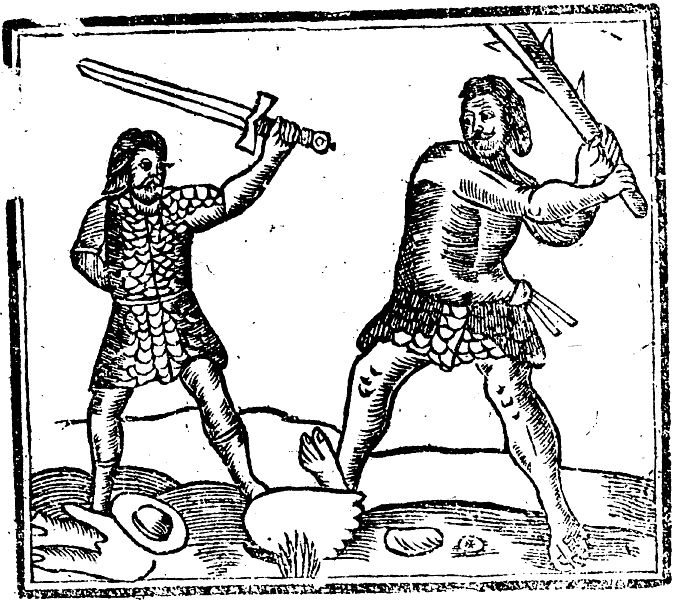 |
Guy of Warwick fighting the giant Colbrand,
from The History of the Famous Exploits
of Guy, Earl of Warwick (1680) |
A leftfield but equally convincing theory is proposed by Martin Wiggins, who points to the legend of Guy of Warwick, a folk hero whose adventures were retold many times in medieval and Renaissance England on the page, on stage, and in song. In the many tales associated with him, Guy battles enemies and vanquishes monsters in order to
prove himself to the woman he loves. And in a 1612 ballad entitled
Saint George's Commendation to all Soldiers, Guy kills a giant named Brandimore. Could
Brandimer have been a play about Guy of Warwick, with a memorable scene of the slaying of Brandimore?
The ballad in question is a yobbishly patriotic effort that probably
sounds better after four pints of lager. Each verse describes the
adventures of various warrior heroes from history and myth before
concluding "St George for England, St Denis for France / Honi soit qui
mal y pense!" One verse goes as follows:
The noble Earl of Warwick, that was called Sir Guy,
The infidels and pagans much did he defy,
He slew the giant Brandimore, and after was the death
Of that most ghastly dun-cow, the Devil of Dunsmore Heath,
Besides his noble deeds done beyond the seas.
St George, St George, the dragon did appease,
St George for England, St Denis for France,
Honi soit qui mal y pense!
Wiggins points out that many of the other heroes mentioned in the ballad appear in plays performed at Henslowe's playhouses, including
Orlando,
Godfrey of Bouillon,
Sir John Mandeville, and several others that we will meet later in the year. So, if you wanted to speculate wildly, you could propose that the ballad-maker was conjuring memories of plays performed back in the days of Good Queen Bess. If so, as Wiggins suggests, the ballad verse might record what happened in the play: the slaying of Brandimore, adventures beyond the seas during the Crusades, and Guy's most famous deed, the vanquishing of the monstrous Dun Cow (an escaped giant cow who caused mayhem on
Dunsmore Heath, near Warwick).
[
Update, 19/4/16 - Reader Matthew Steggle helpfully comments that there's a more detailed description of Guy of Warwick fighting "the giant Brandamore" in the popular prose work
The Famous History of the Seven Champions of Christendom by Richard Johnson, first published in 1616. In it, Guy is one of a team of knights attacked by three giants, including Brandamore, "a mishapen
Fiend, whose bulk is
a weight too heavy for the Earth to bear". Guy punches Brandamore so hard "that he tumbled
backwards
over the dead carcasses of two or three slaughtered
soldiers", but eventually, it is another knight who kills Brandamore after the latter "through
the weight of his armour, and the hotness of the
weather, sweat so abundantly that it ran
into his eyes and quite blinded
him". Incidentally, searching for 'Brandamore' in
Early English Books Online also brings up a
Dialogue between the Two Giants in Guildhall, Colebrond and
Brandamore, Concerning the Late Election of Citizens to Serve in
Parliament for the City of London (1661)!
The Guildhall giants are normally associated with Gog and Magog, however. It's all rather intriguing, and an enthusiastic researcher could probably discover a lot more about the giant Brandamore in early modern English culture.]
This theory is very tempting, but could a fight with a giant really be performed onstage? Yes it could. A 1590s play about
Guy of Warwick does exist, and it does indeed include a sequence in which Guy fights a giant. The giant is called Colbron, so this play can't be the hypothetical
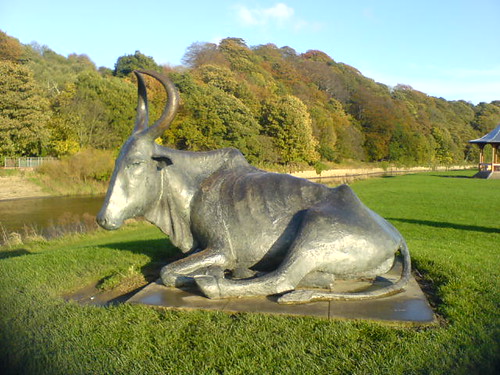
Brandimore, but it does suggest that such a scene was not impossible. As for the slaying of the Dun Cow, though, I'm not so sure... in the surviving play, a character merely reminisces about "the wild cow slaughtered / That kept such revels upon Dunsmore Heath".
Which was it?
Both of these theories have their strong points. But I'm going to plump for
Brandimore, for reasons that are entirely frivolous: for me, the possibility - however slight - that a play might have featured a warrior battling a giant cow onstage is so entertaining that I have resolved to believe in it, no matter what.
FURTHER READING
Brandimer information
- W.W. Greg, Henslowe's Diary, Part 2: Commentary (A.H. Bullen, 1908), 155.
- Helen Moore, ed. Guy of Warwick 1661, The Malone Society Reprints 170 (Manchester University Press, 2007)
- Martin Wiggins, British Drama, 1533-1642: A Catalogue, vol. 3 (Oxford University Press, 2013), entry 897.
Henslowe links
Comments?
Did I make a mistake? Do you have a question? Have you anything to add? Please post a comment below!

