Henslowe writes: R at bendo & Richardo the 4 of Marche 1591 ... xvjs
In modern English: Received at Bindo and Ricciardo, 4th March, 1592 ... 16 shillings.
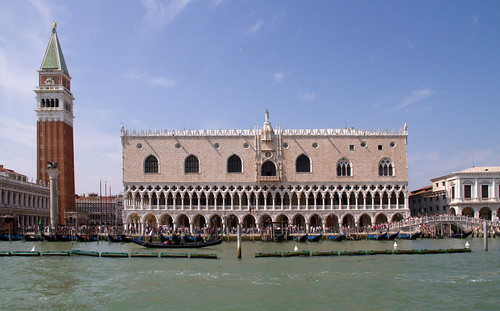
Today, Lord Strange's Men performed Bindo and Ricciardo. The play is lost but we can guess at its content because it was presumably based on the old Italian tale about the architect Bindo and his son Ricciardo. The playwright most likely read it in William Painter's The Palace of Pleasure (1566), an anthology often used by Renaissance dramatists looking for stories. Here follows the story, but I should warn you that it is completely bonkers.
The tale of Bindo and Ricciardo
In 'Novel 48' of William Painter's Palace of Pleasure, Bindo the architect builds a treasure-house for the Duke of Venice. But he incorporates a secret tunnel into the design, and, after the building is completed, he and his son Ricciardo sneak in at night and steal an expensive cup. The Duke notices the theft and installs a trap. When Bindo and Ricciardo break in a second time, Bindo falls into a boiling cauldron. With his dying breath, he tells Ricciardo to cut off his head and bury it to conceal his body's identity and thus prevent the Duke from knowing that Ricciardo was involved.
The rest of the story is about the Duke's attempts to identify the dead thief and entrap his accomplice. At first, the Duke's methods are fairly sensible; he parades the headless corpse around Venice in the hope that the thief's family will be unable to restrain themselves from lamenting. This almost works, because Bindo's widow is distraught, but by devious stratagems Ricciardo manages to silence her.
Veal: tempting to the lickerous.
Then things get weird. The Duke believes that thieves are unusually 'lickerous' (a new word that I've now learned, which means fond of fine food). So he bans the sale of fresh meat in Venice for twenty days, and then arranges to have an exceptionally good quality piece of veal sold in the markets for an outrageous price. His logic is that since thieves are lickerous, the cup-thief will be the only person in Venice who will pay the ridiculous price for the veal, and his identity will thus be revealed. I am not sure that this logic would stand up in court. But anyway, Ricciardo manages, by another devious stratagem, to obtain some of the veal without paying for it, so the Duke's cunning plan is foiled.
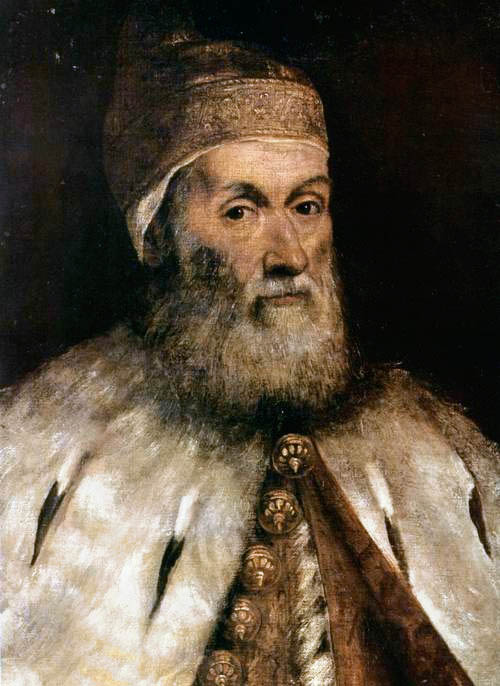
Girulamo Priuli, Doge of Venice in
1566. He was probably not as silly as the Duke in the story.
The Duke now comes up with a plan so crazy that I can't believe I'm writing it. He believes that lickerous people must be exceptionally lecherous. So he invites 25 of the most notorious lechers in Venice - including Ricciardo - to sleep over at his palace, each in a room which has access to the bedroom of his beautiful daughter - but he warns them that if they get into bed with her, she will mark them with ink. He's banking on the cup-thief being so naturally lecherous that he won't be able to restrain himself and will thus be marked by the daughter and finally identified. This is a very, very silly plan, if you ask me, and its logical flaws are vast and stupefying.
But it almost works. Ricciardo, presumably driven by his lickerous lecherousness, is indeed unable to restrain himself from sneaking into the daughter's bedroom, and "accomplishe[s] the thing he came for" (the daughter's opinion about this is not mentioned, incidentally...). But back in his room, he realizes that she has marked his face with ink. So Ricciardo devises another plan. He returns, steals the ink, and sneaks into the rooms of the sleeping lechers, marking them all with multiple spots of ink. Next morning, when the Duke sees the many-spotted lechers, he realizes that there is no way of identifying the culprit.
But instead of being angry, the Duke laughs and offers a pardon to the culprit, and when Ricciardo confesses that it was he, the Duke allows him to marry his daughter. And so, "Ricciardo, encouraged, proved a very stout and valiant man
in such wise almost as the affairs of the whole state passed through
his hands, and lived a long time after with the love and goodwill
of the whole commonality of Venice."
I'm not sure what the moral of this tale is, beyond "don't get caught". And it's hard to know exactly how the playwright might have adapted this bawdy tale to to the stage. At this time, anti-theatricalist pamphleteers were railing against the immorality of the stage. It's easy to see why, if plays like Bindo and Ricciardo were common.
What's next?
There will be no post tomorrow, because 5th March was a Sunday in 1592 and the players did not perform. Henslowe's Diary ... as a Blog! will thus return on 6th March.
Henslowe writes: ne ... R at harey the vj the 3 of marche 1591 ... iijll xvjs 8d
In modern English: New. Received at Harry VI, 3rd March 1592 ... £3, 16 shillings and eightpence.
Today, we have the first appearance of William Shakespeare in Henslowe's Diary! Well, sort of. The extent to which Shakespeare was actually involved in Harry VI is unclear, but this entry sheds some interesting light on his early career successes.
There are a couple of things to say about what Henslowe wrote today. First, notice that he writes "ne" next to the entry. Henslowe will add these letters to a few other plays in the future, and scholars have determined that he probably means "new"; in other words, he's noting the first performance of a new play. Secondly, you can see that London's theatregoers were very excited about this new play called Harry VI, because Henslowe achieved his best box office so far. There are twenty shillings in a pound, so he made 75 shillings today, far more than the 50 he made with The Jew of Malta a few days ago).
So, what was this instant blockbuster called Harry VI? It was almost certainly the play we know today as Shakespeare's The First Part of Henry VI (most likely written in collaboration with others). To understand how we know this, it's easiest to begin by looking at the story of Shakespeare's play and then at the evidence connecting it with Harry VI.
What happens in The First Part of Henry VI...
1540s portrait of King Henry VI
The First Part of Henry VI is set in the 15th century, in the aftermath of the early death of the heroic King Henry V, and the coronation of his son, a mere child, as Henry VI.
England is losing its lands in France to a rebellion. The French army is aided by Joan of Arc (called Joan la Pucelle in the play), who is presented as a sinister, witch-like figure who can conjure devils. But the English have their own weapon of mass destruction: the great warrior Lord Talbot, who triumphs at Orléans and Rouen.
Meanwhile, civil war is brewing in England, emerging out of a quarrel between Richard, Duke of York, and the Duke of Somerset. The two factions show their allegiance by choosing red or white roses from a bush. The tensions undermine Talbot's successes in France when rivalry between York and Somerset causes reinforcements to be delayed and Talbot to be killed in battle at Bordeaux.
Joan at the stake; detail from Vigiles du roi Charles VII (1484)
The play ends with uneasy optimism: Joan is captured and Richard has her burned at the stake; and the French and English agree to forge peace by marrying King Henry to a Frenchwoman. The Earl of Suffolk has captured Margaret of Anjou, a French noblewoman, and persuades Henry to marry her.
But Suffolk, who has fallen in love with Margaret, is not trustworthy: in the play's last lines, he tells the audience,
Margaret shall now be queen, and rule the king:
But I will rule both her, the king, and realm.
And on this cliffhanger ending, the play seems designed to make us want to see The Second Part of King Henry VI...
Is Harry VI another name for Shakespeare's The First Part of Henry VI?
The evidence for Harry VI being Shakespeare's play is pretty strong. In his 1592 book Piers Penniless's Supplication to the Devil, Thomas Nashe described the popular success of a patriotic play featuring Lord Talbot:
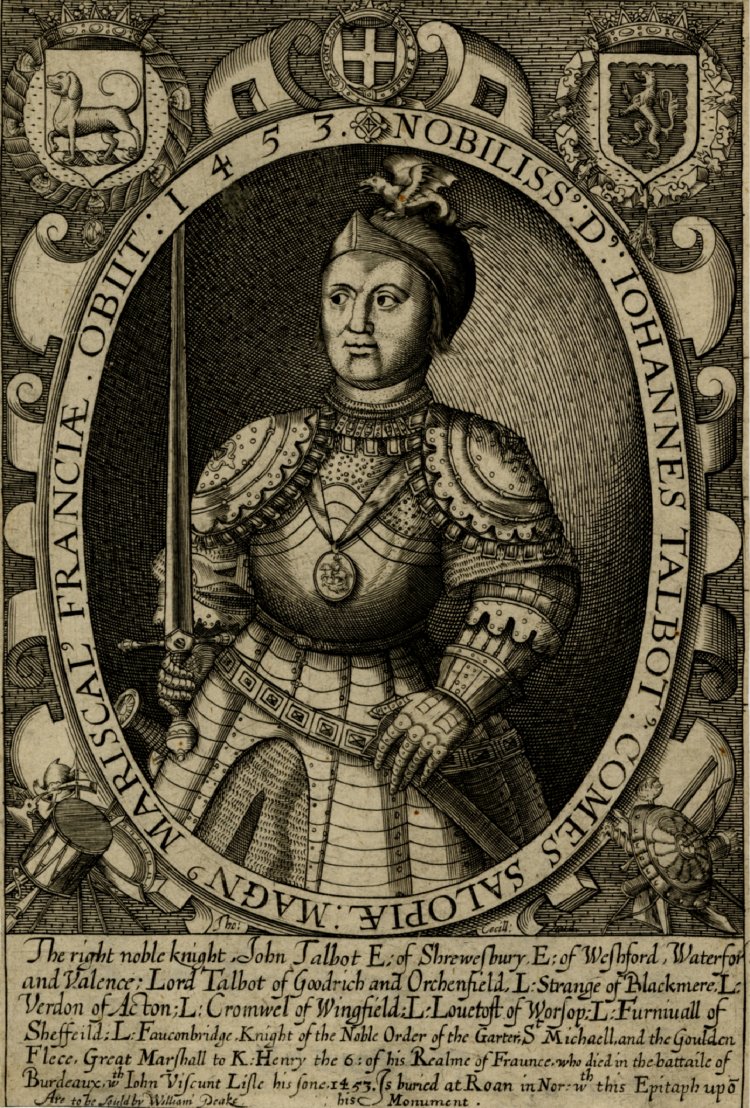
How would it have joyed brave Talbot, the terror of the French, to think that after he had lain two hundred years in his tomb, he should triumph again on the stage and have his bones new-embalmed with the tears of 10,000 spectators at least (at several times), who, in the tragedian that represents his person, imagine they behold him fresh bleeding.
Imaginary portrait of Talbot
by Thomas Cecil, c.1626-32
The play Nashe describes featured the triumphs and death of the famous Lord Talbot, just as Shakespeare's play does. And the apparent popularity of this play (with its "ten thousand spectators") fits with the box office receipts of Harry VI. Furthermore, Nashe's book is dedicated to Lord Strange - the patron of the company that performed Harry VI - and in it he praises the company's leading actor, Edward Alleyn.All of this suggests that Nashe is describing the Harry VI of Lord Strange's Men and that Harry VI has survived under the title The First Part of Henry VI.
That much is clear. More confusing is the play's relationship with the Second and Third parts; here we need to take things more slowly...
What exactly is The First Part of Henry VI?
The Second Part in the 1623 First Folio
1. In 1623, the first ever collected works of Shakespeare (the 'First Folio') was published. In it are three plays about the Wars of the Roses, entitled The First Part of Henry VI, The Second Part of Henry VI, and The Third Part of Henry VI. They are among Shakespeare's earliest plays. Along with his Tragedy of King Richard III they form a 'tetralogy' (a linked series of four plays).
The Second Part, published
in 1594 as The First Part of the Contention
2. But the Henry VI plays didn't always have those titles. In 1594, a version of The Second Part was printed under the title The First Part of the Contention betwixt the Two Famous Houses of York and Lancaster. And in 1595, a version of The Third Part was printed under the title The True Tragedy of Richard, Duke of York, and the Death of Good King Henry VI, with the Whole Contention between the Two Houses, Lancaster and York. These titles imply that in the 1590s, the Second and Third parts were thought of as a two-parter. And those two plays never refer back to the events of The First Part. So why does The First Part (which was never printed before 1623) even exist? 3. Another weird thing is that a 1592 book called Greene's Groatsworth of Wit alludes to The Third Part as if it was so well-known that readers were expected to recognize specific lines from it. If The Third Part was already well-known in 1592, why was TheFirst Part described by Henslowe in that year as "new"?
4. Because of all this, the general consensus among scholars is that Part One was written after the other two; it was a 'prequel' about the backstory of the already popular First Part of the Contention and True Tragedy of Richard Duke of York. The plays were then renamed the First, Second and Third partslater.
Choosing the Red and White Roses
by Henry Payne (1908)
5. That's why The First Part seems so detached from the other two. Indeed, it might not even have been written for the same company, because The First Part of the Contention and True Tragedy of Richard Duke of York never appear in Henslowe's Diary. One theory is that Lord Strange's Men observed the success of a rival company performing Shakespeare's two-parter about Henry VI's reign, and decided to piggyback on its popularity by creating their own prequel; later, Shakespeare's company acquired the play and the three plays were finally performed together. (That's only one of several alternative theories, but it gives you a sense of how complicated the background of this play may have been.)
6. But what of Shakespeare? Many modern scholars think Shakespeare didn't actually write much of TheFirst Part (different styles are detectable within it, and collaborative authorship was very common at the time) and there is a complex debate ongoing about exactly how much Shakespeare wrote and who his co-authors were. Does this mean that Strange's Men hired Shakespeare and others to quickly put together a prequel to his own work? Or perhaps Shakespeare had nothing to do with the original Harry VI and what we read today is a version that he reworked once his own company had got hold of it? Again, there are many theories.
If you've read this far and are still interested, I recommend the detailed reassessment of the evidence in Sally-Beth MacLean and Lawrence Manley's book (cited below). However, you may well feel by this point that the play's the thing and you no longer care when it was made and by whom! So, let's look instead at...
The play today
As we have seen, The First Part of Henry VI was extremely popular when it was first performed at the Rose (and would continue to be so for some time); we can speculate that Edward Alleyn was at his barnstorming best as the warrior Talbot, and we could even speculate that the demonic Joan of Arc was an attempt at recycling the fun of the demonic Pope Joan in the play performed two days previously.
For modern audiences and theatre practitioners, however, The First Part is much less appealing, and is rarely staged. It's easy to see why: the plot is episodic, and some of the writing is bland. As a result, The First Part is almost never performed by itself and is seen only on those rare occasions when ambitious theatre companies perform the entire trilogy (or the entire tetralogy including Richard III). If you'd like to look at images from different productions, the Designing Shakespeare website from Royal Holloway University is a great way of doing so. And look out for Kings of War, an upcoming postmodern adaptation by the amazing Toneelgroep Amsterdam.
Brenda Blethyn as Joan of Arc in the BBC Shakespeare film of The First Part of Henry VI (1981)
But even when it's performed within the trilogy, The First Part is often condensed or rearranged. This is evident in the few available film versions, all of which have been made for TV. The 1960 BBC series An Age of Kingscondensed the play into a 1-hour episode. The RSC's Wars of the Roses series, filmed by the BBC in 1965, shrunk it into two 50-minute episodes. [Update 7/5/16: the BBC's 2016 Hollow Crownadaptation is equally truncated.] The only (almost) uncut version is the 1981 TV film for the BBC Shakespeare series, directed by Jane Howell; a low-budget production with a deliberately artificial aesthetic, it offers the only opportunity most people will have to see The First Part of Henry VI in its entirety.
What we learn from this
One thing that the success of Harry VI demonstrates is that Elizabethan audiences liked prequels. We've already seen some possible prequels in Henslowe's Diary: Muly Moloccomay have been a prequel to The Battle of Alcazar, and The Spanish Comedymay have been a prequel to The Spanish Tragedy.
Prequels remain popular today, of course, as we, like the Elizabethans, desire to see what happened to the characters we enjoy before they became the characters we enjoy. It's a shame that the most famous modern examples - George Lucas's godawful prequels to the Star Wars trilogy - are as aesthetically problematic as TheFirst Part of Henry VI. But even those films manage to send occasional shivers down the spines of those who love the original works, as our knowledge of what the characters will become colours our experience of watching their formation...
A great example in The First Part of Henry VI is the penultimate scene, in which the Earl of Suffolk captures Lady Margaret. In Shakespeare's Second and Third parts, and in his Richard III, Margaret is an extraordinary character, the dynamic and powerful "she-wolf of France" who contrasts with the quiescent King Henry, and who ultimately becomes a vengeful widow spitting fury at the usurping Richard. The audience at the Rose would have been very familiar with this character, so when Margaret appears in The First Part as a fairly ordinary young noblewoman who nonetheless shows flashes of wit and strength, the audience might get a vertiginous thrill as they imagine the future that the character is as yet unaware of. And they will know that Suffolk's smug belief in his dominance over Margaret will prove horribly misguided.
FURTHER READING
Information on The First Part of Henry VI
Edward Burns, ed. King Henry VI, Part 1. The Arden Shakespeare (Thomson, 2000), 67-90.
Michael Taylor, ed. Henry VI, Part One. The Oxford Shakespeare (Oxford University, Press, 2005), 1-14.
Carol Chillington Rutter and Stuart Hampton-Reeves, Shakespeare in Production: The Henry VI Plays (Manchester University Press, 2009)
Martin Wiggins, British Drama, 1533-1642: A Catalogue, vol. 3 (Oxford University Press, 2013), entry 919.
Sally-Beth MacLean and Lawrence Manley, Lord Strange's Men and their Plays (Yale University Press, 2014), 96-99 and chapter 9.
Henslowe writes: R at matchavell the 2 of marche 1591 ... xiiijs
In modern English: Received at Machiavel, 2nd March, 1592 ... 14 shillings.
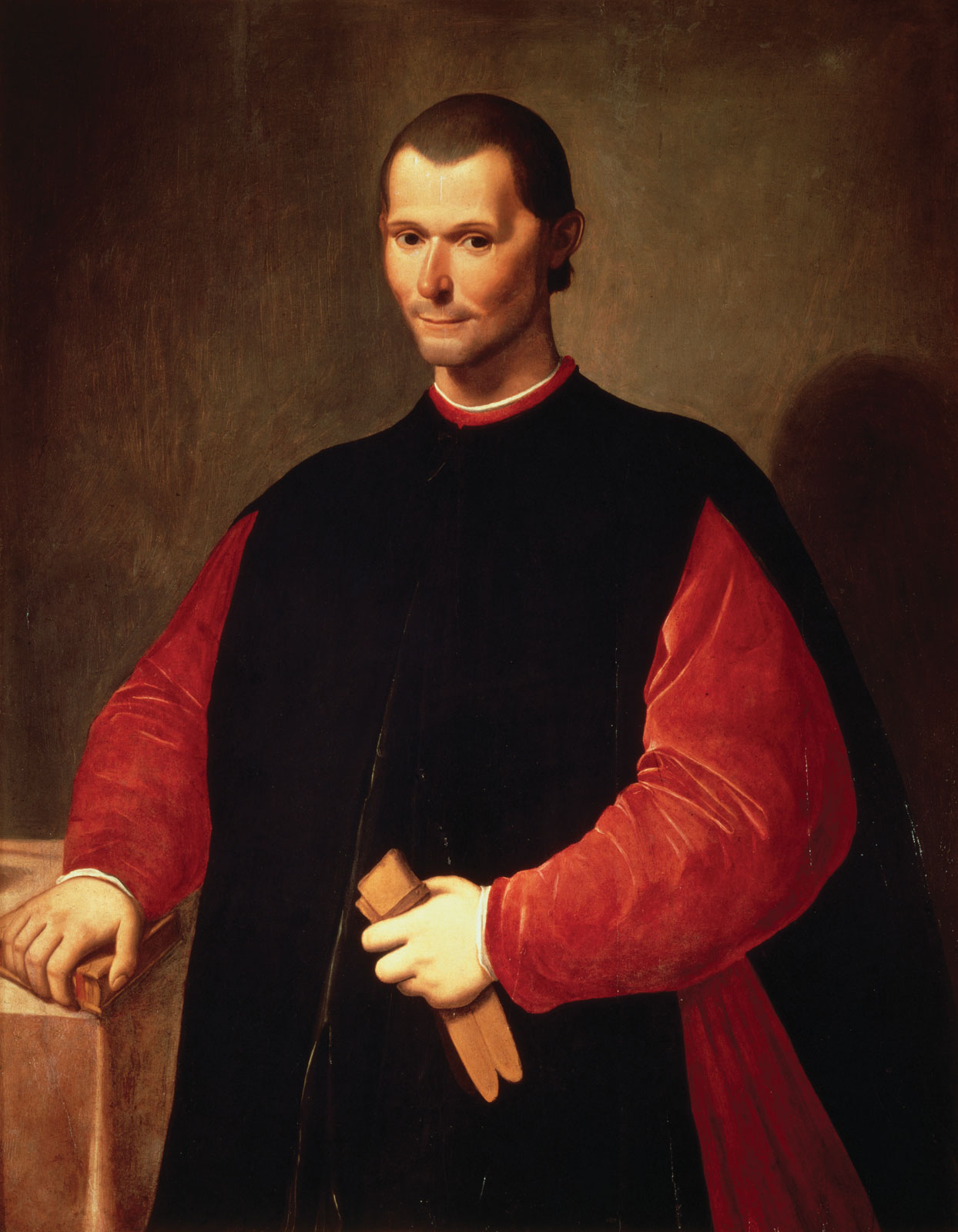
Niccolò Machiavelli, the
original machiavel.
Today, Lord Strange's Men performed Machiavel, another lost play. The term 'machiavel' derives from the Florentine political theorist Niccolò Machiavelli, and refers to a manipulative character who devises stratagems to advance themselves. Unfortunately, this information is not very informative about the play, since machiavels are extremely common in Elizabethan dramaand indeed appear in many plays performed by Strange's Men: examples we've looked at include Sacrapante in Orlando Furioso, Lorenzo in The First Part of Hieronimo, and both Barabas and Ferneze in The Jew of Malta (Machiavelli himself even speaks the prologue of the latter play).
All we can therefore say is that this was yet another play about a machiavel, and we learn that ... audiences liked machiavels. Indeed, they still do...
FURTHER READING
Machiavel information
Martin Wiggins, British Drama, 1533-1642: A Catalogue, vol. 3 (Oxford University Press, 2013), entry 899.
Henslowe writes: R at poope Jone the 1 of marche 1591 ... xvs
In modern English: Received at Pope Joan, 1st March 1592 ... 15 shillings
Today, Lord Strange's Men performed a play called Pope Joan. It did not take much at the box office and this is the only record of its performance, so it was probably an old play at the end of its stage life. The play has not survived the passage of time, which is unfortunate, because it would be fascinating to see how an Elizabethan playwright approached the tale of Pope Joan.
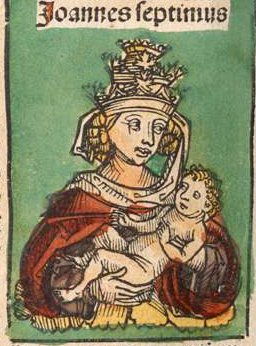
In the Pope Joan legend, a 9th century Englishwoman disguises herself as a man in order to conceal her romantic relationship with a monk. In Athens, she becomes known for her great learning, and after her lover dies, she continues in her disguise to Rome, where she is eventually elected Pope. But she has an affair and becomes pregnant. She conceals the pregnancy but is unmasked when she gives birth during a religious procession. Depending on the legend, she either dies in childbirth or is stoned to death by the horrified crowd. The church hastily excommunicates her, buries her in unconsecrated ground, and tries to remove her name from the historical record.
Pope Joan gives birth in public (from a 1539 edition of Boccaccio's On Famous Women)
The story is well-known and is still told today; for example here's a trailer for a 2009 German film:
This trailer captures the dramatic potential of the tale for modern audiences, but it's unlikely that an Elizabethan play would have been so sympathetic toward Joan. Craig M. Rustici's research shows that she was always represented in a negative light in Renaissance England, and he speculates that the play would have presented her as a "corrupt villainess", perhaps counselled by demons. Joan's tale was often utilised by anti-Catholic writers to undermine faith in the wisdom of the church and in the unbroken line of Papal succession; the play may, then, have been performed as a satire on the Catholic church, although Rustici adds that its depiction of a woman in a position of power could also have been covert satire on Queen Elizabeth I.
Pope Joan illustrated in the Nuremberg Chronicle (1493)
Still, dramatic performance may arouse more complex responses than prose propaganda can, and one cannot help wondering what the central performance (presumably by a talented boy actor rather than Edward Alleyn) was like. If Joan was presented as demonic or as a source of carnivalesque chaos, she might have been a theatrically exciting and entertaining character - a female Barabas, perhaps? Could Pope Joan be one of the great lost female roles in Elizabethan drama?
FURTHER READING
Pope Joan information
Craig M. Rustici, The Afterlife of Pope Joan: Deploying the Popess Legend in Early Modern England (University of Michigan Press, 2006), ch. 2.
Martin Wiggins, British Drama, 1533-1642: A Catalogue, vol. 3 (Oxford University Press, 2013), entry 894.
Sally-Beth MacLean and Lawrence Manley, Lord Strange's Men and their Plays (Yale University Press, 2014), 144-7.
Henslowe writes: R at mvlamvlluco the 29 of febrearye 1591 ... xxxiiijs
In modern English: Received at Muly Molocco, 29th February, 1592 ... 34 shillings
Today, for the first time since Henslowe's records began, Lord Strange's Men returned to a play that they had already staged. They chose to stage Muly Molocco again, which they had last performed just over a week ago.
1629 Portuguese illustration of the Battle of Alcazar
Muly Molocco was about Abd el-Malik's struggle for the throne of Morocco; you can read more about it in the blog entry for 21st February. The play had clearly increased in popularity, because Henslowe received 34 shillings this time, compared to 29 last time.
I wonder how many audience members were seeing Muly Molocco for the first time, based on word of mouth, and how many were seeing it again because they loved it? Questions like these are impossible to answer, but, as someone who has seen Star Wars: The Force Awakens four times, I cannot help but wonder whether Elizabethan audiences took similar pleasure in repetition...
That's all I have to say. Short posts like this one will appear with increasing frequency from now on, as Lord Strange's Men begin to cycle through the plays in their repertory. But not yet! There will be plenty more new plays to learn about this week, so stay tuned!
Henslowe writes: R at clorys & orgasto the 28 febreary 1591 ... xviijs
In modern English: Received at Cloris and Ergasto, 28th February, 1592 ... 18 shillings.
Cloris and Ergasto is another lost play. And it is the first play in Henslowe's list of performances about which we know almost nothing.
Pastoral Concert by Titian or Giorgione, 1509
In his catalogue of British drama, Martin Wiggins observes that the names Cloris and Ergasto both appear in pastoral literature (a genre set in a utopian vision of the countryside), but never appear together. We can speculate, therefore, that this play was some kind of romantic tale involving shepherds. But beyond that, Cloris and Ergasto is a complete mystery.
The genre of pastoral is quite different from the other plays we've seen Lord Strange's Men perform, which have tended to revolve around violent adventures and tragedy. Perhaps Cloris and Ergasto is a sign that the company had a wider range.
I'm sorry that I can't say any more than this. To make up for it, here is a happy video of a shepherd and his sheep:
FURTHER READING
Cloris and Ergasto information
Martin Wiggins, British Drama, 1533-1642: A Catalogue, vol. 3 (Oxford University Press, 2013), entry 878.
Henslowe writes: R at the Jewe of malltuse the 26 of febrearye 1591 ... ls
In modern English: Received at The Jew of Malta, 26th February 1592 ... 50 shillings
Finally, we are looking at a play that has stood the rest of time! Christopher Marlowe's The Jew of Malta is still occasionally performed today, so it's fun to begin with a trailer for the (now closed) RSC production of 2015, which starred Jasper Britton and was directed by Justin Audibert. It's a useful introduction to the play, although I would disagree with the interviewed audience member who labels it "Wolf Hall with knobs on"; it really isn't.
The Jew of Malta was clearly a crowd-pleaser at the Globe in 1592: it made 50 shillings today, almost twice what Harry of Cornwall made yesterday, and way more than some of those plays earlier in the week which only made 15 or so shillings. No doubt this was due in part to Edward Alleyn's performance as the enjoyably villainous Barabas. But the play isn't just fun - it's a comic tragedy with a sophisticated and subversive attitude toward its subject matter.
The play opens with an prologue spoken by the ghost of Niccolò Machiavelli, who boasts that his cunning followers are taking over the world, and sneers, "I count religion but a childish toy, / And hold there is no sin but ignorance".
Caravaggio's portrait of the Grand
Master of the Knights of Malta,
1607-8.
The island of Malta is ruled by the Catholic Knights of Malta, led by Governor Ferneze. They confiscate the money of the island's Jews in order to pay a tribute to the threatening Turks. When one of the Jews, Barabas, objects, they confiscate all of his money and turn his house into a nunnery. Barabas's daughter, Abigail, fakes conversion to become a nun and find a stash of jewels hidden in the house. Meanwhile, Ferneze acquires Spanish military support and thus decides not to pay the Turks their tribute - and yet he also refuses to return the Jews' money. This fires Barabas with the desire for revenge. He buys a slave, Ithamore, who revels in villainy as much as he. And together they devise a series of outrageously cunning plots which result in Ferneze's son Lodowick and his friend duelling and killing one another; the entire nunnery being killed with poisoned porridge; and one monk strangled while another is framed for his murder.
By this point, you may find this plot summary disturbing, as the money-obsessed, sadistic Jewish villain sounds like the most noxious kind of anti-Semitic caricature. And on one level, the play does indeed originate in the stereotypical images that abounded in Elizabethan London. But what makes it more sophisticated than that - and thus still performable today - is that Barabas is no less evil and avaricious than the Christian rulers of Malta or the Muslim Turks, who are equally Machiavellian. As a result, the play instead comes across as a satire on hypocrisy in all religions, and on the human ability to use religion to justify crimes, rather than singling out one religion for special hatred. The 2015 RSC production was amazingly well-judged in the way it deftly navigated the religious, racial and political minefield that the play opens up (take a look at Peter Kirwan's review for a vivid description).
Edmund Kean as Barabas in 1818
The other thing that a plot summary can't capture is the wicked comedy that fills the play, despite its hideous events. The audience loves Barabas, as he repeatedly speaks directly to them in a conspiratorial manner, inviting them to be complicit in his crazy plans. He has deliciously nasty lines, such as "How sweet the bells ring now the nuns are dead!", and performs a gloriously sadistic speech about his violent hobbies:
As for myself, I walk abroad o'nights,
And kill sick people groaning under walls;
Sometimes I go about and poison wells.
[...] Being young, I studied physic, and began
To practice first on the Italian;
There I enriched the priest with burials
And always kept the sexton's arms in ure
With digging graves and ringing dead men's knells...
Having placed the audience on Barabas's side, Marlowe then presents us with his tragic (but still funny) doom. Barabas loses his daughter, who had loved the murdered Lodowick; she rejects her father by joining the nuns for real, only to die by his poisoned porridge. As Barabas progresses with increasingly devious plots, he is ultimately outwitted: he makes a deal with Ferneze to kill the leader of the invading Turks, but the governor is fooling him and it is Barabas who plunges into a boiling cauldron while the Christians and Muslims negotiate a wary peace.
The play's satirical tone, which emphasizes the way religion is used by all of the characters in a self-serving manner, means that the play's final lines, spoken by Governor Ferneze, are filled with irony:
So march away, and let due praise be given
Neither to Fate nor Fortune, but to Heaven.
If you would like to read The Jew of Malta, there are plenty of modern-spelling editions available in print.
What we learn from this
It's interesting to take a famous play like the The Jew of Malta, which we would normally think of as a work of art on its own terms, and see it instead as just one part of the repertory of Lord Strange's Men at the Rose.
In that context, it has a lot in common with the other plays we've seen so far. In particular, religious conflicts in the Mediterranean have been present, even if only as a backdrop, in John of Bordeaux, Muly Molocco, Orlando Furioso, and Sir John Mandeville, so that The Jew of Malta's setting and subject matter are not surprising. And the play is therefore an important reminder that the Rose productions were not always straightforward fun. In my descriptions of the plays I've tended to emphasize the spectacle, the patriotism, and the simple entertainment value. But The Jew of Malta is a brilliant and intelligent satire that was nonetheless extremely popular with its audience, so perhaps we should not automatically assume any of these plays to have produced merely straightforward responses.
What's next?
There will be no post tomorrow, because 27 February 1592 was a Sunday and the players did not perform. Henslowe's Diary will thus return on 28 February!
FURTHER READING
Jew of Malta information
Roma Gill, intro. to The Complete Works of Christopher Marlowe, Volume IV: The Jew of Malta (Clarendon Press, 1995)
Martin Wiggins, British Drama, 1533-1642: A Catalogue, vol. 2 (Oxford University Press, 2012), entry 828.
Sally-Beth MacLean and Lawrence Manley, Lord Strange's Men and their Plays (Yale University Press, 2014), 85-8.