Monday, 8 January 2018

8 January, 1594 - George a Greene

Here's what the Earl of Sussex's Men performed at the Rose playhouse on this day, 424 years ago...

Henslowe writes: R at the piner of wiackeffeld the 8 of Jenewary 1593 ... xxiijs 

In modern English: Received at The Pinner of Wakefield, 8th January 1594 ... 23 shillings


Fighting with staves, from a German fighting
manual published by Christian Egenolff
Today, Sussex's Men revived George a Greene, the Pinner of Wakefield. This is a festive comedy in which the eponymous northern folk hero helps the king, wins the hand of a fair maiden, and beats several opponents at stave-fighting. You can read more about this play in the entry for 28 December.

After the popularity of Friar Francis yesterday, the Rose receipts have returned to sluggishness again. However, despite this uneventful day, I encourage you to enjoy Henslowe's spelling of 'Wakefield' (see above), which is one of his masterpieces.


Henslowe links


Comments?


Did I make a mistake? Do you have a question? Have you anything to add? Please post a comment below!


Sunday, 7 January 2018

7 January, 1594 - Friar Francis

Here's what the Earl of Sussex's Men performed at the Rose playhouse on this day, 424 years ago...

Henslowe writes: R at frier frances the 7 of Jenewary 1593 ... iijll jds

In modern English: Received at Friar Francis, 7th January, 1594 ... £3 and 1 shilling


Today, Sussex's Men introduced another of their plays to the Rose audience. Friar Francis received very impressive box office despite the failure of William the Conqueror to do the same thing last week, and despite the Christmas holidays being over.

Friar Francis is a lost play, but we do possess some information about it from an unusual source. It seems that before the play was staged at the Rose, it had already achieved fame due to a curious incident during a performance in the Norfolk town of King's Lynn. Perhaps it was this notoriety that drew large crowds to the Rose today.


The legend of the King's Lynn performance


A legend of the performance of Friar Francis in King's Lynn was recounted many years later by the actor-playwright Thomas Heywood. In his book An Apology for Actors (1612), Heywood defends theatre against those who believed it to be sinful, arguing that plays can be morally improving. He uses as an example an event that "within these few years happened" during a performance of "the old history of Friar Francis" by Sussex's Men in King's Lynn.

A 1608 news pamphlet reporting a
murder; perhaps Friar Francis was
inspired by a true crime narrative
similar to this one.
According to Heywood, the play was about a woman who was haunted by the ghost of the husband she had murdered: "in her most solitary and private contemplations, in most horrid and fearful shapes, [it] appeared and stood before her". During the King's Lynn performance, a widow in the audience suddenly cried out "Oh my husband, my husband! I see the ghost of my husband fiercely threatening and menacing me!" When audience members "enquired the reason of her clamour", the widow confessed that she too had murdered her husband - and now, his "fearful image personated itself in the shape of that ghost" upon the stage! The woman was taken to court where she confessed her crime voluntarily.

Heywood insists that "this is true, as well by the report of the actors as the records of the town" and "there are many eyewitnesses of this accident yet living, vocally to confirm it". Historians have found no trace of any such records. But there is a record of a performance in the town by Sussex's Men in 1592, so at least some of Heywood's tale is based in truth.

Perhaps the story is a myth, or had gotten exaggerated in the retelling. But Heywood certainly didn't make it up, for it also appears in the anonymous play A Warning for Fair Women (printed in 1599), in which a character recounts the same tale:

A woman that had made away her husband,
And sitting to behold a tragedy,
At Lynn, a town in Norfolk,
Acted by players travelling that way,
Wherein a woman that had murdered hers
Was ever haunted with her husband's ghost,
The passion written by a feeling pen
And acted by a good Tragedian,
She was so moved with the sight thereof,
As she cried out the play was made by her,
And openly confessed her husband's murder.

Whether or not it is true, the story expresses the belief that seeing a representation of ones own sins onstage can elicit a guilty urge to confess. You can see the same idea in Hamlet, when the prince stages his father's murder before the eyes of his guilty uncle, and produces a telling response.


But what about Friar Francis?


The story of the guilty murderess is all very interesting, but there is no mention of a friar in it, which is rather disappointing for a play called Friar Francis. Perhaps the friar appeared in a subplot. In their entry on the play for the Lost Plays Database, David McInnis and Matthew Steggle point out a little book from 1590 entitled A Subtle Practice Wrought in Paris by Friar Francis which may perhaps describe that hypothetical subplot.

Image from Hans Holbein's
Dance of Death (1538)
This short text, which purports to be a letter from France, tells a rather silly tale of two French friars quarreling over a pretty nun with whom they are both in love. Friar Francis manages to trick his rival into going to the Pope with a fraudulent message about the king having been captured in battle, thus leaving himself alone with the nun.

Chaos erupts at the Vatican when the fraudulent news is exposed. As punishment, both friars are forced to walk barelegged through Rome while whipping each other with wire. After a surprisingly gruesome description of the resulting injuries, the author then informs us that the the pain and humiliation were so unbearable that both friars died.

What's the moral? The author ends with a shrug: "thus have you heard in as brief sort as I could, the comitragical history of these unfortunate friars, which is so laughed at here, and so much moaned elsewhere". I will leave you to consider your own response.


FURTHER READING


Friar Francis information

  • David McInnis and Matthew Steggle, "Friar Francis", Lost Plays Database (2011). 
  • Martin Wiggins, British Drama, 1533-1642: A Catalogue, vol. 3 (Oxford University Press, 2013), entry 924.

Henslowe links


Comments?


Did I make a mistake? Do you have a question? Have you anything to add? Please post a comment below!

Friday, 5 January 2018

5 January, 1594 - God Speed the Plough

Here's what the Earl of Sussex's Men performed at the Rose playhouse on this day, 424 years ago...

Henslowe writes: R at god spead the plowe the 5 of Jenewary 1593 ... xjs 

In modern English: Received at God Speed the Plough, 5th January ... 11 shillings

Today, Sussex's Men revived God Speed the Plough, the play with which they had begun their stint at the Rose just under a fortnight ago; you can read more about this play in the entry for 26 December, 1593. Once again, the enormous audience on the opening day has not been matched in the repeat performance, which scraped a paltry eleven shillings, representing a near-empty theatre.

We don't know the subject matter of God Speed the Plough, but in his Catalogue of British Drama, Martin Wiggins points out that today's performance was very close to Plough Monday, the traditional start of the agricultural year (which in 1594 was January 7), so if the play was about country life, its timing was very appropriate.


What's next?


There will be no blog entry tomorrow because 6th January was a Sunday in 1594 and the players did not perform. Henslowe's Diary ... as a Blog! will thus return on the 7th, for a week that will contain a mixture of old and new plays.

Henslowe links


Comments?


Did I make a mistake? Do you have a question? Have you anything to add? Please post a comment below!

Thursday, 4 January 2018

4 January, 1594 - William the Conqueror

Here's what the Earl of Sussex's Men performed at the Rose playhouse on this day, 424 years ago...

Henslowe writes: R at william the conkerer the 4 of Jenewary 1593 ... xxijs 

In modern English: Received at William the Conqueror, 4th January, 1594 ... 22 shillings

William the Conqueror,
depicted in the
Bayeux Tapestry
Today, Sussex's Men introduced another of their plays to the Rose audience:  William the Conqueror. No play of that title survives today, but some scholars assume Henslowe was referring to an existing play entitled Fair Em, the Miller's Daughter of Manchester, with the Loves of William the Conqueror.

It's not certain William the Conqueror was Fair Em. After all, the two plays were owned by different playing companies: the title page of Fair Em's printed text states that it was performed by Lord Strange's Men, the previous incumbents of the Rose. But since Strange's Men had broken up by this point, and since it's theorized that some of its members became part of Sussex's Men, we can postulate that a play from the former company might have ended up being been performed by the latter.

Here, then, is a description of Fair Em. Even if it wasn't the same play, it may tell us something about what the one performed at the Rose today was like.


If the play was Fair Em


As you can tell from its title, Fair Em, the Miller's Daughter of Manchester; with the Love of William the Conqueror contains two storylines. The title also hints that the focus is on William's romantic escapades rather than the Battle of Hastings.
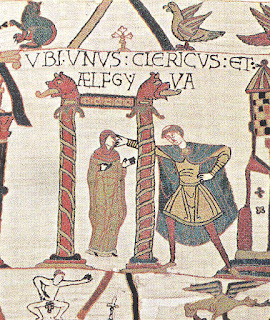
A man and a woman in the Bayeux Tapestry
In the play, William has already conquered England. He falls in love with a portrait of the Danish princess Blanche and travels in disguise to Denmark to woo her. But he finds the real Blanche disappointing: "Ill head, worse featured, uncomely, nothing courtly," he complains to himself, "I never saw a harder-favoured slut." William is not much of a charmer.

William falls in love instead with Mariana, a Swethian princess held captive by the Danes. Blanche becomes jealous and Mariana is not interested in William at all, so the whole thing is getting quite messy.

Mariana persuades the lovestruck William to help her escape in disguise, but she arranges things so that Blanche (her face hidden by a mask) is the woman who actually accompanies William back to England. William doesn't notice that the women have swapped places until much later when the angry Danes invade England to get Blanche back. The King of Denmark tries to forge peace by offering Blanche to William as a bride, but by this point William has become a confirmed woman-hater: "utterly I do abhor their sex," he announces, "they are all disloyal, unconstant - all unjust!".

Shambles Square, a fragment of old Manchester
in the heart of the city . Photo by Richerman
at English Wikipedia, CC BY-SA 3.0.

Let us leave William stewing in misogynist fury and turn to the subplot. Following the Norman invasion, the old Anglo-Saxon nobility is in hiding. The eponymous Em is the daughter of one such nobleman, Sir Thomas Goddard, who has disguised himself and Em as a Manchester miller and his daughter (it's worth remembering that in Henslowe's day, Manchester was a small rural town rather than the industrial metropolis of today).

Em, as the title indicates, is beautiful, and attracts many suitors despite her humble status, including a local gentleman named Manville, and two Normans, Mountney and Valingford. Manville is Em's preferred choice, so she tries to dissuade the other suitors by faking blindness and deafness. This certainly succeeds in repelling Mountney, but unfortunately for Em it repels Manville too, who decides to chase another woman instead. Only Valingford is revealed to be the only loyal wooer.

In the play's conclusion, Em and her suitors appear before King William the Conqueror for judgement. Em reveals that she's not really blind and deaf. Seeing this, Manville switches his affections back to her, but by this point, Em has decided she no longer wants a fickle suitor and prefers Valingford. Of course, this is tricky, because she's only a miller's daughter, and he's a Norman lord. But when it is revealed that her father is in fact a disguised nobleman, that makes everything all right.

The two plots are finally knitted together when King William is so impressed by Em's virtue that his  misogyny crumbles away and he recognizes that he should have loved Blanche all along. A royal wedding is thus in the offing, and in the play's last lines, King William announces,

Then here, Lord Valingford, receive fair Em;
Here, take her, make her thy espousèd wife.
Here go we in, that preparation may be made
To see these nuptials solemnly performed.

If you would like to read Fair Em, take a look at Brett Greatley-Hirsch and Kevin Quarmby's in-progress online edition at Digital Renaissance Editions. If you prefer print, Standish Henning's 1980 edition is the most readable edition, although it's hard to find.


What we learn from this


Fair Em reminds us that it's hard to speculate about a play's nature from its title alone. We might assume that a play called William the Conqueror would have told the story of the Battle of Hastings and the conquest of England. But Fair Em tells us that it could instead have been a wacky romantic comedy, with the Norman conquest used only as an excuse for yet another tale about noblemen disguised as commoners.

Whether or not William the Conqueror was Fair Em, it was performed only once by Sussex's Men at the Rose. If the company was expecting a big audience for this newly-introduced play, they were sorely disappointed with a theatre less than half full, and they never performed it again.


FURTHER READING


Fair Em information

  • Standish Henning, ed. Fair Em: A Critical Edition (Garland, 1980)
  • Martin Wiggins, British Drama, 1533-1642: A Catalogue, vol. 3 (Oxford University Press, 2013), entry 852.
  • Lawrence Manley and Sally-Beth MacLean, Lord Strange's Men and their Plays (Yale University Press, 2014)


William the Conqueror information


Henslowe links


Comments?


Did I make a mistake? Do you have a question? Have you anything to add? Please post a comment below!

Wednesday, 3 January 2018

3 January, 1594 - Huon of Bordeaux

Here's what the Earl of Sussex's Men performed at the Rose playhouse on this day, 424 years ago...

Henslowe writes: R at hewen of burdockes the 3 of Jenewary 1593 ... xiiijs

In modern English: Received at Huon of Bordeaux, 3rd January, 1594 ... 14 shillings

18th century French Huon text
Today, Sussex's Men revived their chivalric adventure, Huon of Bordeaux. This play was based on the epic French tale about a knight who travels to Babylon to steal the Admiral's teeth, aided by Oberon, King of the Fairies. You can read more about Huon of Bordeaux in the entry for 27th December.


The fortunes of Huon are identical with those that we saw of George a Greene yesterday: the first performance of the play had been an enormous success, but this time the attendance has plummeted into the doldrums. The honeymoon peroid is clearly over at the Rose and Sussex's Men cannot expect to play to packed houses any more.

Henslowe links


Comments?


Did I make a mistake? Do you have a question? Have you anything to add? Please post a comment below!

Tuesday, 2 January 2018

2 January, 1594 - George a Greene

Here's what the Earl of Sussex's Men performed at the Rose playhouse on this day, 424 years ago...

Henslowe writes: R at gorge a greene the 2 of Jenewarye 1593 ... xviijs 

In modern English: Received at George a Greene, 2nd January, 1593 ... 18 shillings


Fighting with staves, from a German fighting
manual published by Christian Egenolff
Today, Sussex's Men revived George a Greene, the Pinner of Wakefield. This is a festive comedy in which the eponymous northern folk hero supports the king, wins the hand of a fair maid, and beats several opponents in fights with staves. You can read more about this play in the entry for 28 December.

After the enormous success of George a Greene's first performance at the Rose last week, today's box office must have come as an great disappointment, being about a third of the size. Perhaps Londoners hadn't been very amused by George's story. Or perhaps, as the Christmas holiday season was drawing to an end, people simply had less time for fun at the theatre.


Henslowe links


Comments?


Did I make a mistake? Do you have a question? Have you anything to add? Please post a comment below!

Monday, 1 January 2018

1 January, 1594 - Buckingham

Here's what the Earl of Sussex's Men performed at the Rose playhouse on this day, 424 years ago...

Henslowe writes: R at buckingam the j of Jenewary 1593 ... lviijs 

In modern English: Received at Buckingham, 1st January, 1594 ... 53 shillings

Edward Stafford, 3rd Duke of Buckingham,
one possible subject of this lost play
Welcome to the first day of a new year at the Rose! (But you may have noticed that Henslowe is still calling it 1593; that's because he's using the old style of dating in which the year begins on 25th March.) In Elizabethan London, that meant there were six more days of the Christmas holidays left.

Today, for the first time since their arrival at the Rose last week, Sussex's Men returned to a play that they had already staged. They chose to perform Buckingham, a play now lost, which was probably a tragedy about one of the dukes of Buckingham in English history; you can read more about it in the entry for 30 December 1593.

The decision to restage Buckingham is a surprising one, because the company had last performed it only three days ago; it was normal to leave a longer gap between performances of a one play. But the decision seems to have been a good one: Buckingham brought in impressive box office, and indeed made a bit more money than last time.

Henslowe links


Comments?


Did I make a mistake? Do you have a question? Have you anything to add? Please post a comment below!