Tuesday, 26 December 2017

26 December, 1593 - God Speed the Plough

Here's what the Earl of Sussex's Men performed at the Rose playhouse on this day, 424 years ago...

Henslowe writes: In the name of god Amen begninge the 27 of Decembȝ 1593 the earle of susex his men 
R at good spede the plowghe ... iijll js

In modern English: In the name of God, Amen, beginning 26th December, 1593, the Earl of Sussex's Men
 
Received at God Speed the Plough ... £3 and 1 shilling

On this day, 424 years ago, it was an exciting time for the theatregoers of London! Finally, after nearly a year, the playhouses were re-opening. They had been closed to prevent the spread of plague during a terrible outbreak that lasted throughout most of 1593. Now, with the plague apparently overcome, theatre could return to the city again, and so the people of London flocked to the Rose and we can turn back to Henslowe's Diary to learn what they saw. (Incidentally, Henslowe begins this new set of accounts by getting the date wrong, which is one of his habits, but he'll get back on track a few days from now.)

As I explained yesterday, there have been some changes at the Rose, for it is now inhabited by a new company of players, the Earl of Sussex's Men, who will be performing their own distinctive repertory. We can therefore expect to encounter some unfamiliar plays as the Diary proceeds.


Today's play


Sussex's Men chose to begin their new enterprise with a play previously unknown to the Rose: God Speed the Plough. This play is unfortunately lost, so we know nothing about its content or why the company decided to begin their new season with it. The title is a proverbial phrase that essentially means "good luck with what you're doing", and so the play could be about almost anything.

However, if God Speed the Plough was literally about ploughing, it might have been some kind of pastoral comedy. In her entry on the play for the Lost Plays Database, Roslyn L. Knutson points out that there is a contemporary ballad of that title (called in full, "God Speed the Plough, and Bless the Corn-Mow: A Dialogue between the Husbandman and Serving-man"). This song is about a city servant and a husbandman (that is, a farmer) comparing their lifestyles; the husbandman insists that the life of the country is better. For example,

'Tis pleasure you know to see the corn to grow,
      And to grow so well on the land,
The ploughing and the sowing, the reaping and the mowing,
     Yields pleasure to the husbandman.

Perhaps, then, this play was a celebration of rural life. But that's only a guess. What we do know from the box office record is that God Speed the Plough filled the Rose playhouse, which was presumably packed with excited Londoners, grateful to see anything at all after nearly a year without any plays. The fact that the Rose re-opened during the Christmas holidays no doubt added to that effect.


Further reading


God Speed the Plough information


Henslowe links


Comments?


Did I make a mistake? Do you have a question? Have you anything to add? Please post a comment below!

Monday, 25 December 2017

25 December, 1593 - a new era at the Rose playhouse

Welcome back, and a very merry Christmas to all readers!

This blog is reawakening tomorrow, following an intermittent hiatus of nearly a year, in order to bring you a new set of entries from Henslowe's Diary. The plague that decimated London and forced the actors to take their plays on tour around England is now over. Tomorrow, the Rose playhouse will re-open to host plays once again, and Philip Henslowe will record their takings in his diary!

But things will be different. So far, we have been learning about the plays performed by Lord Strange's Men, a company that has occupied the Rose since February 1592. But the plague and the lengthy enforced tour has decimated London's playing companies, and Lord Strange's Men have broken up. Instead, a new company, the Earl of Sussex's Men, will be on the Rose stage performing their own collection of plays. This means that over the next few weeks we'll get to know ten plays that appear to have been Sussex's Men's stock repertory. Later on, a couple of familiar plays will show up - but let's not get ahead of ourselves.

Despite the change of faces, there may be some continuity. One theory about the fragmentary historical evidence holds that Edward Alleyn, the popular star of Lord Strange's Men, may have become a member of Sussex's Men, and may thus be appearing on the stage tomorrow (or may join the company a couple of weeks later). The reasons are complicated (and are fully explained here), but if this theory is correct, the personnel at the Rose may not have been quite so different as Henslowe's records suggest.

Anyway, for the next few months, on and off, this blog will describe Henslowe's records of the daily performances by Sussex's Men at the Rose. For the last few days, the actors have no doubt been running their lines and Henslowe's team have been freshening up the Rose after its long closure. But today, I want to believe that everyone took the day off for the traditional Elizabethan Christmas feast.

Tune in tomorrow for the first performance!


P3230876


Further reading


  • Scott McMillin, "Sussex's Men in 1594: The Evidence of Titus Andronicus and The Jew of Malta", in Theatre Survey 32.2 (1991): 214-23
  • Ronald Hutton, The Rise and Fall of Merry England (Oxford University Press, 1994), 6-7
  • Lawrence Manley and Sally-Beth MacLean, Lord Strange's Men and their Plays (Yale University Press, 2014), 322-5

Tuesday, 5 December 2017

5 December, 1593 - a visit to Caludon Castle

Welcome back! This blog is briefly reawakening before a more extended revival at the end of the month. As I'm sure you remember, our heroes, Lord Strange's Men, are currently enduring a long tour of England while London's theatres are closed. For most of their journey, we have had only a vague understanding of their itinerary, but we have now reached a rare moment at which we know exactly where they were on one specific day.

On this day, 424 years ago, Lord Strange's Men performed a play at Caludon Castle, near the city of Coventry in the Midlands. An item in Caludon's household account books for 5 December, 1593, reads "Item geven in rewarde to the Erle of Derbies players x s", that is, a 10 shilling payment. The company was now calling itself 'the Earl of Derby's Men', because their patron, Lord Strange, had acquired his father's title following the latter's recent death.

Caludon Castle was the home of Henry, Lord Berkeley. Berkeley enjoyed plays, so a visit to Caludon was common among touring companies. The 'castle' was actually more like a manor house; you can see a reconstruction of it here. Today, it survives as one ruined wall in a park in a suburb of Coventry.


What's next?


This is the last we'll see of Lord Strange's Men: at some point around the date of this performance, the company seems to have broken up, its various members dispersing to other companies. When we return on 26 December, we'll be back to Henslowe's Diary and its list of performances, but this time a different company will occupy the Rose playhouse, and will perform plays that we haven't encountered yet. See you then!


Further information

  • Peter H. Greenfield, "Entertainments of Henry, Lord Berkeley, 1593-4 and 1600-5", in REED Newsletter 8.1 (1983), 12-24.
  • Sally-Beth MacLean and Lawrence Manley, Lord Strange's Men and their Plays (Yale University Press, 2014), 278.

Comments?


Did I make a mistake? Do you have a question? Have you anything to add? Please post a comment below!

Thursday, 28 September 2017

28 September, 1593 - a letter from Henslowe to Alleyn

Welcome back! Once again this blog is briefly returning to life. That's because on this day, 424 years ago, Philip Henslowe wrote another letter to his son-in-law, the actor Edward Alleyn, who was still touring England with his company while London was gripped by plague.


London hit by plague, from John Taylor's The
Fearful Summer (1636)
In this letter, Henslowe passes on commendations from Alleyn's wife, mother and sister. But he chastises Alleyn for not writing enough. He also tells him that things are very bad in London: "all my neighbors dead of the plague, and not my house free, for my two wenches have had the plague, and yet thanks be to God liveth and are well".

Turning from mass death to the mundane, Henslowe now follows up on matters discussed in recent letters, He recounts that "we have had a very bad market at Smithfield"; he has still been unable to sell Alleyn's horse but he has managed to sell "all your cloak-cloth". Furthermore - just in case any regular readers have been worrying about it - you'll be glad to learn that Alleyn's stockings are dyed and his spinach-bed sown.

As for Alleyn himself, it is hard to know how well things are going on the tour. Alleyn has apparently been enquiring about one of his fellow playing companies, Lord Pembroke's Men, because Henslowe informs him that they have come home to London, apparently having found touring to be financially unsustainable. Perhaps Alleyn and Lord Strange's Men were struggling too after months on the road?

At the end of the letter, Henslowe turns optimistic, saying the plague is beginning to ease, although it still sounds terrifying: "this last two weeks of the sickness, 435 hath died; in all, betwixt eleven and twelve-hundred this last week, which I hope in the lord it will continue in ceasing every week, that we may rejoice again at our meeting." He closes with a P.S. from Joan, inquiring about rent prices as she can still "get no rent" from their tenants.


What's next?


This is the last of the series of letters between Henslowe and Alleyn that are preserved in the papers at Dulwich College.  We'll next hear from Alleyn on December 5, when he and his company will perform at a stately home near Coventry. See you then!


Further reading


Comments?


Did I make a mistake? Do you have a question? Have you anything to add? Please post a comment below! 

Monday, 14 August 2017

14 August, 1593 - a letter from Henslowe to Alleyn

Welcome back once again! For the last two weeks, we have been looking at a series of letters exchanged between Edward Alleyn and Philip Henslowe. Today, we are looking at a third letter, written on this day 424 years ago. As you no doubt remember, Henslowe is writing from plague-ridden London to Alleyn, who is touring plays in southwestern England with Lord Strange's Men.

The city of Bath, from a 1610 map by John Speed
Henslowe begins by informing Alleyn that "we heard you were very sick at Bath, and that one of your fellows were fain to play your part for you". You might think this news would have worried Alleyn's wife, Joan, but in fact she was relieved: Henslowe explains, "we had no letter from you when the other wives had letters", and this had made Joan "not to weep a little but took it very greviously, thinking you had conceived some unkindness of her". Henslowe implores Alleyn to write more often in future.

Joan's anxiety was no doubt the result of living amid a near-apocalyptic plague while her husband was far away. Henslowe relates that Joan "prayeth day and night to the lord to cease his hand from punishing us with his cross" and hopes that her husband will soon be "eased of this heavy labour and toil". He then thanks Alleyn for the advice he gave a while back on keeping the house clean to prevent plague, and adds that "we strew it with hearty prayers unto the Lord".

But Henslowe also records more mundane matters. He refers back to an earlier letter of Alleyn's (now lost) "wherein makes mention of your white waistcoat and your lute-box". He refers to yet another letter, brought by one Peter, who had also brought Alleyn's horse for Henslowe to look after. And he reports that while Alleyn's bean-patch is thriving, his tenants "wax very poor" and cannot pay the rent.

Henslowe also reports on the renovations to Alleyn's home. The joiner insists "he will make you such good stuff and such good penniworths as he hopeth shall well like you and content you", and that he will "prove himself an honest man". These words sound deeply suspicious to me, but perhaps I'm jaded by bad reno experiences...

At the end of the letter, Henslowe gives his regards to the rest of Lord Strange's Men while alluding to his financial worries in these uncertain times: "commend me heartily to all the rest of your fellows in general, for I grow poor for lack of them; therefore have no gifts to send but as good and faithful a heart as they shall desire to have come amongst them".

He concludes with a plague update: 1,700-1,800 people have died this week alone.

What's next?


The next letter in this sequence is dated 28 September, so that's when Henslowe's Diary ... as a Blog! will return. See you then!


Further reading

Monday, 7 August 2017

Early August, 1593 - a letter from Henslowe to Alleyn

Welcome back again! Last week, we looked at a letter from Bristol, written by Edward Alleyn to Philip Henslowe. Today, we are reading Henslowe's reply, which is undated but appears to have been written around this date, 424 years ago. If you recall, Henslowe is writing from plague-stricken London to Alleyn, who is touring plays in southwestern England with Lord Strange's Men. Henslowe's letter is co-signed by Alleyn's wife Joan.

After passing on greetings to Alleyn from his family, Henslowe provides mixed news about the plague: "we are all at this time in good health in our house, but round about it hath been almost in every house about us and whole households died, and yet my friend the bailiff doth 'scape but he smells monstrously for fear and dares stay nowhere, for there hath died of the of the plague 113".

Henslowe adds a detail that Alleyn would have found very disturbing: "Robert Browne's wife in Shoreditch and all her children and household be dead and her doors shut up". Browne was an actor in another playing company and was currently touring in Germany. His fate was no doubt what Alleyn feared the most: that of returning home from his travels to find his entire family dead.

Smithfield Market, from the Agas Map (1561)
After passing on this worrying news, Henslowe moves on to more mundane matters. The renovations to Alleyn's house are proceeding well. Following up on Alleyn's requests in the previous letter, Henslowe assures him that all is under control: "your spinach bed not forgotten, your orange-coloured stockings dyed". He does, however, report that there is "no market at Smithfield neither to buy your cloth nor yet to sell your horse, for no man would offer me above £4 for him, therefore I would not sell him but have sent him into the country till you return back again".

Henslowe signs off "praying to God to send you all good health", and hoping that "we may all merrily meet". Perhaps feeling guilty about the doom and gloom he's been reporting, he ends on a positive note: "your poor mouse", he writes, using Alleyn's pet name for Joan, "hath not been sick since you went".

What's next?


A second letter from Henslowe will be described on August 14.


Further reading


Comments?


Did I make a mistake? Do you have a question? Have you anything to add? Please post a comment below! 

Tuesday, 1 August 2017

1 August, 1593 - a letter from Alleyn in Bristol

Welcome back! After yet another lengthy hiatus, this blog is now reawakening a little more enthusiastically for the next couple of weeks. That's because a series of letters survives that were exchanged in the first half of August 1593 between Edward Alleyn, the leading actor of Lord Strange's Men, his wife Joan, and Philip Henslowe, owner of the Rose playhouse. As you may recall, Henslowe and Joan were still living in plague-stricken London, while Lord Strange's Men were engaged in a long enforced tour of England because London's theatres were closed.

So, on this day, 424 years ago, Alleyn wrote to Joan from Bristol, a large port city in southwestern England.The letter was carried to London by a relative of one of the actors in the company, and along with it, Alleyn sent his white waistcoat, explaining, "it is a trouble to me to carry it", and asking Joan to "lay it up for me till I come". As in his previous letter to her, Alleyn calls Joan his "good sweet mouse".

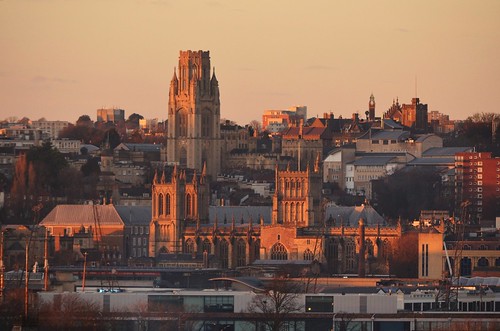
Bristol

Fears of the plague


When writing to Joan back in May, shortly after the tour had begun, Alleyn had made light of his absence, but this time he expresses directly his fears about the plague that was gripping London. He tells Joan he hopes that although "the sickness be round about you yet by [God's] mercy it may escape your house". He advises her to "keep your house fair and clean, which I know you will and every evening throw water before your door and in your backside [I assume he means back yard...] and have in your windows good store of rue and herb of grace"; he feels that this, along with praying, will protect her. As Carol Chillington Rutter observes, these preventative methods may seem unconvincing today, but Alleyn is at least recommending cleanliness, which was the best solution available in an age when the causes of the plague were unknown.

Touring


Alleyn gives us a glimpse of the company's future touring plans when he tells Joan "if you send any more letters, send to me by the carriers of Shrewsbury or to Westchester [an old name for Chester] or to York, to be kept till my Lord Strange's Players come". It looks as though they were planning a great sweep through the North of England, but although there is indeed a record of them reaching Shrewsbury, we do not know if they continued with their plan.


Alleyn signs off by saying that he is in "Bristol, this Wednesday after St James's Day, being ready to begin the play of Harry of Cornwall". In their book on Lord Strange's Men, Lawrence Manley and Sally-Beth Maclean observe that St James's Day was 25 July and that Bristol held an annual 9-day St James's Fair around that date; the company was presumably there in the hopes of large audiences. Since Bristol is in the west country, perhaps Harry of Cornwall was chosen for its local colour?

Homesickness and thoughts of return


Alleyn then adds a rather sad postscript, which suggests intense homesickness (understandable after months of touring): "Mouse, you send me no news of anything. You should send of your domestical matters: such things as happens at home, as how your distilled water proves, or this or that, or anything. What you will."

But Alleyn hasn't finished. Running out of space, he writes in the left-hand margin,
And Jug, I pray you, let my orange-tawny stockings of woolen be dyed a very good black against I come home to wear in the winter. You sent me not word of my garden, but next time you will, but remember this in any case: that all that bed which was parsley in the month of September you sow it with spinach, for then is the time. I would do it myself, but we shall not come home till Allhallowtide. And so, sweet mouse, farewell, and brook our long journey with patience.
Allhallowtide was the 3-day holiday period that began on October 31 (now Hallowe'en). Alleyn was thus expecting to remain on the road at least another two months.

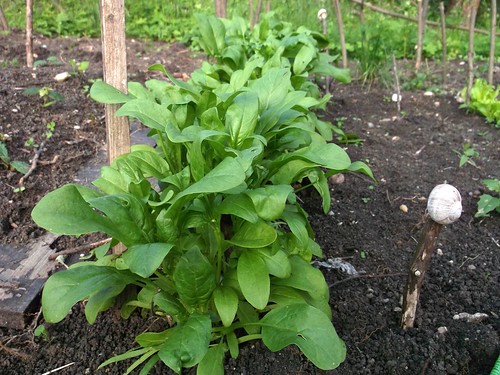
Špenát / spinach


What's next?


A follow-up letter from Henslowe will be described in a post to appear next week.

Further reading


  • Facsimile of the letter, from the Henslowe-Alleyn Digitisation Project. (Unless I'm missing something, they're in error when they date it 24th July).
  • Carol Chillington Rutter, Documents of the Rose Playhouse (Manchester University Press, 1984), 73-5.
  • Lawrence Manley and Sally-Beth MacLean, Lord Strange's Men and their Plays (Yale University Press, 2014)