Sunday, 17 April 2016

17 April, 1592 - Muly Molocco

Here's what Lord Strange's Men performed at the Rose playhouse on this day, 424 years ago...
Henslowe writes: R at mvllo mvlluco the 17 of aprell 1591 ... xxxs 

In modern English: Received at Muly Molocco, 17th April, 1592 ... 30 shillings 


1629 Portuguese illustration of the Battle of Alcazar
Today Lord Strange's Men returned to Muly Molocco again, a play that they frequently performed, and which they had last staged just over a week ago. The play was about Abd el-Malik's struggle for the throne of Morocco; you can read more about it in the blog entry for 21st February.

After its surprise success during Easter Week, the box office returns for Muly Molocco have stabilized, and it is back to being a solid, mid-ranking play.

Monday, 21st February - 29 shillings
Tuesday, 29th February - 34 shillings
Friday, 17th March - 29 shillings
Wednesday, 29th March - 62 shillings
Saturday, 8th April - 23 shillings

Monday, 17th April - 30 shillings


Henslowe links 


Comments?


Did I make a mistake? Do you have a question? Have you anything to add? Please post a comment below! 

Friday, 15 April 2016

15 April, 1592 - Sir John Mandeville

Here's what Lord Strange's Men performed at the Rose playhouse on this day, 424 years ago...
Henslowe writes: R at mandevell the 15 of aprell 1591 ... xxvjs

In modern English: Received at Mandeville, 15th April, 1592 ... 26 shillings


Mandevillian monster from
the Nuremberg Chronicle (1493)
Today, Lord Strange's Men performed again their lost play about Sir John Mandeville. Although Mandeville is today most famous for his fantastical travel narratives, the most plausible theory is that this play was a chivalric and comic romance, in which Sir John won the hand of a fair lady above his station. You can read more about the play in the entry for 24th February.

The company had last performed this play just under two weeks ago, when it had received 30 shillings during Easter Week. It received 4 shillings less on this outing, which is not bad considering that it received a mere 12 back in February. This play may be best described as chugging along.


What's next?


There will be no blog entry tomorrow because 16th April was a Sunday in 1592. Henslowe's Diary ... as a Blog! will thus return on 17th April...

Henslowe links 


Comments?


Did I make a mistake? Do you have a question? Have you anything to add? Please post a comment below! 

Thursday, 14 April 2016

14 April, 1592 - Hieronimo

Here's what Lord Strange's Men performed at the Rose playhouse on this day, 424 years ago...
Henslowe writes: R at Joronymo the 14 aprelle 1591 ... xxxiijs 

In modern English: Received at Hieronimo, 14th April, 1592 ... 33 shillings 


Woodcut from the 1615 edition of The Spanish Tragedy.
Today, Lord Strange's Men gave another performance of Hieronimo, which is almost certainly an alternate title for Thomas Kyd's The Spanish Tragedy, a play that they had previously performed just over a week ago. You can read more about this play in the entry for the 14th of March. As with the previous performance, they performed it alone, rather than as a follow-up to The Spanish Comedy of Don Horatio.

The Spanish Tragedy was capable of producing  spectacular box office, and had done so back on the 14th and 31st March. But, as with the performance on the 7th, today's was relatively unimpressive. The company's weekly performances of the play seem to be producing solid rather than exceptional results.

14th March - 71 shillings
20th March - 38 shillings
31st March - 60 shillings
7th April - 26 shillings 

14th April - 33 shillings


    Henslowe links


    Comments?


    Did I make a mistake? Do you have a question? Have you anything to add? Please post a comment below!

    Wednesday, 13 April 2016

    13 April, 1592 - Harry VI

    Here's what Lord Strange's Men performed at the Rose playhouse on this day, 424 years ago...

    Henslowe writes: R at harey the vj the 13 of aprell 1591 ... xxvjs

    In modern English: Received at Harry VI, 13th April, 1592 ... 26 shillings

    1540s portrait of King
    Henry VI
    Today, Lord Strange's Men performed Harry VI again. This play was almost certainly Shakespeare's First Part of Henry VI; you can read more about it in the blog entry for 3rd March.

    The company last performed Harry VI just over a week ago; since its premiere in early March, it has been their most frequently-performed play. However, today's performance was its weakest so far, faring not much better than that of Bindo and Ricciardo yesterday. Harry VI appears to have officially become just another play.

    • Friday, 3rd March - 75 shillings
    • Tuesday, 7th March - 60 shillings
    • Saturday, 11th March - 47 shillings
    • Thursday, 16th March - 31 shillings
    • Tuesday, 28th March - 68 shillings
    • Wednesday, 5th April - 41 shillings
    • Thursday, 13th April - 26 shillings

    Henslowe links


    Comments?


    Did I make a mistake? Do you have a question? Have you anything to add? Please post a comment below!


    Tuesday, 12 April 2016

    12 April, 1592 - Bindo and Ricciardo

    Here's what Lord Strange's Men performed at the Rose playhouse on this day, 424 years ago...

    Henslowe writes: R at byndo & Richardo the 12 of aprell 1591 ... xxiijs

    In modern English: Received at Bindo and Ricciardo, 12th April ... 23 shillings

    Today, Lord Strange's Men returned to their risque Italian comedy Bindo and Ricciardo. Although lost, the story on which it is based survives, revealing it to be a bizarre comedy about the cunning thief Ricciardo's escape from justice. You can read more about this play in the entry for 4th March.

    The company had last performed the play nearly five weeks ago. It made 7 shillings more this time around, but remained one of the less popular plays in the repertory.


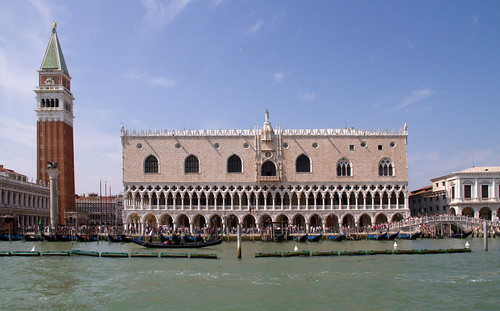
    Doge's Palace 3

    Henslowe links


    Comments?


    Did I make a mistake? Do you have a question? Have you anything to add? Please post a comment below!

    Monday, 11 April 2016

    11 April, 1592 - Titus and Vespasian

    Here's what Lord Strange's Men performed at the Rose playhouse on this day, 424 years ago...
    Henslowe writes: ne ... R at tittus & vespacia the 11 aprell 1591 ... iijll iiijs

    In modern English: New. Received at Titus and Vespasian, 11th April, 1592 ... £3 and 4 shillings.

    Today, Lord Strange's Men unveiled a brand new play: Titus and Vespasian. The play is lost, but its title suggests that it told the story of the siege of Jerusalem by Titus, son of the Roman Emperor Vespasian. It was extremely successful at the box office, just like the company's previous new play, Harry VI, which premiered over a month ago, and it made almost as much money. Apparently, mass audiences could be attracted to the Rose by the promise of a new play.

    16th century illustration of Vespasian's
    forces sailing for Jerusalem
    The events of the 1st century Jewish rebellion against Rome, and Titus's subsequent siege and destruction of Jerusalem, were well-known and much retold in Elizabethan England. The basic outline of this story is simple: some of the Jewish inhabitants of Jerusalem revolt and overthrow the Romanized rulers; Titus and his Roman forces arrive and besiege the city until its people begin to die of starvation; and the Romans then invade and massacre the inhabitants.

    If this plot sounds familiar, it's because just over two weeks ago, Lord Strange's Men performed a lost play called Jerusalem, which was probably about the eleventh century siege of the city and the eventual expulsion of its Islamic rulers by Godfrey of Bouillon. Clearly, sieges of Jerusalem were popular in the theatre, and it's easy to see why. A play about the capture of Jerusalem would depict holy war in the starkest and most direct terms: in Jerusalem, the audience watched Christians purging non-Christians from the Holy City.

    But the story told in Titus and Vespasian - in which pagan Romans capture Jerusalem from Jewish rebels - might have seemed less straightforward in its moral framework to Elizabethan audiences, as it's not immediately obvious which side should receive the sympathy of a Christian audience.

    Nicholas Poussin, The Destruction and Sack of the Temple at Jerusalem (1637)
    It was certainly possible to defy history and turn the story into a symbol of Christian triumphalism. In one medieval tradition, the tale begins with Vespasian being miraculously cured of a disease; he is converted to Christianity as a result, and orders the taking of Jerusalem in order to revenge the death of Christ, thereby giving the war a religious motivation.

    But Sally-Beth MacLean and Lawrence Manley have shown that the lost play was more likely related in some way to Peter Morwen's History of the Latter Times of the Jews' Commonweal (1558) and other works deriving from it, including Richard Legge's Latin play Solymitana Clades (c.1590), Thomas Nashe's prose work Christ's Tears over Jerusalem (1594) and William Heminges' play The Jews' Tragedy, or their Fatal and Final Overthrow by Vespatian and his son Titus (c.1628-30). In these works, the villains are not the Jews as such, but rather the Zealots, a fanatical sect who rise up against the Romanized king Agrippa.

    In the various versions of this story, the Zealots occupy the Temple and start performing human sacrifices to God. In his retelling, Thomas Nashe revels in the disgusting imagery of mass sacrifice:

    The marble floor of [the Temple] they made so slippery, with their un-respited, and not so much as Sabbath-ceased, bloodshed and bowel-clinging fat of them that were slaine, that a man might better swim then walk on it.

    Sixteenth century illustration of
    the Romans destroying Jerusalem
    When the Romans arrive to recapture the city, the various Jewish factions try and fail to unite against the Romans. The siege results in famine, causing terrible suffering; as Nashe writes, "every corner of Jerusalem" was ringing with "the howling, wringing of hands, sobbing and yelling of men, women, and children". In one famed sequence, a high-born mother, Miriam, becomes so crazed with starvation that she cooks her own child; in his version, Nashe implores the reader to sympathize with and understand her actions:

    Mothers of London, each one of you to yourselves, do but imagine that you were Miriam; with what heart, suppose you, could you go about the cookery of your own children? Not hate but hunger, taught Miriam to forget motherhood.
    Titus then invades, executes the Zealot leaders, and marches in triumph through the ruined city. In one sequence that appears in a number of the retellings, Titus is horrified at the actions of the Zealots. In his version, Nashe addresses the city of Jerusalem and describes how:

    Titus (an infidel), understanding the multitude of thy profanations and contumacies, was afraid to stay in thee, saying, "Let us hence, lest their sins destroy us."

    The tale of the siege of Jerusalem is thus a grim one, with much opportunity for onstage violence and horror. The evidence seems to suggest that the lost play was at least partly sympathetic toward the Romans and the ordinary Jewish citizens, while condemning the religious extremism of the Zealots. Indeed, Manley and MacLean note that the image of the Zealots could have been used to satirize extremist Puritans in England.  This is all speculative, but the popularity of this subject in Elizabethan England, the range of works inspired by it, and the impressive box office of the play's debut at the Rose, suggest that there was something about this story captured the imagination of readers and audiences at the time.


    FURTHER READING


    Titus and Vespasian information

    • Martin Wiggins, British Drama, 1533-1642: A Catalogue, vol. 3 (Oxford University Press, 2013), entry 923.
    • Sally-Beth MacLean and Lawrence Manley, Lord Strange's Men and their Plays (Yale University Press, 2014), 128-33.
    • David McInnis, "Titus and Vespasian", Lost Plays Database (2015). 


    Henslowe links


    Comments?


    Did I make a mistake? Do you have a question? Have you anything to add? Please post a comment below!

    Sunday, 10 April 2016

    10 April, 1592 - The Comedy of Hieronimo

    Here's what Lord Strange's Men performed at the Rose playhouse on this day, 424 years ago...

    Henslowe writes: R at the comodey of Jeronymo the 10 aprell 1591 ... xxviijs 

    In modern English: Received at The Comedy of Hieronimo, 10th April, 1592 ... 28 shillings

    Today's entry is a bit of a puzzle. We have already seen Henslowe record The Spanish Comedy of Don Horatio, and we have seen him record its companion play, Hieronimo (which we know today as The Spanish Tragedy). So, what is The Comedy of Hieronimo? Most scholars think it is just an alternative name for The Spanish Comedy of Don Horatio, and I'm going to follow suit (you can read more about the complexities surrounding these plays in the entry for 23rd February). Today's entry is thus an interesting reminder of how fluid play-titles can be in this period; it looks almost as if Edward Alleyn's performance as Hieronimo in the play gradually caused Henslowe to start thinking of it as Hieronimo's comedy rather than Horatio's.

    So, today, Lord Strange's Men gave another performance of the play which I will now call The Comedy of Hieronimo. This lost play was most likely about the events leading up to those in Thomas Kyd's The Spanish Tragedy. On this outing, Don Horatio received solid box office, continuing this week's general trend in which audiences are smaller than they were during the highs of Easter Week, but not disastrously so.

    Wednesday, 23rd February - 13 shillings and sixpence
    Monday, 13th March - 29 shillings
    Wednesday, 30th March - 39 shillings
    Monday, 10th April - 28 shillings

    Henslowe links


    Comments?


    Did I make a mistake? Do you have a question? Have you anything to add? Please post a comment below!